. 2012;8(12):e1003071.
doi: 10.1371/journal.ppat.1003071. Epub 2012 Dec 6.

MiniCD4 microbicide prevents HIV infection of human mucosal explants and vaginal transmission of SHIV(162P3) in cynomolgus macaques

Affiliations

MiniCD4 microbicide prevents HIV infection of human mucosal explants and vaginal transmission of SHIV(162P3) in cynomolgus macaques

Nathalie Dereuddre-Bosquet et al. PLoS Pathog. 2012.

Abstract

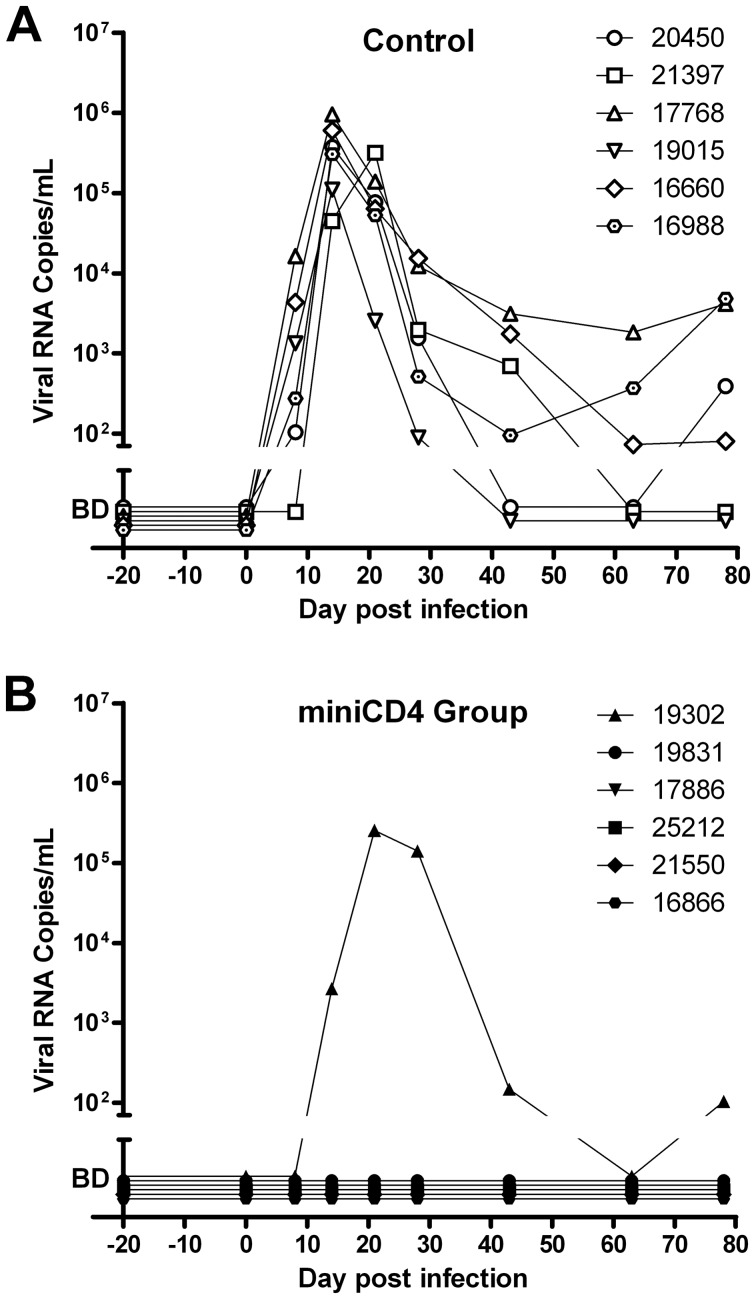
In complement to an effective vaccine, development of potent anti-HIV microbicides remains an important priority. We have previously shown that the miniCD4 M48U1, a functional mimetic of sCD4 presented on a 27 amino-acid stable scaffold, inhibits a broad range of HIV-1 isolates at sub-nanomolar concentrations in cellular models. Here, we report that M48U1 inhibits efficiently HIV-1(Ba-L) in human mucosal explants of cervical and colorectal tissues. In vivo efficacy of M48U1 was evaluated in nonhuman primate (NHP) model of mucosal challenge with SHIV(162P3) after assessing pharmacokinetics and pharmacodynamics of a miniCD4 gel formulation in sexually matured female cynomolgus macaques. Among 12 females, half were treated with hydroxyethylcellulose-based gel (control), the other half received the same gel containing 3 mg/g of M48U1, one hour before vaginal route challenge with 10 AID(50) of SHIV(162P3). All control animals were infected with a peak plasma viral load of 10(5)-10(6) viral RNA (vRNA) copies per mL. In animals treated with miniCD4, 5 out of 6 were fully protected from acquisition of infection, as assessed by qRT-PCR for vRNA detection in plasma, qPCR for viral DNA detection in PBMC and lymph node cells. The only infected animal in this group had a delayed peak of viremia of one week. These results demonstrate that M48U1 miniCD4 acts in vivo as a potent entry inhibitor, which may be considered in microbicide developments.


Conflict of interest statement

The authors have declared that no competing interests exist.

Figures
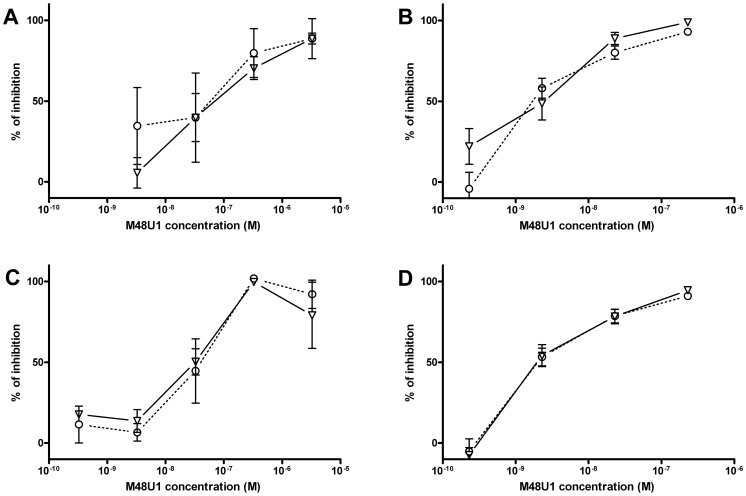
Figure 1
Figure 1. Inhibition of HIV-1Ba-L infection by M48U1 in genital tissue explant models.
Inhibition of HIV-1Ba-L infection of cervical (A) and colorectal (B) tissue explants pre-treated with M48U1. (C) Inhibition of HIV-1Ba-L trans-infection of PM-1 T cells co-cultured with cells migrating out of cervical tissue explants treated with M48U1. (D) Inhibition of HIV-1Ba-L infection of colorectal tissue explants treated with M48U1 coming from dilution of the formulation at 0.3% in the gel used for in vivo challenge, comprising 1.5% hydroxyethylcellulose (HEC), 0.1% sorbic acid and 2.5% glycerol kept at 4°C during more than one year. Viral replication was assessed by measuring p24 production in supernatants at days 10 (circle, dotted line) and 15 (triangle, solid line). The percentage of inhibition was normalized relative to the p24 values obtained for explants not exposed to HIV-1Ba-L (0% infectivity) and for explants exposed to HIV-1Ba-L in the absence of M48U1 (100% infectivity). Data points correspond to mean values and error bars represent the standard error of the mean (SEM) from three independent experiments performed in triplicates.
Figure 2
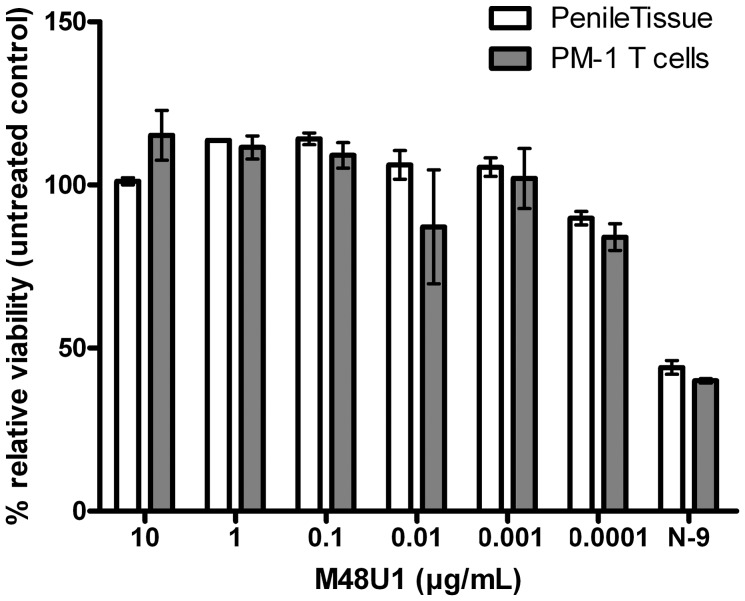
Figure 2. Viability assay to evaluate the cytotoxicity of M48U1 on mucosal tissue explants and PM-1 T cells.
Penile tissue explants (blank bars) and PM-1 cells (grey bars) were exposed to 10-fold dilutions of M48U1 for 24 h at 37°C. After removing the peptide, the tissue explants and the cells were incubated with MTT for 2 h. Then the viability was determined by measuring the formazan release. Nonoxynol-9 microbicide (500 ng/mL) was employed as cytotoxic reference, while the untreated control was assumed as 100% of viability. Data points correspond to mean values and error bars represent the standard error of the mean (SEM) from two independent experiments performed in triplicates.
Figure 3
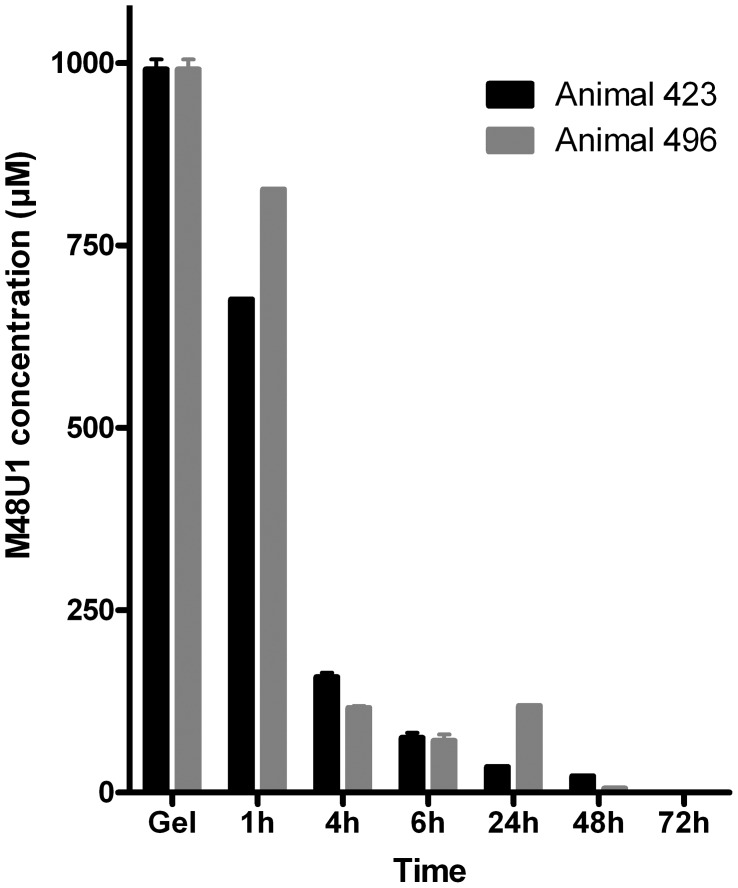
Figure 3. Pharmacokinetic studies in non-infected macaques.
Mean concentration of M48U1 miniCD4 measured in the vaginal fluid of two cynomolgus macaques following vaginal administration of a single 2 g sample of 1.5% hydroxyethylcellulose (HEC) gel containing M48U1 at 3 mg/g (about 1 mM). The vaginal fluids were sampled before and 1 h, 4 h, 6 h, 24 h, 48 h and 72 h after gel application and analyzed by MS spectra with an internal reference for M48U1 quantification. The bars represent the standard error of the mean (SEM) of the three assay replicates.
Figure 4
Figure 4. Protection of macaques against vaginal SHIV challenge by pretreatment with M48U1 gel.
Viral loads in placebo (A) and M48U1-gel (B) treated macaques. One hour after gel application, animals were challenged with 10 AID50 of SHIV162P3. Macaques were monitored regularly for plasma viremia for 78 days. The area below the ordinate axis break represents values below the 60 RNA copies/mL detection limit (BD – below detection).

References

    1. Balzarini J, Van Damme L (2007) Microbicide drug candidates to prevent HIV infection. Lancet 369: 787–797. - PubMed
    1. Lederman MM, Offord RE, Hartley O (2006) Microbicides and other topical strategies to prevent vaginal transmission of HIV. Nat Rev Immunol 6: 371–382. - PubMed
    1. Abdool Karim Q, Abdool Karim SS, Frohlich JA, Grobler AC, Baxter C, et al. (2010) Effectiveness and safety of tenofovir gel, an antiretroviral microbicide, for the prevention of HIV infection in women. Science 329: 1168–1174. - PMC - PubMed
    1. Lederman MM, Veazey RS, Offord R, Mosier DE, Dufour J, et al. (2004) Prevention of vaginal SHIV transmission in rhesus macaques through inhibition of CCR5. Science 306: 485–487. - PubMed

    1. Veazey RS, Ketas TJ, Dufour J, Moroney-Rasmussen T, Green LC, et al. (2010) Protection of rhesus macaques from vaginal infection by vaginally delivered maraviroc, an inhibitor of HIV-1 entry via the CCR5 co-receptor. J Infect Dis 202: 739–744. - PMC - PubMed

Publication types

MeSH terms