


The genetic architecture of adaptations to high altitude in Ethiopia
- PMID: 23236293
- PMCID: PMC3516565
- DOI: 10.1371/journal.pgen.1003110
The genetic architecture of adaptations to high altitude in Ethiopia
Abstract
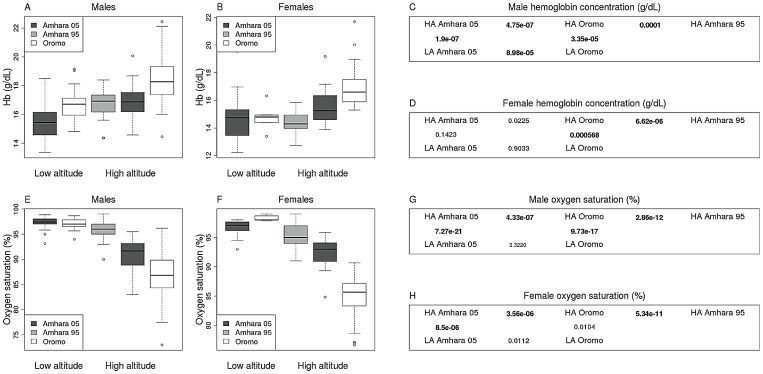
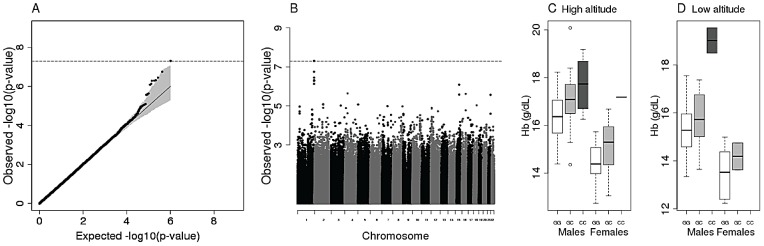
Although hypoxia is a major stress on physiological processes, several human populations have survived for millennia at high altitudes, suggesting that they have adapted to hypoxic conditions. This hypothesis was recently corroborated by studies of Tibetan highlanders, which showed that polymorphisms in candidate genes show signatures of natural selection as well as well-replicated association signals for variation in hemoglobin levels. We extended genomic analysis to two Ethiopian ethnic groups: Amhara and Oromo. For each ethnic group, we sampled low and high altitude residents, thus allowing genetic and phenotypic comparisons across altitudes and across ethnic groups. Genome-wide SNP genotype data were collected in these samples by using Illumina arrays. We find that variants associated with hemoglobin variation among Tibetans or other variants at the same loci do not influence the trait in Ethiopians. However, in the Amhara, SNP rs10803083 is associated with hemoglobin levels at genome-wide levels of significance. No significant genotype association was observed for oxygen saturation levels in either ethnic group. Approaches based on allele frequency divergence did not detect outliers in candidate hypoxia genes, but the most differentiated variants between high- and lowlanders have a clear role in pathogen defense. Interestingly, a significant excess of allele frequency divergence was consistently detected for genes involved in cell cycle control and DNA damage and repair, thus pointing to new pathways for high altitude adaptations. Finally, a comparison of CpG methylation levels between high- and lowlanders found several significant signals at individual genes in the Oromo.
Conflict of interest statement
The authors have declared that no competing interests exist.
Figures
References
-
- Moore LG, Shriver M, Bemis L, Hickler B, Wilson M, et al. (2004) Maternal adaptation to high-altitude pregnancy: an experiment of nature–a review. Placenta 25 Suppl A: S60–71. - PubMed
-
- Brutsaert TD (2008) Do high-altitude natives have enhanced exercise performance at altitude? Appl Physiol Nutr Metab 33: 582–592. - PubMed
-
- Lowe GD, Lee AJ, Rumley A, Price JF, Fowkes FG (1997) Blood viscosity and risk of cardiovascular events: the Edinburgh Artery Study. Br J Haematol 96: 168–173. - PubMed
-
- Danesh J, Collins R, Peto R, Lowe GD (2000) Haematocrit, viscosity, erythrocyte sedimentation rate: meta-analyses of prospective studies of coronary heart disease. Eur Heart J 21: 515–520. - PubMed
Publication types
MeSH terms
Substances
Grants and funding
LinkOut - more resources
Full Text Sources
