


Elevated cardiovascular risk among adults with obstructive and restrictive airway functioning in the United States: a cross-sectional study of the National Health and Nutrition Examination Survey from 2007-2010
- PMID: 23237325
- PMCID: PMC3546884
- DOI: 10.1186/1465-9921-13-115
Elevated cardiovascular risk among adults with obstructive and restrictive airway functioning in the United States: a cross-sectional study of the National Health and Nutrition Examination Survey from 2007-2010
Abstract
Background: Reasons for the excess risk for cardiovascular disease among people with chronic obstructive pulmonary disease remain unclear. Our objective was to examine the cardiovascular risk profile for adults with obstructive and restrictive impairments of lung functioning in a representative sample of adults from the United States.
Methods: We used data from adults aged 20-79 years who participated in the National Health and Nutrition Examination Survey from 2007 to 2010 and had a pulmonary function test. The severity of obstructive impairment was defined by adapting the Global Initiative for Chronic Obstructive Lung Disease criteria.
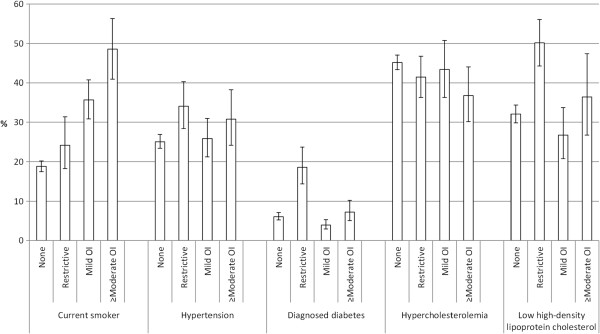
Results: Among 7249 participants, 80.9% had a normal pulmonary function test, 5.7% had a restrictive impairment, 7.9% had mild obstructive impairment, and 5.5% had moderate or severe/very severe obstructive impairment. Participants with obstructive impairment had high rates of smoking and increased serum concentrations of cotinine. Compared to participants with normal pulmonary functioning, participants with at least moderate obstructive impairment had elevated concentrations of C-reactive protein but lower concentrations of total cholesterol and non-high-density lipoprotein cholesterol. Among participants aged 50-74 years, participants with at least a moderate obstructive impairment or a restrictive impairment had an elevated predicted 10-year risk for cardiovascular disease.
Conclusions: The high rates of smoking among adults with impaired pulmonary functioning, particularly those with obstructive impairment, point to a need for aggressive efforts to promote smoking cessation in these adults. In addition, adults with restrictive impairment may require increased attention to and fine-tuning of their cardiovascular risk profile.
Figures
References
-
- Kochanek KD, Xu J, Murphy SL, Miniño AM, Kung HC. Deaths: Preliminary Data for 2009. Natl Vital Stat Rep. 2011;59:1–51. - PubMed
MeSH terms
LinkOut - more resources
Full Text Sources
Medical
Molecular Biology Databases
Research Materials
