. 2013 Feb;131(2):468-76.
doi: 10.1016/j.jaci.2012.10.029. Epub 2012 Dec 11.

TACI mutations and impaired B-cell function in subjects with CVID and healthy heterozygotes

Affiliations

TACI mutations and impaired B-cell function in subjects with CVID and healthy heterozygotes

Monica Martinez-Gallo et al. J Allergy Clin Immunol. 2013 Feb.

Abstract

Background: Mutations in the gene coding for the transmembrane activator and calcium-modulating cyclophilin ligand interactor (TACI) are found in 8% to 10% of subjects with common variable immunodeficiency (CVID). Although heterozygous mutations may coincide with immunodeficiency in a few families, most mutation-bearing relatives are not hypogammaglobulinemic. Thus, the role of TACI mutations in producing the immune defect remains unclear.

Objective: This study examined the expression and function of TACI mutations in healthy heterozygous relatives.

Methods: We examined the surface and intracellular expression of TACI protein in EBV-transformed B cells of patients and relatives with mutations in 7 families, binding of a proliferation-inducing ligand, and secretion of IgG and IgA by ligand-activated B cells. We tested whether Toll-like receptor 9 agonists increased TACI expression and whether an agonistic anti-TACI antibody could induce activation-induced cytidine deaminase mRNA in those with mutations.

Results: Intracellular and extracellular TACI expression was defective for B cells of all subjects with mutations, including subjects with CVID and relatives. Although Toll-like receptor 9 triggering normally up-regulates B-cell TACI expression, this was defective for all subjects with mutations. Triggering TACI by an agonistic antibody showed loss of activation-induced cytidine deaminase mRNA induction in all mutation-bearing B cells. However, ligand-induced IgG and IgA production was normal for healthy relatives but not for subjects with CVID.

Conclusion: Thus, B cells of relatives of subjects with CVID who have mutations in TACI but normal immune globulin levels still have detectable in vitro B-cell defects.


Figures

FIG 1
FIG 1
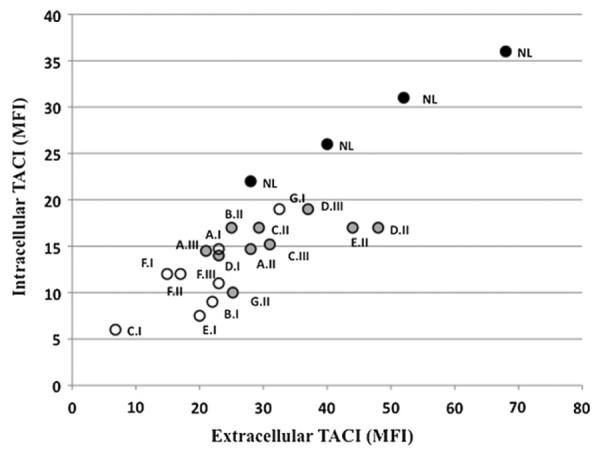
Impaired expression of surface and intracellular TACI. The mean fluorescence intensity for surface TACI expression (MFI; x-axis) on EBV-transformed B-cell lines of subjects and relatives with mutations was determined and compared with the same cells examined for intracellular TACI expression (y-axis). Subjects with CVID are shown as open circles, relatives with mutations are shown as shaded circles, and controls are shown as black circles. These results were compared with normal control (NL) B-cell lines with no mutations (black circles). The subject numbers from Table I are indicated. The expression of intracellular and extracellular TACI for all cell lines, shown for 1 experiment that was representative of 3 performed, was highly correlated (Spearman test r = 0.8553, P = .0001).
FIG 2
FIG 2
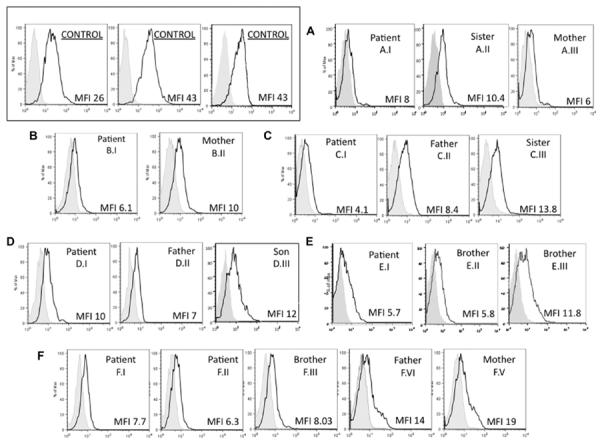
Heterozygous mutations impair APRIL binding. B-cell lines of patients with CVID and relatives with TACI mutations (as identified on each panel from Table I) were tested to determine the surface binding of Mega-FLAG-APRIL, using monoclonal anti-FLAG-biotin and phycoerythrin streptavidin, in comparison with B cells of 3 healthy controls (upper left). These subjects are from 6 families (A–F) and also identified on each panel by the same numbers as given in Table I. For each cell line, mean fluorescence intensity (MFI; x-axis) for FLAG-APRIL binding is indicated in each panel for each B-cell population. Cell counts are on the y-axis. FLAG-APRIL binding fluorescence is indicated in the open areas; controls (biotin anti-FLAG) are marked in the shaded areas of each panel. Data shown are from 1 experiment, representative of 3 performed on these cell lines. Differences between normal B cells (6 tested) and CVID B cells, or B cells of relatives were both significant (Mann Whitney test P = .024, P = .001.) Patients and relatives were not different (P = .104). Note: MFI for the 6 controls were 20, 23, 34, 26, 43, and 25.
FIG 3
FIG 3
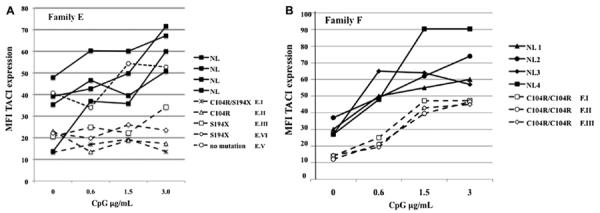
A, TACI upregulation by TLR9 activation. EBV cells from 5 subjects from Family E were cultured with the TLR9 agonist CpG oligodeoxynucleotide (ODN) at the indicated concentrations for 48 hours; B-cell surface TACI expression was determined by FACS, using biotin-labeled anti-TACI followed by streptavidinphycoerythrin. The patient with CVID and her family members have the indicated mutations; one sister (E.V.) has no mutation. B cells of 4 unrelated controls (NL) are included for comparison. B, Similarly, PBMCs of subjects from 3 subjects of Family F were cultured with CpG ODN 2006 to examine upregulation of TACI expression on peripheral blood B cells. TACI expression was determined by FACS as for subjects in Fig 3, A. Similarly treated peripheral blood B cells of 4 unrelated controls (NL) were included for comparison. MFI, Mean fluorescence intensity.
FIG 4
FIG 4
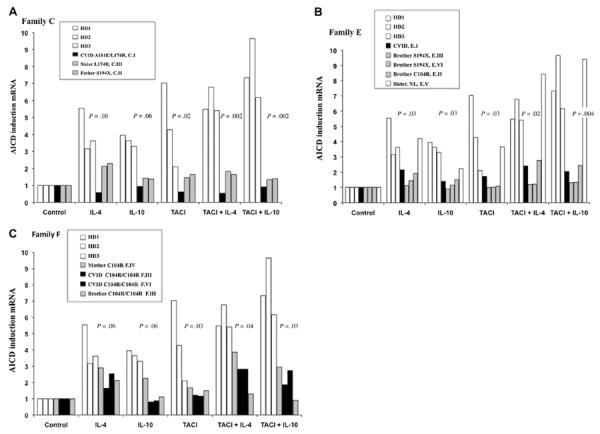
TACI-induced expression of AID mRNA. To examine whether single or compound mutations in TACI affect TACI activation that lead to isotype switch, the induction of AID mRNA by an agonist anti-TACI antibody, with or without added IL-4 or IL-10, was examined for B cells of subjects from Families C, E, and F compared with similarly treated cells from a healthy control. The index patients with CVID (C1, E1, and F1) have 2 mutations in TACI, whereas other members are either normal or have 1 mutation. For this B cells were cultured with biotin-labeled anti-TACI on antibiotin beads for 24 hours, and AID mRNA was quantitated by real-time PCR. Results for AID mRNA for Family C is given in A, Family E in B, and Family F in C. The significant differences (Mann-Whitney test) for induction of AID mRNA for controls compared with subjects for each condition are indicated on the figure.
FIG 5
FIG 5
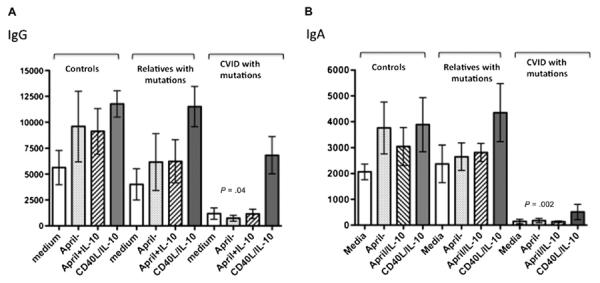
Immune globulin production in vitro. PBMCs of subjects with CVID (n = 6) or family members (n = 6) with the same TACI mutations (C104R, A181E, S194X) or cells of healthy controls (n 5 7) were incubated with the indicated activators for 12 days, and IgG (A) or IgA (B) was determined. Relatives with TACI mutations had similar amounts of IgG and IgA production in comparison with control B cells (Mann-Whitney test P = .2 and .5, and ANOVA P = .1638), but subjects with CVID had impaired IgG (P = .04) and especially IgA secretion (P = .001) compared with controls.

References

    1. Cunningham-Rundles C. Common variable immunodeficiency. Curr Allergy Asthma Rep. 2001;1:421–9. - PubMed
    1. Warnatz K, Denz A, Drager R, Braun M, Groth C, Wolff-Vorbeck G, et al. Severe deficiency of switched memory B cells (CD27(+)IgM(−)IgD(−)) in subgroups of patients with common variable immunodeficiency: a new approach to classify a heterogeneous disease. Blood. 2002;99:1544–51. - PubMed
    1. Bonhomme D, Hammarstrom L, Webster D, Chapel H, Hermine O, Le Deist F, et al. Impaired antibody affinity maturation process characterizes a subset of patients with common variable immunodeficiency. J Immunol. 2000;165:4725–30. - PubMed
    1. Ochtrop ML, Goldacker S, May AM, Rizzi M, Draeger R, Hauschke D, et al. T and B lymphocyte abnormalities in bone marrow biopsies of common variable immunodeficiency. Blood. 2011;118:309–18. - PubMed
    1. Chapel H, Lucas M, Lee M, Bjorkander J, Webster D, Grimbacher B, et al. Common variable immunodeficiency disorders: division into distinct clinical phenotypes. Blood. 2008;112:277–86. - PubMed

Publication types

MeSH terms