. 2012 Dec 14:11:95.
doi: 10.1186/1475-925X-11-95.

Estimation of human trunk movements by wearable strain sensors and improvement of sensor's placement on intelligent biomedical clothes

Affiliations

Estimation of human trunk movements by wearable strain sensors and improvement of sensor's placement on intelligent biomedical clothes

Paolo Tormene et al. Biomed Eng Online. .

Abstract

Background: The aim of this study was to evaluate the concept of a wearable device and, specifically: 1) to design and implement analysis procedures to extract clinically relevant information from data recorded using the wearable system; 2) to evaluate the design and placement of the strain sensors.

Methods: Different kinds of trunk movements performed by a healthy subject were acquired as a comprehensive data set of 639 multivariate time series and off-line analyzed. The space of multivariate signals recorded by the strain sensors was reduced by means of Principal Components Analysis, and compared with the univariate angles contemporaneously measured by an inertial sensor.

Results: Very high correlation between the two kinds of signals showed the usefulness of the garment for the quantification of the movements' range of motion that caused at least one strain sensor to lengthen or shorten accordingly. The repeatability of signals was also studied. The layout of a next garment prototype was designed, with additional strain sensors placed across the front and hips, able to monitor a wider set of trunk motor tasks.

Conclusions: The proposed technologies and methods would offer a low-cost and unobtrusive approach to trunk motor rehabilitation.


Figures
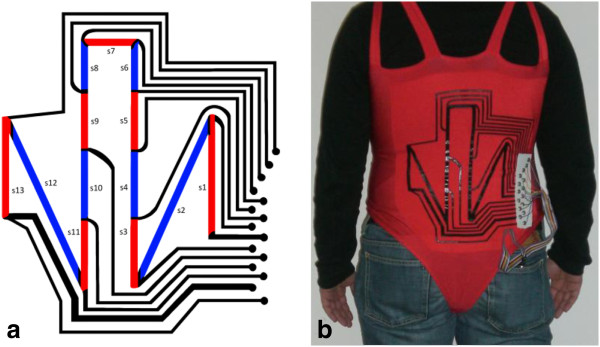
Figure 1
Figure 1
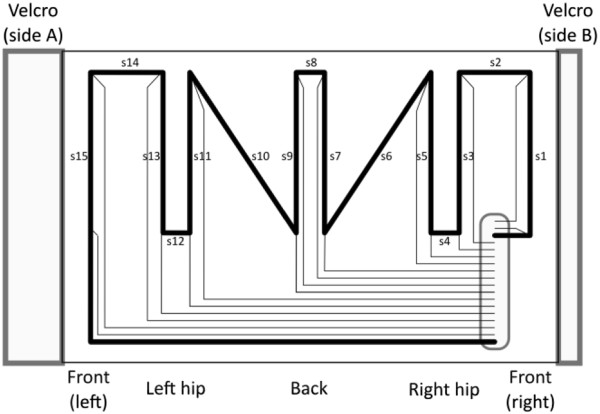
Garment Prototype.a) Layout of the placement of CE strain sensors on the garment prototype. Thick lines are sensors; thin lines are connection wires made of the same polymer. b) Picture of the garment from behind. The readout electronic device is placed in a pocket of the subject’s pants.
Figure 2
Figure 2
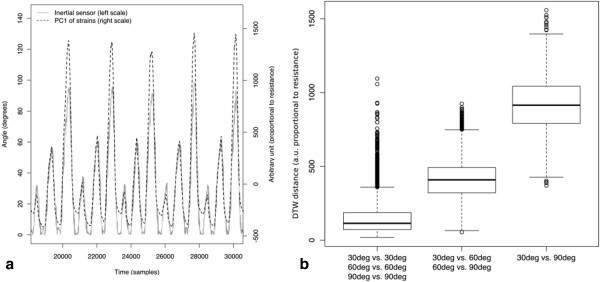
Acquired data analysis.a) The first principal component of the signals acquired by the 13 CE strain sensors is plotted together with the angle measured by the MEMS inertial sensor, versus time b) the boxplots represent distributions of “DTW distances” between couples of motor tasks, showing, as common, median, quartiles, largest and smallest observations, and outliers. Distances are computed between trunk flexions performed with: 1) the same ROM; 2) 30 degrees ROM difference; 3) 60 degrees difference.
Figure 3
Figure 3
New garment layout. Draft of the layout of a new garment prototype. Note CE strain sensors surrounding the body, placed respectively: s1 and s15 in the front; s3, s5, s11 and s13 across the hips

References

    1. Dickstein R, Shefi S, Marcovitz E, Villa Y. Anticipatory postural adjustment in selected trunk muscles in post stroke hemiparetic patients. Arch Phys Med Rehabil. 2004;85:261–267. doi: 10.1016/j.apmr.2003.05.011. - DOI - PubMed
    1. Bartolo M, Serrao M, Tassorelli C, Don R, Ranavolo A, Draicchio F, Pacchetti C, Buscone S, Perrotta A, Furnari A. et al. Four-week trunk-specific rehabilitation treatment improves lateral trunk flexion in Parkinson's disease. Mov Disord. 2010;25:325–331. doi: 10.1002/mds.23007. - DOI - PubMed
    1. Jacobs JV, Henry SM, Nagle KJ. Low back pain associates with altered activity of the cerebral cortex prior to arm movements that require postural adjustment. Clin Neurophysiol. 2010;121:431–440. doi: 10.1016/j.clinph.2009.11.076. - DOI - PMC - PubMed
    1. Schmid M, De Nunzio AM, Schieppati M. Trunk muscle proprioceptive input assists steering of locomotion. Neurosci Lett. 2005;384:127–132. doi: 10.1016/j.neulet.2005.04.059. - DOI - PubMed
    1. Courtine G, De Nunzio AM, Schmid M, Beretta MV, Schieppati M. Stance- and locomotion-dependent processing of vibration-induced proprioceptive inflow from multiple muscles in humans. J Neurophysiol. 2007;97:772–779. doi: 10.1152/jn.00764.2006. - DOI - PubMed

LinkOut - more resources