. 2013 Jan 2;110(1):46-51.
doi: 10.1073/pnas.1213186110. Epub 2012 Dec 13.

A Pictet-Spengler ligation for protein chemical modification

Affiliations

A Pictet-Spengler ligation for protein chemical modification

Paresh Agarwal et al. Proc Natl Acad Sci U S A. .

Abstract

Aldehyde- and ketone-functionalized proteins are appealing substrates for the development of chemically modified biotherapeutics and protein-based materials. Their reactive carbonyl groups are typically conjugated with α-effect nucleophiles, such as substituted hydrazines and alkoxyamines, to generate hydrazones and oximes, respectively. However, the resulting C=N linkages are susceptible to hydrolysis under physiologically relevant conditions, which limits the utility of such conjugates in biological systems. Here we introduce a Pictet-Spengler ligation that is based on the classic Pictet-Spengler reaction of aldehydes and tryptamine nucleophiles. The ligation exploits the bioorthogonal reaction of aldehydes and alkoxyamines to form an intermediate oxyiminium ion; this intermediate undergoes intramolecular C-C bond formation with an indole nucleophile to form an oxacarboline product that is hydrolytically stable. We used the reaction for site-specific chemical modification of glyoxyl- and formylglycine-functionalized proteins, including an aldehyde-tagged variant of the therapeutic monoclonal antibody Herceptin. In conjunction with techniques for site-specific introduction of aldehydes into proteins, the Pictet-Spengler ligation offers a means to generate stable bioconjugates for medical and materials applications.


Conflict of interest statement

Conflict of interest statement: C.R.B. is a cofounder and member of the Scientific Advisory Board of Redwood Bioscience.

Figures
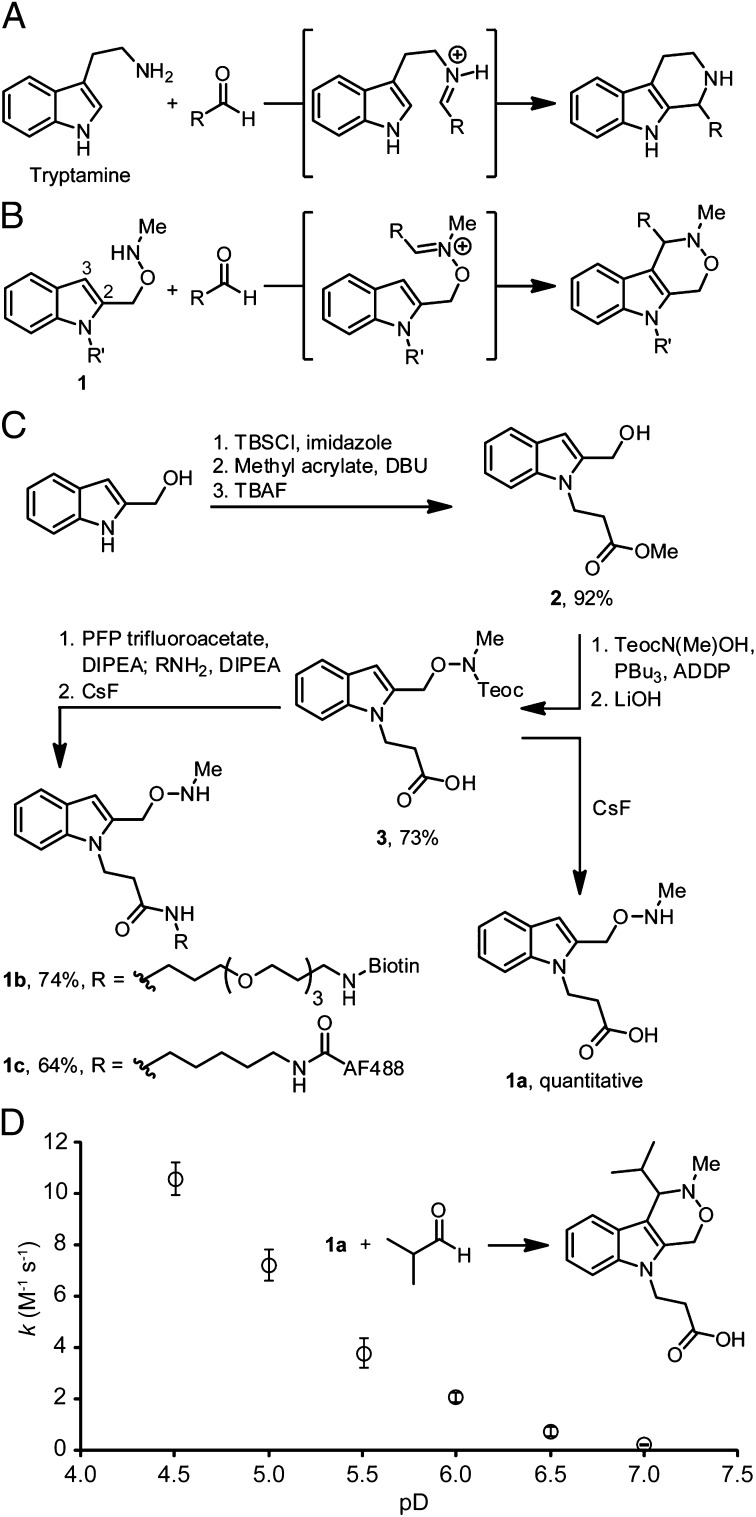
Fig. 1.
Fig. 1.
Design and evaluation of the Pictet-Spengler ligation. (A) The Pictet-Spengler reaction. (B) The Pictet-Spengler ligation. (C) Synthesis of aldehyde- and ketone-reactive indoles used in this study. (D) Second-order rate constants for the reaction of 1a with isobutyraldehyde in D2O solutions containing 100 mM deuterated acetate (pD ≤ 5.5) or phosphate (pD ≥ 6.0) buffers. Error bars represent SD of at least three replicate experiments. ADDP, 1,1′-(azodicarbonyl)dipiperidine; DBU, 1,8-diazabicyclo[5.4.0]undec-7-ene; DIPEA, diisopropylethylamine; PFP, pentafluorophenyl; TBAF, tetrabutylammonium fluoride; TBS, tert-butyldimethylsilyl; Teoc, 2-(trimethylsilyl)ethoxycarbonyl.
Fig. 2.
Fig. 2.
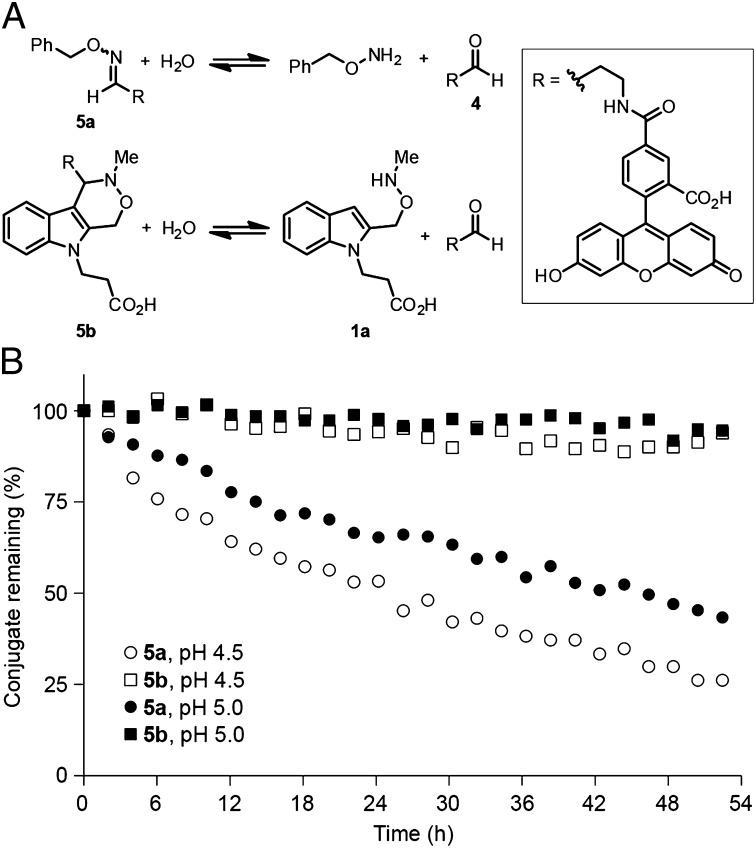
Hydrolytic stability of a model oxime and oxacarboline. (A) Scheme showing hydrolysis of indoles 5a and 5b. (B) Liquid chromatography data showing hydrolysis of 1 μM 5a and 5b at room temperature over 2 d.
Fig. 3.
Fig. 3.
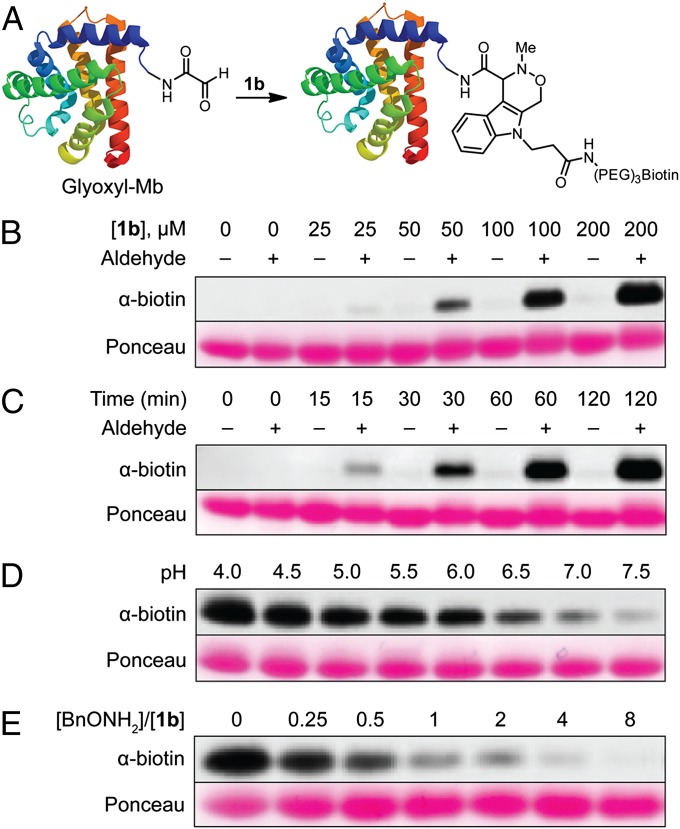
Optimization of the Pictet-Spengler ligation on glyoxyl-Mb. (A) General scheme for biotinylation of glyoxyl-Mb. Indole 1b exhibits (B) concentration-dependent, (C) time-dependent, and (D) pH-dependent labeling of glyoxyl-Mb. Additionally, (E) biotinylation can be diminished by cotreatment with BnONH2. Mb (– aldehyde) or glyoxyl-Mb (+ aldehyde) was treated with (B) 0–200 μM 1b for 3 h at pH 4.0, (C) 250 μM 1b for 0–2 h at pH 4.0, (D) 250 μM 1b for 3 h at pH 4.0–7.5, or (E) 100 μM 1b for 3 h at pH 4.5 in the presence of 0–800 μM BnONH2. All reactions were run at 37 °C and quenched with 10 mM benzaldehyde before resolution by SDS/PAGE. Biotinylation was assessed with an FITC-conjugated α-biotin antibody and total protein loading with Ponceau S.
Fig. 4.
Fig. 4.
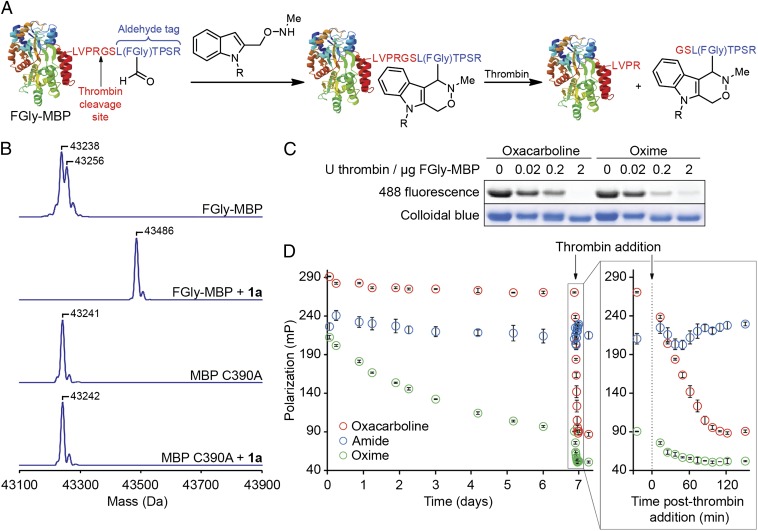
Modification of FGly-MBP by the Pictet-Spengler ligation. (A) Scheme depicting Pictet-Spengler ligation with FGly-MBP followed by thrombin-catalyzed cleavage of a C-terminal 8-mer peptide containing the oxacarboline. (B) Deconvoluted mass spectra of Pictet-Spengler ligations. FGly-MBP and MBP C390A were incubated with 1 mM 1a at pH 5.0 for 12 h at 37 °C before analysis by ESI-MS. Expected masses (Da): FGly-MBP, 43256, and 43238 (M – H2O); FGly-MBP + 1a, 43486; MBP C390A, 43242. (C) Thrombin-catalyzed cleavage of FGly-MBP conjugates. (D) Fluorescence polarization analysis of AF488-MBP conjugate hydrolysis; (Inset) polarization of solutions immediately following thrombin addition. Solutions containing 100 nM AF488 conjugate were incubated in PBS (pH 7.2) at 37 °C for 1 wk before thrombin addition.
Fig. 5.
Fig. 5.
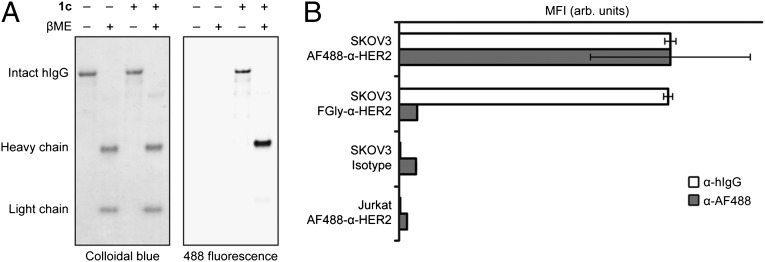
Characterization of FGly-α-HER2 modified by the Pictet-Spengler ligation. (A) Reducing and nonreducing SDS/PAGE analysis of FGly-α-HER2 and AF488-α-HER2. (B) Median fluorescence intensity of SKOV3 and Jurkat cell populations treated with human antibodies. Cells were treated with AF488-α-HER2, FGly-α-HER2, or human isotype control and then fluorescently labeled with α-hIgG and α-AF488 antibodies. Error bars represent SD of three replicate experiments. βME, beta-mercaptoethanol.

References

    1. Glazer AN. Specific chemical modification of proteins. Annu Rev Biochem. 1970;39:101–130. - PubMed
    1. Michalet X, Weiss S, Jäger M. Single-molecule fluorescence studies of protein folding and conformational dynamics. Chem Rev. 2006;106(5):1785–1813. - PMC - PubMed
    1. Wong LS, Khan F, Micklefield J. Selective covalent protein immobilization: Strategies and applications. Chem Rev. 2009;109(9):4025–4053. - PubMed
    1. Shen B-Q, et al. Conjugation site modulates the in vivo stability and therapeutic activity of antibody-drug conjugates. Nat Biotechnol. 2012;30(2):184–189. - PubMed
    1. Cho H, et al. Optimized clinical performance of growth hormone with an expanded genetic code. Proc Natl Acad Sci USA. 2011;108(22):9060–9065. - PMC - PubMed

Publication types

LinkOut - more resources