


Fibroblast Growth Factor 19 and 7α-Hydroxy-4-Cholesten-3-one in the Diagnosis of Patients With Possible Bile Acid Diarrhea
- PMID: 23238290
- PMCID: PMC3412680
- DOI: 10.1038/ctg.2012.10
Fibroblast Growth Factor 19 and 7α-Hydroxy-4-Cholesten-3-one in the Diagnosis of Patients With Possible Bile Acid Diarrhea
Abstract
Objectives: Increased colonic bile acids can cause chronic diarrhea. Bile acid diarrhea (BAD) is treatable by sequestrants, and may be secondary to ileal disease or primary BAD. It is underdiagnosed, partly because the selenium-75-homocholic acid taurine (SeHCAT) retention test is not available in many countries, and is underutilized in others. Serum 7α-hydroxy-4-cholesten-3-one (C4), a measure of bile acid synthesis, is available for diagnosis in specialist centers. Recently, deficiency of the ileal hormone fibroblast growth factor 19 (FGF19) has been shown in BAD. Our aim is to evaluate the diagnostic value of FGF19 in a large and prospective group of patients with chronic diarrhea, previously investigated with C4.
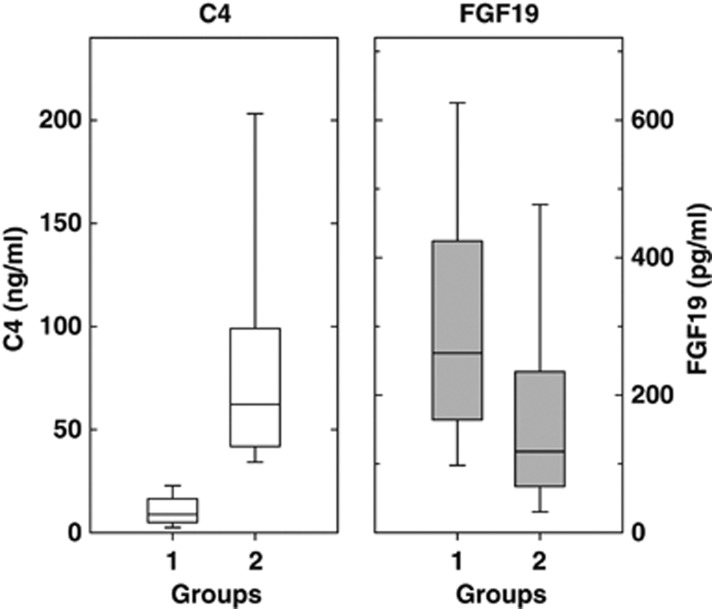
Methods: Patients undergoing routine investigation provided fasting blood samples. C4 was determined by high-performance liquid chromatography, and used to stratify two groups: group 1 (n=119), consisting of patients with normal C4 (≤ 28 ng/ml), and group 2 (n=139), consisting of patients with high C4 (>28 ng/ml), including any of the possible causes of BAD. Serum FGF19 was measured in stored samples by enzyme-linked immunosorbent assay.
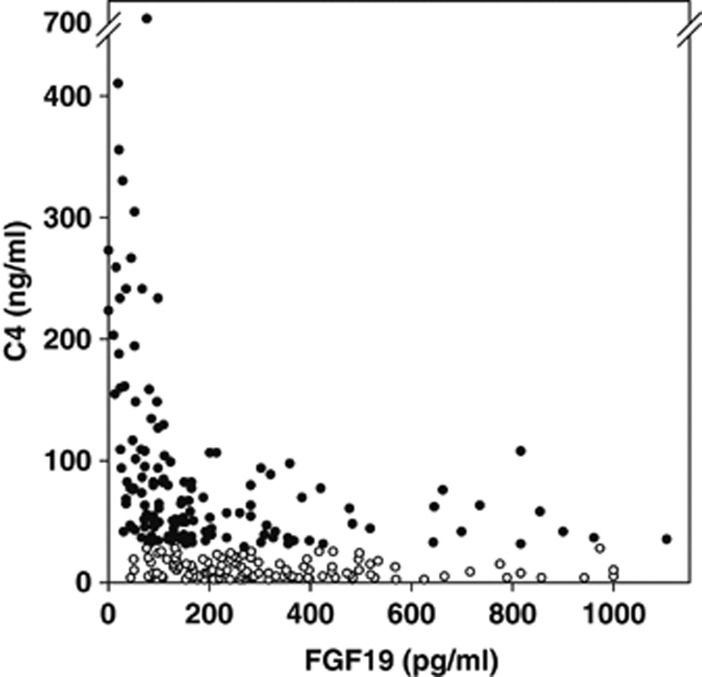
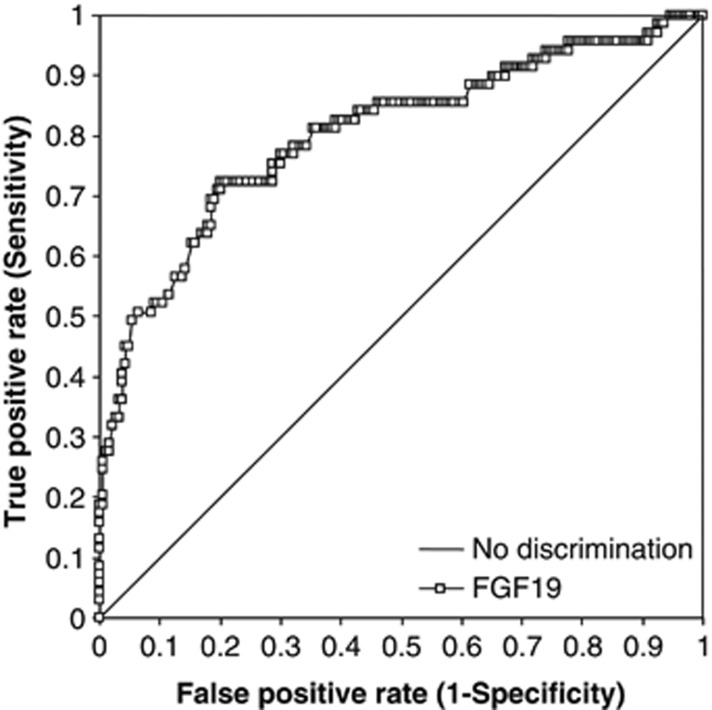
Results: FGF19 and C4 were significantly inversely related (r(s)=-0.64, P<0.001). Patients with raised C4 had significantly lower median FGF19 values. Both of these were more marked when secondary to ileal disease, in particular ileal resection, than in primary BAD. The sensitivity and specificity of FGF19 at 145 pg/ml for detecting a C4 level >28 ng/ml were 58% and 79%, respectively. For C4 >60 ng/ml, these were 74% and 72%; on receiver-operating characteristic analysis, the area under the curve was 0.80 (95% confidence interval 0.74-0.87).
Conclusions: Serum FGF19 could be developed as a simple blood test to increase the diagnostic rates of BAD.
Figures
References
-
- Pattni SS, Walters JRF. Recent advances in the understanding of bile acid malabsorption. Br Med Bull. 2009;92:79–93. - PubMed
-
- Keely SJ, Scharl MM, Bertelsen LS, et al. Bile acid-induced secretion in polarized monolayers of T84 colonic epithelial cells: Structure-activity relationships. Am J Physiol Gastrointest Liver Physiol. 2007;292:G290–G297. - PubMed
-
- Bajor A, Ung KA, Ohman L, et al. Indirect evidence for increased mechanosensitivity of jejunal secretomotor neurones in patients with idiopathic bile acid malabsorption. Acta Physiol (Oxf) 2009;197:129–137. - PubMed
LinkOut - more resources
Full Text Sources
Other Literature Sources
Research Materials
Miscellaneous
