


Disrupted brain networks in the aging HIV+ population
- PMID: 23240599
- PMCID: PMC3621327
- DOI: 10.1089/brain.2012.0105-Rev
Disrupted brain networks in the aging HIV+ population
Abstract
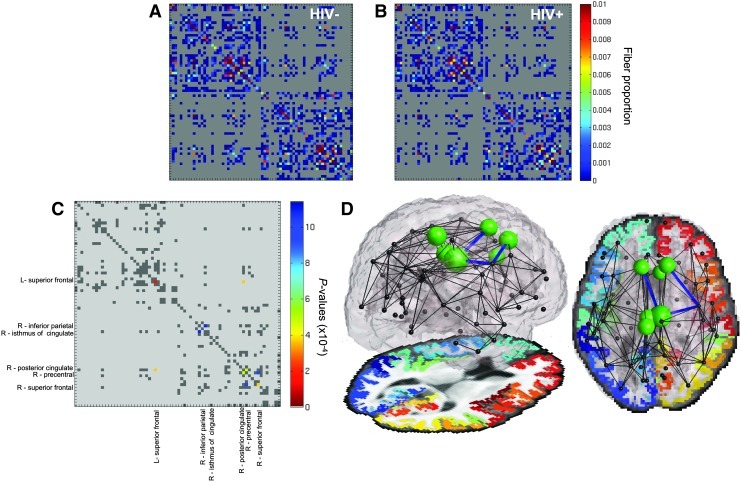
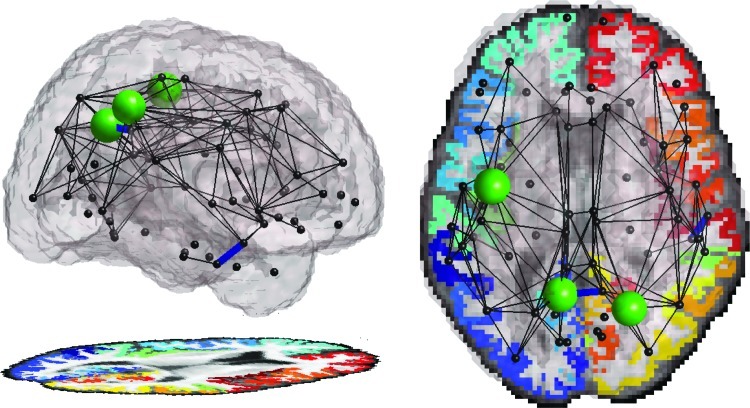
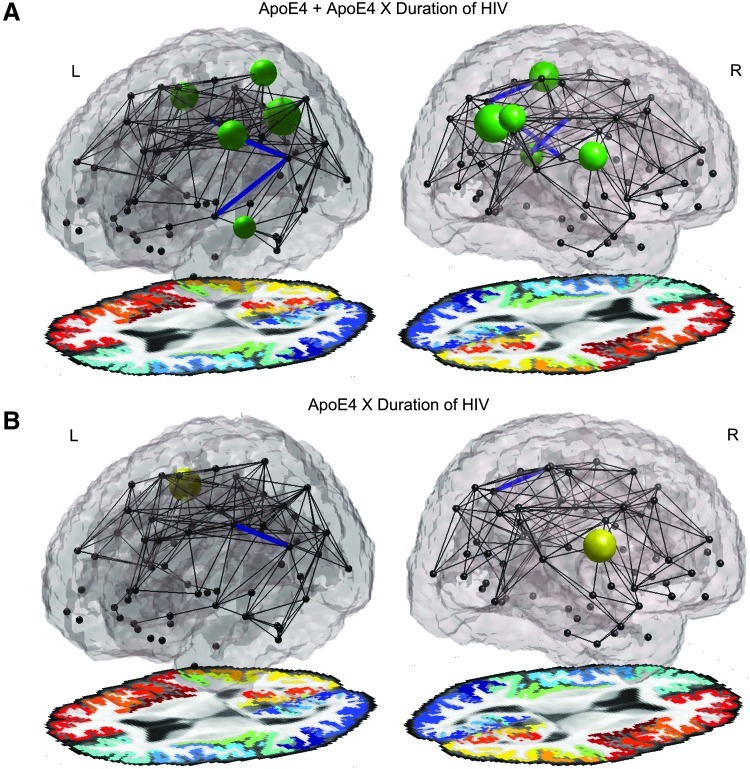
Antiretroviral therapies have become widely available, and as a result, individuals infected with the human immunodeficiency virus (HIV) are living longer, and becoming integrated into the geriatric population. Around half of the HIV+ population shows some degree of cognitive impairment, but it is unknown how their neural networks and brain connectivity compare to those of noninfected people. Here we combined magnetic resonance imaging-based cortical parcellations with high angular resolution diffusion tensor imaging tractography in 55 HIV-seropositive patients and 30 age-matched controls, to map white matter connections between cortical regions. We set out to determine selective virus-associated disruptions in the brain's structural network. All individuals in this study were aged 60-80, with full access to antiretroviral therapy. Frontal and motor connections were compromised in HIV+ individuals. HIV+ people who carried the apolipoprotein E4 allele (ApoE4) genotype-which puts them at even greater risk for neurodegeneration-showed additional network structure deficits in temporal and parietal connections. The ApoE4 genotype interacted with duration of illness. Carriers showed greater brain network inefficiencies the longer they were infected. Neural network deficiencies in HIV+ populations exceed those typical of normal aging, and are worse in those genetically predisposed to brain degeneration. This work isolates neuropathological alterations in HIV+ elders, even when treated with antiretroviral therapy. Network impairments may contribute to the neuropsychological abnormalities in elderly HIV patients, who will soon account for around half of all HIV+ adults.
Figures
References
-
- Basser PJ. Pierpaoli C. Microstructural and physiological features of tissues elucidated by quantitative-diffusion-tensor MRI. J Magn Reson B. 1996;111:209–219. - PubMed
-
- Benjamini Y. Hochberg Y. Controlling the false discovery rate - a practical and powerful approach to multiple testing. J Roy Stat Soc B Met. 1995;57:289–300.
Publication types
MeSH terms
Substances
Grants and funding
- T15 LM007356/LM/NLM NIH HHS/United States
- R01 EB007813/EB/NIBIB NIH HHS/United States
- T32 GM008042/GM/NIGMS NIH HHS/United States
- K23 AG032872/AG/NIA NIH HHS/United States
- P50 AG023501/AG/NIA NIH HHS/United States
- R01 EB008432/EB/NIBIB NIH HHS/United States
- P30 AI027763/AI/NIAID NIH HHS/United States
- UL1 RR024131/RR/NCRR NIH HHS/United States
- T15 LM07356/LM/NLM NIH HHS/United States
- R01 NS080655/NS/NINDS NIH HHS/United States
- P30-AI027763/AI/NIAID NIH HHS/United States
- K23AG032872/AG/NIA NIH HHS/United States
- P41 RR013642/RR/NCRR NIH HHS/United States
