


Informants' traits weigh heavily in young children's trust in testimony and in their epistemic inferences
- PMID: 23240893
- PMCID: PMC3601569
- DOI: 10.1111/cdev.12029
Informants' traits weigh heavily in young children's trust in testimony and in their epistemic inferences
Abstract
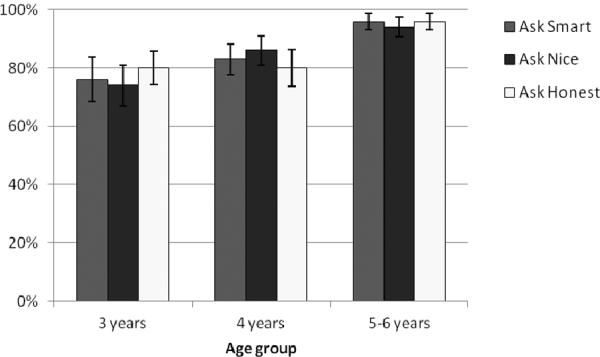
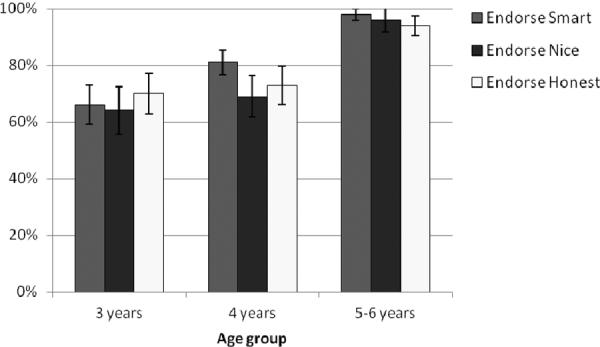
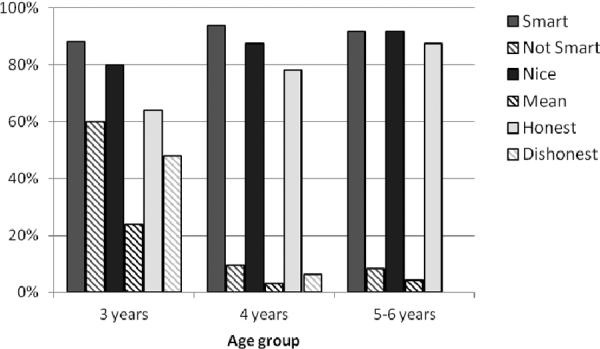
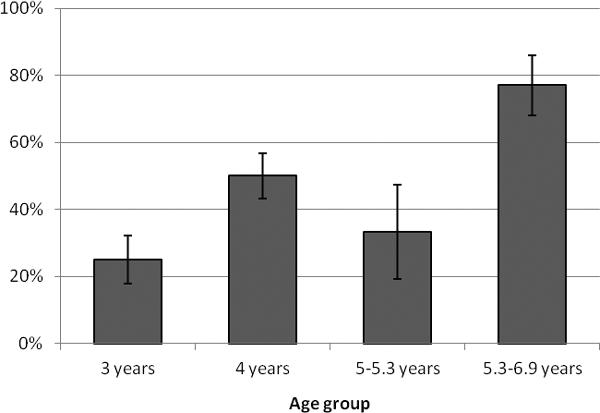
This study examined how informants' traits affect how children seek information, trust testimony, and make inferences about informants' knowledge. Eighty-one 3- to 6-year-olds and 26 adults completed tasks where they requested and endorsed information provided by one of two informants with conflicting traits (e.g., honesty vs. dishonesty). Participants also completed tasks where they simultaneously considered informants' traits and visual access to information when inferring their knowledge and trusting their testimony. Children and adults preferred to ask and endorse information provided by people who are nice, smart, and honest. Moreover, these traits influenced the knowledge that young children attributed to informants. Children younger than 5 years of age reported that people with positive traits were knowledgeable even when they lacked access to relevant information.
© 2012 The Authors. Child Development © 2012 Society for Research in Child Development, Inc.
Figures
References
-
- Alvarez JM, Ruble DN, Bolger N. Trait understanding or evaluative reasoning? An analysis of children's behavioral predictions. Child Development. 2001;72:1409–1425. doi: 10.1111/1467-8624.00356. - PubMed
-
- Birch SAJ, Vauthier SA, Bloom P. Three and four-year-olds spontaneously use others' past performance to guide their learning. Cognition. 2008;107:1018–1034. doi:10.1016/j.cognition.2007.12.008. - PubMed
-
- Brosseau-Liard PE, Birch SAJ. `I bet you know more and are nicer too!': What children infer from others' accuracy. Developmental Science. 2010;13:772–778. doi: 10.1111/j.1467-7687.2009.00932.x. - PubMed
-
- Brosseau-Liard PE, Birch SAJ. Epistemic states and traits: Preschoolers appreciate the differential informativeness of situation-specific and person-specific cues to knowledge. Child Development. 2011;82:1788–1796. doi: 10.1111/j.1467-8624.2011.01662.x. - PubMed
-
- Cain KM, Heyman GD, Walker ME. Preschoolers' ability to make dispositional predictions within and across domains. Social Development. 1997;6:53–75. doi: 10.1111/j.1467-9507.1997.tb00094.x.
