


Lungs don't forget: Comparison of the KRAS and EGFR mutation profile and survival of collegiate smokers and never smokers with advanced lung cancers
- PMID: 23242442
- PMCID: PMC3534987
- DOI: 10.1097/JTO.0b013e31827914ea
Lungs don't forget: Comparison of the KRAS and EGFR mutation profile and survival of collegiate smokers and never smokers with advanced lung cancers
Abstract
Background: We hypothesize that among patients with lung cancers the KRAS/EGFR mutation profile and overall survival of collegiate smokers (former smokers who smoked between 101 lifetime cigarettes and 5 pack-years) are distinct from those of never smokers and former smokers with 15 pack-years or more.
Methods: We collected age, sex, stage, survival, and smoking history for patients evaluated from 2004 to 2009 with advanced stage lung cancers and known KRAS/EGFR status. Mutation profile and overall survival were compared using Fisher's exact test and log-rank test, respectively.
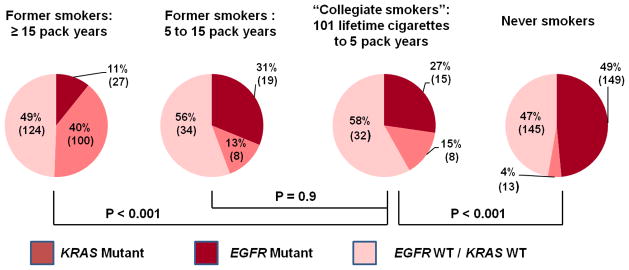
Results: Data were available for 852 patients with advanced-stage lung cancers with known KRAS/EGFR status, of which 6% were collegiate smokers, 36% were never smokers, and 30% were former smokers with 15 pack-years or more. The mutation profile of collegiate smokers (15% KRAS mutations, 27% EGFR mutations) was distinct from those of never smokers (p < 0.001) and former smokers with 15 pack-years or more (p < 0.001) and not significantly different from those of former smokers with 5 to 15 pack-years (p = 0.9). Median overall survival for collegiate smokers was 25 months, compared with 32 months for never smokers (p = 0.4), 33 months for former smokers with 5 to 15 pack-years (p = 0.48), and 21 months for former smokers with 15 pack-years or more (p = 0.63).
Conclusions: Collegiate smokers with advanced-stage lung cancers represent a distinct subgroup of patients with a higher frequency of KRAS mutations and lower frequency of EGFR mutations compared with never smokers. These observations reinforce the recommendation for routine mutation testing for all patients with lung cancers and that no degree of tobacco exposure is safe.
Figures
References
-
- Pham D, Kris MG, Riely GJ, et al. Use of cigarette-smoking history to estimate the likelihood of mutations in epidermal growth factor receptor gene exons 19 and 21 in lung adenocarcinomas. Journal of clinical oncology : official journal of the American Society of Clinical Oncology. 2006;24:1700–1704. - PubMed
-
- Pao W, Miller V, Zakowski M, et al. EGF receptor gene mutations are common in lung cancers from “never smokers” and are associated with sensitivity of tumors to gefitinib anderlotinib. Proceedings of the National Academy of Sciences of the United States of America. 2004;101:13306–13311. - PMC - PubMed
-
- Paez JG, Janne PA, Lee JC, et al. EGFR mutations in lung cancer: correlation with clinical response to gefitinib therapy. Science. 2004;304:1497–1500. - PubMed
-
- Lynch TJ, Bell DW, Sordella R, et al. Activating mutations in the epidermal growth factor receptor underlying responsiveness of non-small-cell lung cancer to gefitinib. The New England journal of medicine. 2004;350:2129–2139. - PubMed
Publication types
MeSH terms
Substances
Grants and funding
LinkOut - more resources
Full Text Sources
Other Literature Sources
Medical
Research Materials
Miscellaneous
