Impact of donor-specific anti-HLA antibodies on graft failure and survival after reduced intensity conditioning-unrelated cord blood transplantation: a Eurocord, Société Francophone d'Histocompatibilité et d'Immunogénétique (SFHI) and Société Française de Greffe de Moelle et de Thérapie Cellulaire (SFGM-TC) analysis
- PMID: 23242594
- PMCID: PMC3696621
- DOI: 10.3324/haematol.2012.077685
Impact of donor-specific anti-HLA antibodies on graft failure and survival after reduced intensity conditioning-unrelated cord blood transplantation: a Eurocord, Société Francophone d'Histocompatibilité et d'Immunogénétique (SFHI) and Société Française de Greffe de Moelle et de Thérapie Cellulaire (SFGM-TC) analysis
Abstract
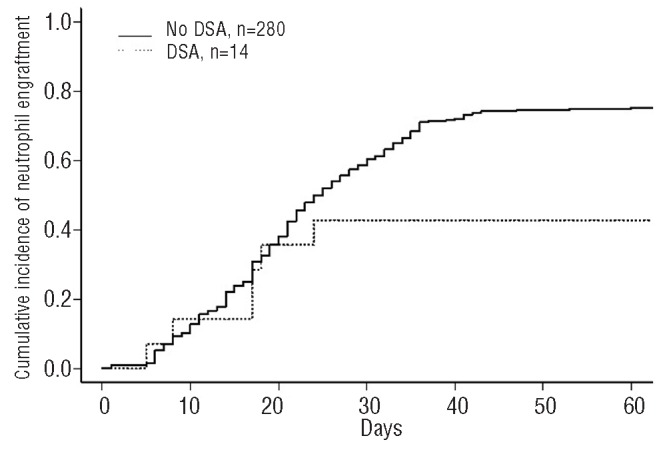
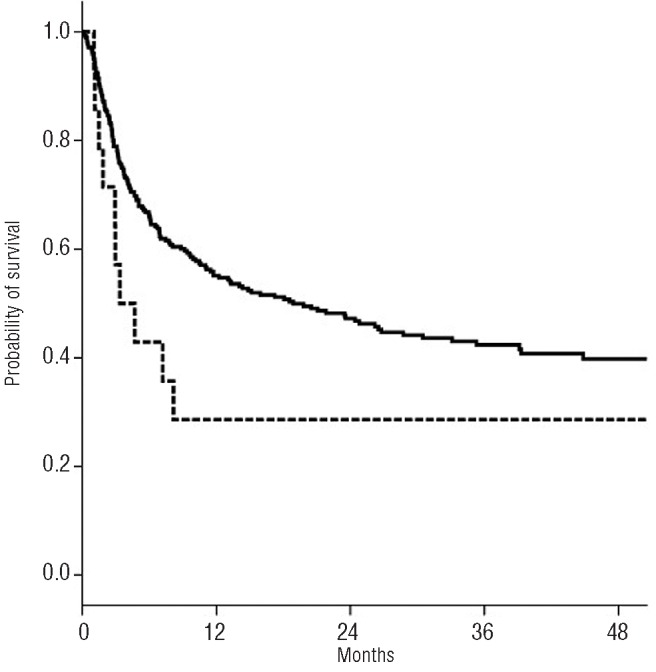
Graft failure is a major complication after unrelated cord blood transplantation. Presence of HLA-antibodies before cord blood transplantation may impact graft failure. To analyze the effect of anti-HLA antibodies on unrelated cord blood transplantation outcomes, we analyzed 294 unrelated cord blood transplant recipients after reduced intensity conditioning regimen. The majority of the patients (82%) were transplanted for malignancies, 60% with double-unrelated cord blood transplant, 63% were HLA mismatched. Retrospectively, pre-unrelated cord blood transplant serum was tested for HLA-Ab using Luminex™ platform. Results were interpreted as mean fluorescence intensity (MFI) against donor-specific mismatch. Among 62 recipients (23%) who had anti-HLA antibodies before unrelated cord blood transplant, 14 patients had donor specific anti-HLA antibodies (DSA) (7 were donor-specific anti-HLA antibodies for single unrelated cord blood transplant and 7 for double unrelated cord blood transplant). Donor specific anti-HLA antibodies threshold ranged from 1620-17629 of mean fluorescence intensity (MFI). Cumulative incidence of Day-60 neutrophil engraftment was 76%: 44% for recipients with donor specific anti-HLA antibodies and 81% in those without donor specific anti-HLA antibodies (P=0.006). The cumulative incidence of 1-year transplant related mortality was 46% in patients with donor specific anti-HLA antibodies and 32% in those without antibodies (P=0.06). The presence of donor specific anti-HLA antibodies was associated with a trend for decreased survival rate (42% vs. 29%; P=0.07). Donor specific anti-HLA antibody in recipients of unrelated cord blood transplant is associated with graft failure and decreased survival. Patient's screening for donor specific anti-HLA antibodies before unrelated cord blood transplantation is recommended before choosing an HLA mismatched cord blood unit. Whenever possible it is important to avoid selecting a unit for which the patient has donor specific anti-HLA antibodies.
Figures
References
-
- Gluckman E, Rocha V, Arcese W, Michel G, Sanz G, Chan KW, et al. Factors associated with outcomes of unrelated cord blood transplant: guidelines for donor choice. Exp Hematol. 2004;32(4):397–407 - PubMed
-
- Eapen M, Rubinstein P, Zhang MJ, Stevens C, Kurtzberg J, Scaradavou A, et al. Outcomes of transplantation of unrelated donor umbilical cord blood and bone marrow in children with acute leukaemia: a comparison study. Lancet. 2007;369(9577): 1947–54 - PubMed
-
- Rocha V, Labopin M, Sanz G, Arcese W, Schwerdtfeger R, Bosi A, et al. Transplants of umbilical-cord blood or bone marrow from unrelated donors in adults with acute leukemia. N Engl J Med. 2004;351(22): 2276–85 - PubMed
-
- Brunstein CG, Fuchs EJ, Carter SL, Karanes C, Costa LJ, Wu J, et al. Alternative donor transplantation after reduced intensity conditioning: results of parallel phase 2 trials using partially HLA-mismatched related bone marrow or unrelated double umbilical cord blood grafts. Blood. 2011;118(2):282–8 - PMC - PubMed
Publication types
MeSH terms
Substances
LinkOut - more resources
Full Text Sources
Medical
Research Materials