. 2013 Feb 14;121(7):1165-74.
doi: 10.1182/blood-2012-06-438002. Epub 2012 Dec 14.

Anti-CD22-chimeric antigen receptors targeting B-cell precursor acute lymphoblastic leukemia

Affiliations

Anti-CD22-chimeric antigen receptors targeting B-cell precursor acute lymphoblastic leukemia

Waleed Haso et al. Blood. .

Abstract

Immune targeting of B-cell malignancies using chimeric antigen receptors (CARs) is a promising new approach, but critical factors impacting CAR efficacy remain unclear. To test the suitability of targeting CD22 on precursor B-cell acute lymphoblastic leukemia (BCP-ALL), lymphoblasts from 111 patients with BCP-ALL were assayed for CD22 expression and all were found to be CD22-positive, with median CD22 expression levels of 3500 sites/cell. Three distinct binding domains targeting CD22 were fused to various TCR signaling domains ± an IgG heavy chain constant domain (CH2CH3) to create a series of vector constructs suitable to delineate optimal CAR configuration. CARs derived from the m971 anti-CD22 mAb, which targets a proximal CD22 epitope demonstrated superior antileukemic activity compared with those incorporating other binding domains, and addition of a 4-1BB signaling domain to CD28.CD3 constructs diminished potency, whereas increasing affinity of the anti-CD22 binding motif, and extending the CD22 binding domain away from the membrane via CH2CH3 had no effect. We conclude that second-generation m971 mAb-derived anti-CD22 CARs are promising novel therapeutics that should be tested in BCP-ALL.


Figures
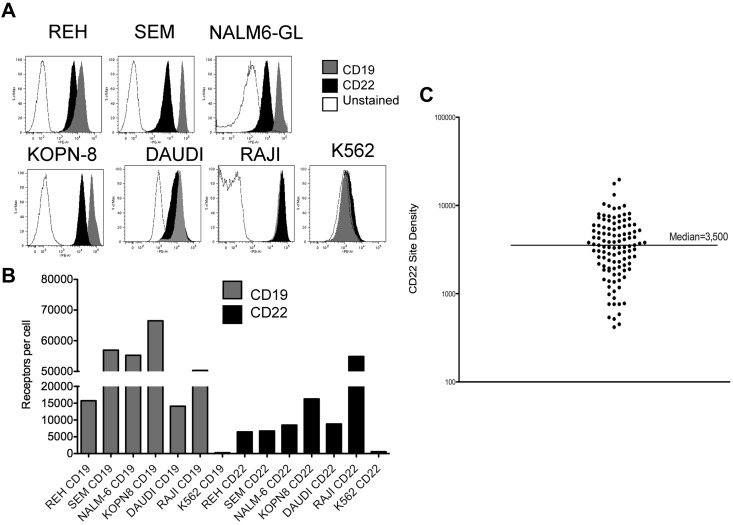
Figure 1
Figure 1
Expression of CD22 and CD19 B-cell precursor ALL cell lines. (A) Surface expression of CD19 and CD22 on the ALL lines REH, SEM, NALM6-GL, KOPN8, Daudi, Raji, and on K562, as determined by directly labeled flow cytometry antibodies. (B) Quantified surface antigen expression, y-axis, for each line as listed on the x-axis. (C) CD22 site density on 110 individual patient samples of BCP-ALL, with median indicated.
Figure 2
Figure 2
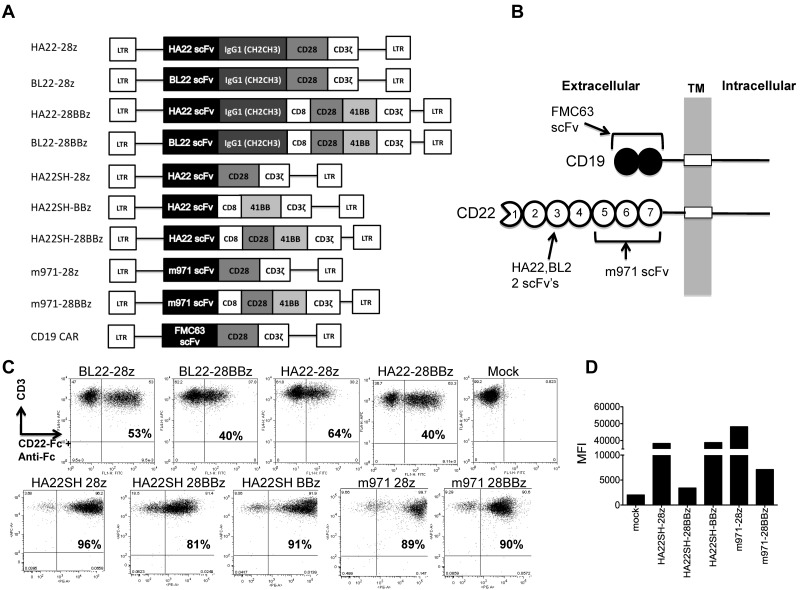
CD22 CARs expressing high affinity scFv (HA22), standard affinity (BL22), and membrane proximal binding (m971) anti-CD22 scFv-derived domains. (A) Second-generation CAR constructs (CD28 and CD3zeta or 4-1BB and CD3zeta signaling domains) and third-generation constructs (CD28, 4-1BB, and CD3zeta) expressed HA22, BL22, m971, or FMC63-derived scFv, ± an IgG1-derived CH2CH3 spacer domain. (B) HA22 and BL22 scFvs bind Ig domain 3, whereas m971 binds within Ig domains 5-7 of CD22. (C) Expression on transduced T cells of CD22 CARs containing CH2CH3 domains (top row) or in the shorter format, omitting this domain (bottom row). CD22 CARs were detected by CD3-APC (y-axis) and CD22-Fc followed by an anti–IgG-Fc-FITC stain. Percent transduction is noted in the top-right quadrant of each plot. (D) MFI, y-axis, of the indicated CD22 CAR constructs, x-axis. Results are representative of more than 3 retroviral supernatant preparations.
Figure 3
Figure 3
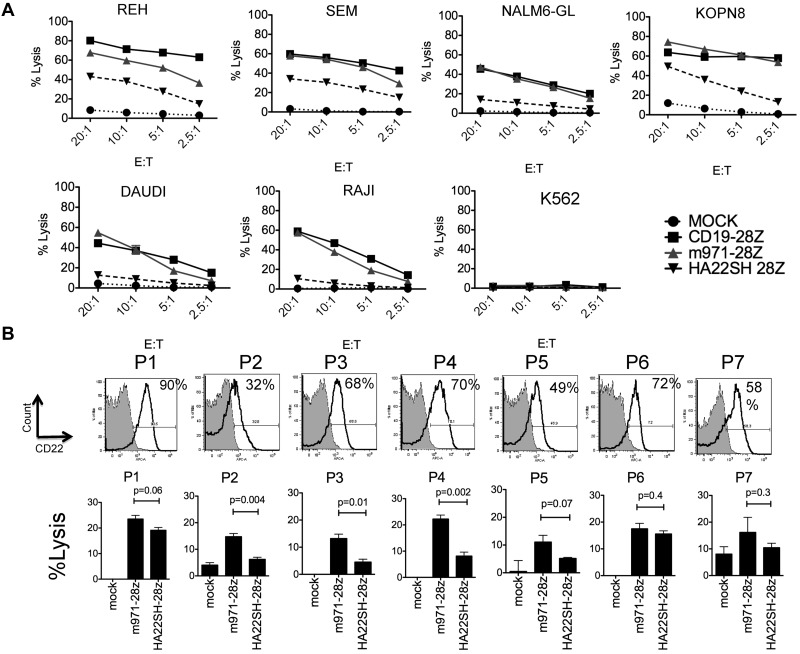
Comparison of CD22-CAR and CD19-CAR–mediated lysis. (A) 51Cr-release assay to evaluate lytic activity of CD22 HA22SH-28z second-generation CAR (inverted triangle), m971-28z second-generation CAR (gray triangle), CD19 CAR (squares), or mock transduced T cells (circles) against ALL lines, as listed. The E/T ratio is shown on the x-axis. (B) Top row, flow cytometric analysis of CD22 expression on 7 primary patient pre-B ALL samples (see “Methods”). Percentage expression over control is indicated. Bottom row, lysis of patient blasts with m971-28z or HASH-28z–expressing T cells in a 4 hours 51Cr-release assay, percent lysis indicated at E/T ratio of 30:1. Significant differences between the vectors is noted (average of triplicate wells). For m971 versus mock, P5 and P7 had P > .05, for HASH P2, P5, and P7 has P > .05, all other values versus mock were less than 0.05.
Figure 4
Figure 4
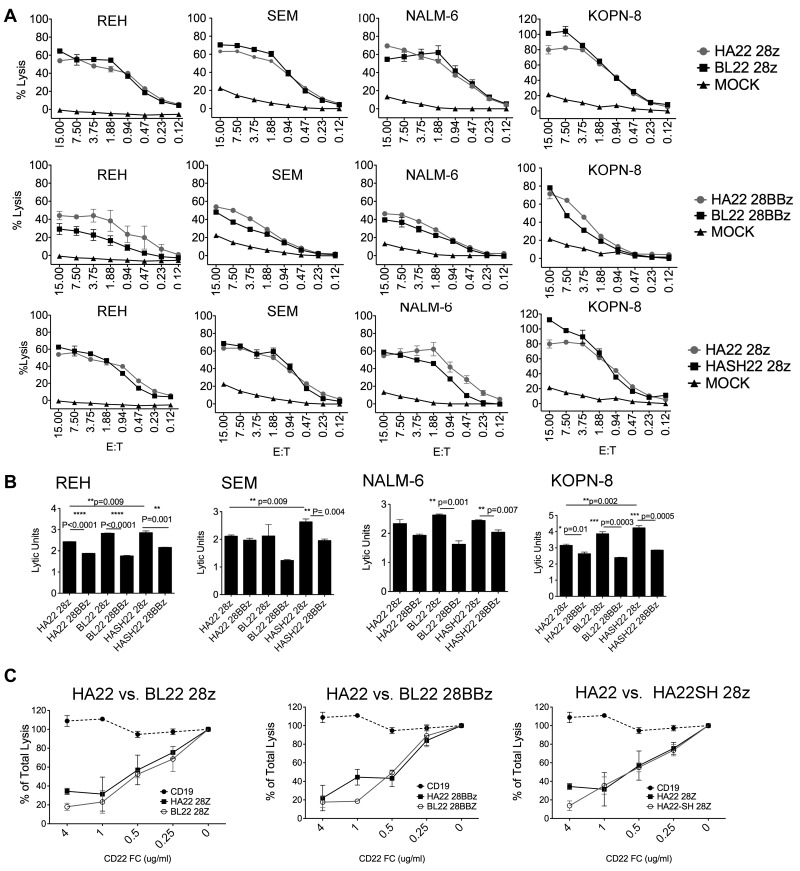
HA22 and BL22-derived CD22 CARs mediate similar lytic activity. (A) The lytic activity HA22 and BL22-derived CD22 CARs in the context of second and third-generation signaling constructs was compared against ALL cell lines at the indicated E:T ratios in a 4-hour 51Cr-release assay. SEM of triplicate wells is shown. The first row compares binding affinity of the scFv (BL22 versus HA22-derived) in second-generation vectors, the second row makes the comparison in the third-generation vectors, and the third row compares vectors with and without CH2CH3 domains (HA22-28z versus HASH22-28z). (B) Comparison of signaling domain structure on vector formats using REH, SEM, NALM-6, and KOPN-8 cell line targets. Lytic activity is expressed in lytic units, which corrects for transduction efficiency, at an E/T ratio of 10:1. Significant differences are noted, using an unpaired student t test. (C) Increasing concentrations of CD22-Fc, as designated on the x-axis, were added to triplicate wells in a 4-hour lytic assay using REH as the target and an E:T of 10:1. CD19-CAR, dashed line, served as a negative control. Assays were repeated 3 times with similar results.
Figure 5
Figure 5
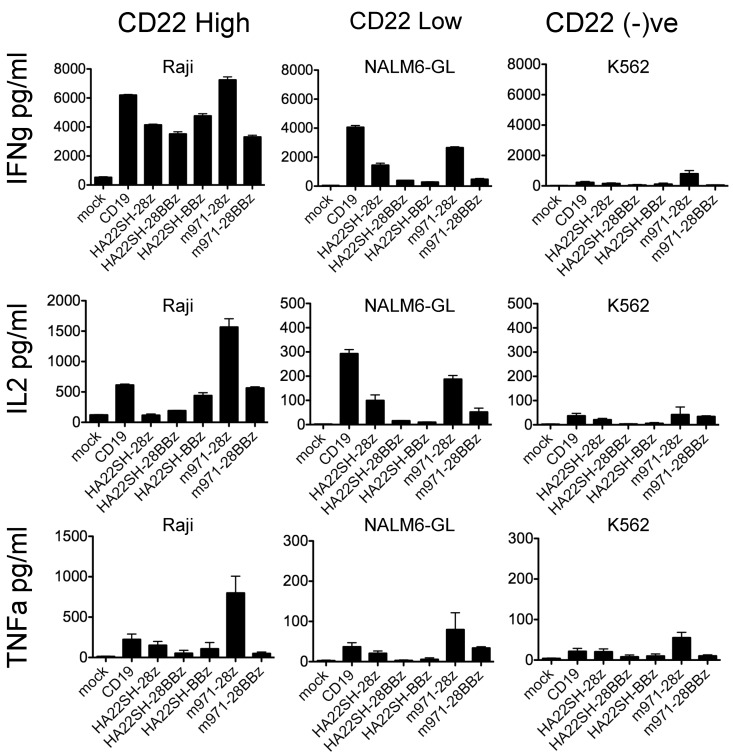
Cytokine release by CAR-transduced T cells. CAR-transduced T cells (vectors listed, x-axis) were incubated with irradiated CD22-high (Raji, column 1), CD22-low (NALM6-GL, column 2), or CD22-negative (K562, column 3) leukemia cell lines at a ratio of 10:1 for 24 hours and culture supernatants analyzed for IFN-γ (top row), IL-2 (second row), and TNF-α (third row). Averages and SD of triplicate wells are shown.
Figure 6
Figure 6
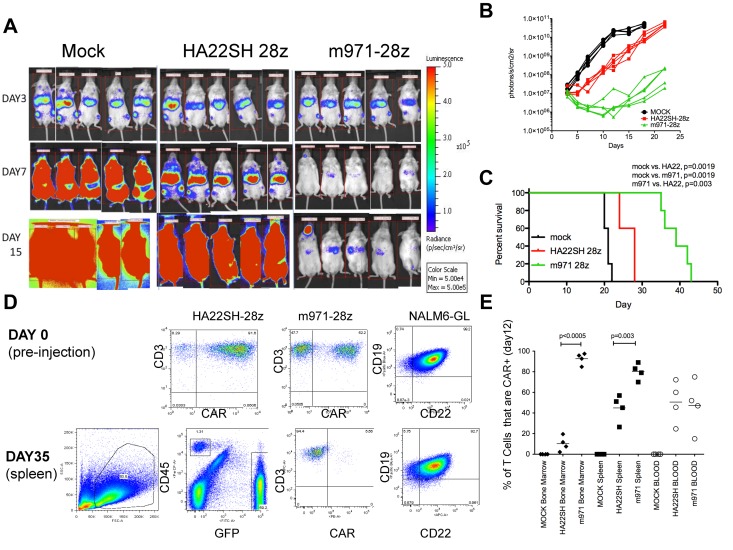
Evaluation of CD22 CARs in vivo. On day 0, NSG mice were injected intravenously with 5 × 10⁵ NALM6-GL cells. On day 3 mice received 1 × 10⁷ CAR+ T cells (HA22SH-28z (n = 5) or m971-28z (n = 5) or mock T cells (n = 5). (A) Bioluminescent imaging pre-treatment (day 3), day 7 and day 15 after intravenous injection of NALM6-GL. (B) Bioluminescent signal for each mouse over time, comparing mock, HASH-28z and m971-28z. (C) Kaplan-Meier survival curves for each group, listing significant differences between each group, survival statistics calculated using log-rank (Mantel-Cox) analysis. (D) Top row: flow cytometric analysis of transduced T cells used in the experiment, as well as CD22 and CD19 expression on NALM6-GL before injection. Bottom row: left panel, FSC versus SSC gating of splenocytes excised from a mouse on sacrifice; center-left panel, FSC versus SSC gated cells were analyzed for green fluorescence (NALM6-GL, x-axis) and CD45-PerCp (y-axis); center right, CD45-gated cells were stained for CD3-APC (y-axis) and for CAR expression; right panel, GFP+ gated cells were stained for CD22 and CD19. (E) In a separate experiment, carried out identically, mice were killed on day 12, and analyzed for CAR expression on gated human T cells in the bone marrow, spleen, and blood. Percentage of T cells expressing CARs is plotted (y-axis), and significant differences, using unpaired 2-tailed t test, are shown.

Comment in

  • CAReful epitope selection matters.
    Handgretinger R. Handgretinger R. Blood. 2013 Feb 14;121(7):1065-6. doi: 10.1182/blood-2012-12-474239. Blood. 2013. PMID: 23411729 No abstract available.

References

    1. Pui CH, Evans WE. Treatment of acute lymphoblastic leukemia. N Engl J Med. 2006;354(2):166–178. - PubMed
    1. Bassan R, Hoelzer D. Modern therapy of acute lymphoblastic leukemia. J Clin Oncol. 2011;29(5):532–543. - PubMed
    1. Wayne AS, Reaman GH, Helman LJ. Progress in the curative treatment of childhood hematologic malignancies. J Natl Cancer Inst. 2008;100(18):1271–1273. - PubMed
    1. Kantarjian H, Thomas D, Wayne AS, O'Brien S. Monoclonal Antibody-Based Therapies: A New Dawn in the Treatment of Acute Lymphoblastic Leukemia. J Clin Oncol. 2012;30(31):3876–3883. - PMC - PubMed
    1. Lee DW, Barrett DM, Mackall C, Orentas R, Grupp SA. The future is now: chimeric antigen receptors as new targeted therapies for childhood cancer. Clin Cancer Res. 2012;18(10):2780–2790. - PMC - PubMed

Publication types

MeSH terms