. 2013 Feb;127(1):70-85.
doi: 10.1037/a0031216. Epub 2012 Dec 17.

The neural basis of nonvisual object recognition memory in the rat

Affiliations
Free PMC article

The neural basis of nonvisual object recognition memory in the rat

Mathieu M Albasser et al. Behav Neurosci. 2013 Feb.
Free PMC article

Abstract

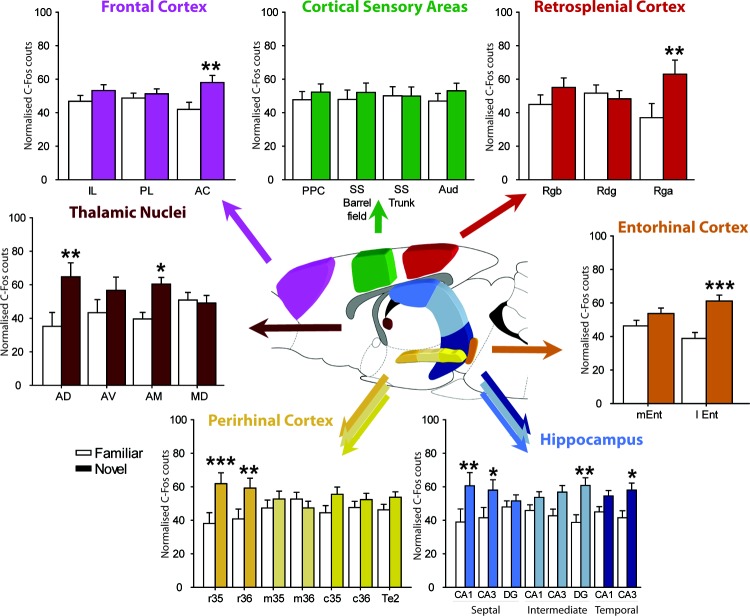
Research into the neural basis of recognition memory has traditionally focused on the remembrance of visual stimuli. The present study examined the neural basis of object recognition memory in the dark, with a view to determining the extent to which it shares common pathways with visual-based object recognition. Experiment 1 assessed the expression of the immediate-early gene c-fos in rats that discriminated novel from familiar objects in the dark (Group Novel). Comparisons made with a control group that explored only familiar objects (Group Familiar) showed that Group Novel had higher c-fos activity in the rostral perirhinal cortex and the lateral entorhinal cortex. Outside the temporal region, Group Novel showed relatively increased c-fos activity in the anterior medial thalamic nucleus and the anterior cingulate cortex. Both the hippocampal CA fields and the granular retrosplenial cortex showed borderline increases in c-fos activity with object novelty. The hippocampal findings prompted Experiment 2. Here, rats with hippocampal lesions were tested in the dark for object recognition memory at different retention delays. Across two replications, no evidence was found that hippocampal lesions impair nonvisual object recognition. The results indicate that in the dark, as in the light, interrelated parahippocampal sites are activated when rats explore novel stimuli. These findings reveal a network of linked c-fos activations that share superficial features with those associated with visual recognition but differ in the fine details; for example, in the locus of the perirhinal cortex activation. While there may also be a relative increase in c-fos activation in the extended-hippocampal system to object recognition in the dark, there was no evidence that this recognition memory problem required an intact hippocampus.


Figures

Figure 1
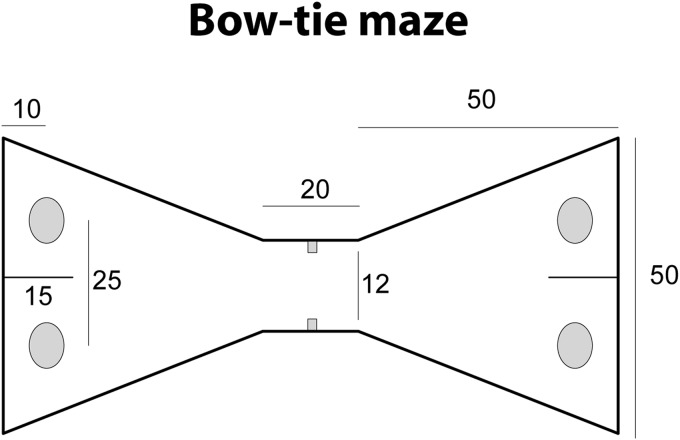
Figure 1. Schematic drawing showing a plan, with dimensions, of the bow-tie maze. From “Qualitatively different modes of perirhinal-hippocampal engagement when rats explore novel vs. familiar objects as revealed by c-fos imaging” by M. Albasser, G. L. Poirier, and J. P. Aggleton, 2010European Journal of Neuroscience, 31, 134-147. Copyright [2009] by John Wiley and Sons. Adapted with permission.
Figure 2
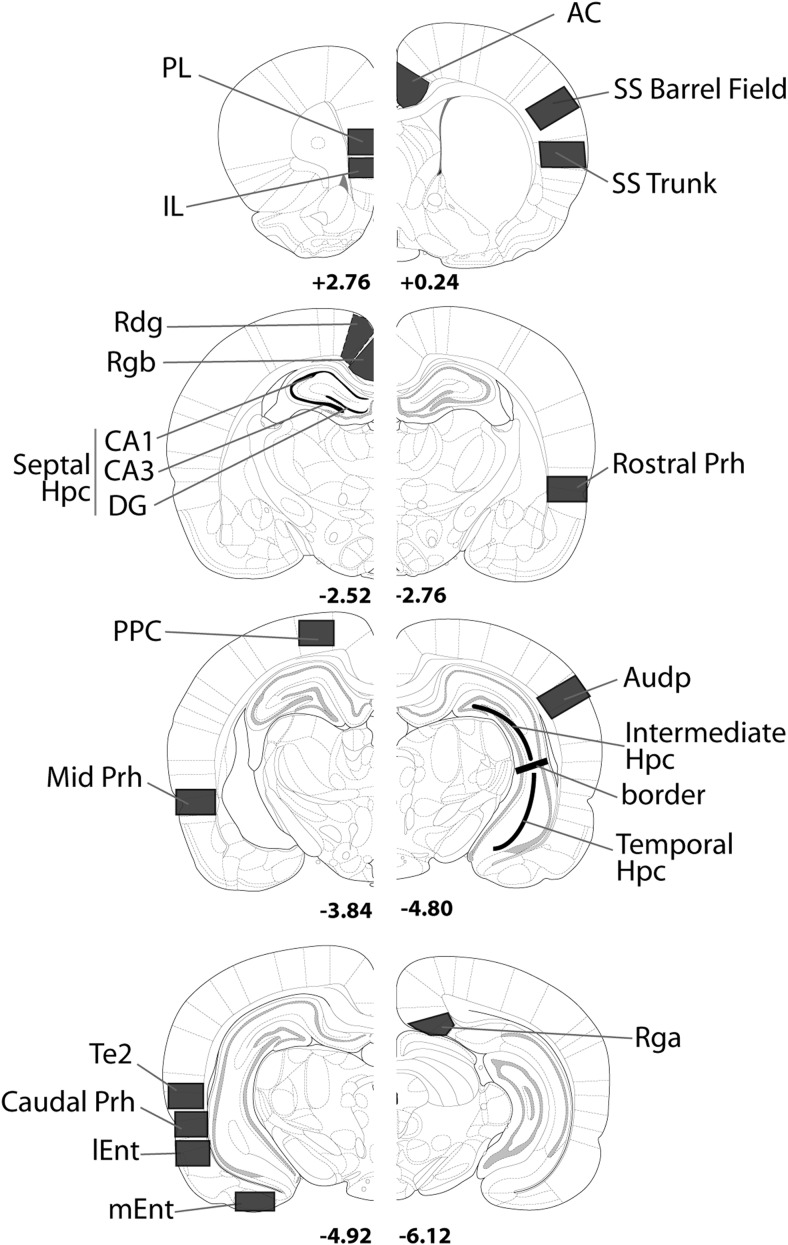
Figure 2. Coronal sections indicating the regions of interest. Abbreviations: AC = anterior cingulate cortex; Audp = primary auditory cortex; DG = dentate gyrus; dSub = dorsal subiculum; Hpc = hippocampus; IL = infralimbic cortex; lEnt = lateral entorhinal cortex; mEnt = medial entorhinal cortex; PL = prelimbic cortex; Prh = perirhinal cortex; Rdg = retrosplenial dysgranular cortex; Rga = retrosplenial granular; Rgb = retrosplenial granular; Te2 = cortical area Te2; Visp = primary visual cortex; vSub = ventral subiculum. The numbers refer to the distance (mm) from bregma. From The Rat Brain in Stereotaxic Coordinates (figures 12, 31, 54, 56, 65, 73, 74 and 84) by G. Paxinos and C. Watson, 2005
Figure 3
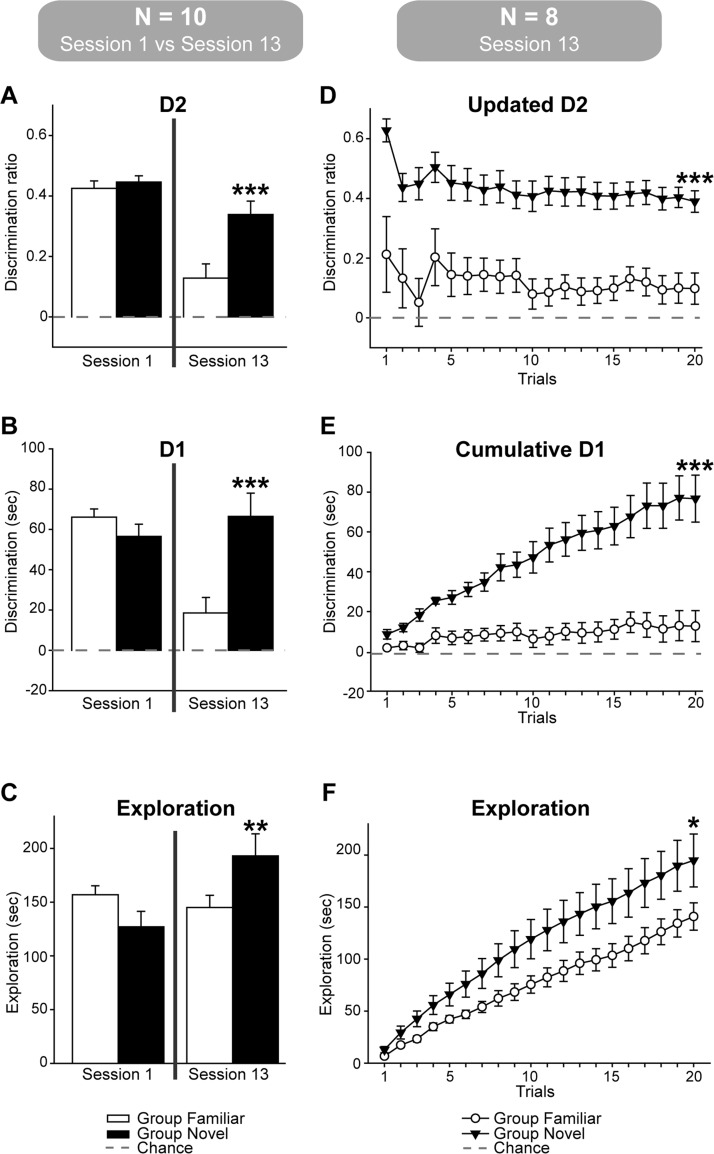
Figure 3. Object recognition performance of Group Novel and Group Familiar on Session 1 and Session 13. The recognition performance (mean +/− one standard error) of the 10 rats from each group is shown on the left, where the discrimination ratios (D2, A.) and the exploration differences (D1, B.) are shown. The bottom left graph (C.) shows the total amounts of object exploration (irrespective of whether to novel or familiar objects). The graphs on the right (n = 8) show the corresponding trial by trial data (D1, D.; D2, E.; total exploration, F.) for the revised groups that used only those Group Novel rats (n = 8) showing clear object recognition in the final session. For all graphs on the right side of the figure the data are cumulative, i.e., they are not independent across trials. Those conditions leading to a significant group difference by the end of 20 trials are indicated: * p < 0.05, ** p < 0.01, *** p < 0.001.
Figure 4
Figure 4. Histograms showing the normalized Fos counts for Group Novel (dark) and Group Familiar (light) for the seven grouped regions of interest. Because the data are normalized they sum to 100. Abbreviations: AC = anterior cingulate cortex; AD = anterior dorsal thalamic nucleus; AM = anterior medial thalamic nucleus; Audp = primary auditory cortex; AV = anterior ventral thalamic nucleus; DG = dentate gyrus; dSub = dorsal subiculum; Hpc = hippocampus; I = infralimbic cortex; lEnt = lateral entorhinal cortex; MD = medial dorsal thalamic nucleus; mEnt = medial entorhinal cortex; PL = prelimbic cortex; Perirhinal cortex (r = rostral; m = mid; c = caudal, areas 35 and 36); PPC = posterior parietal cortex; Rdg = retrosplenial dysgranular cortex; Rga = retrosplenial granular a; Rgb = retrosplenial granular b; SS = somatosensory cortex; Te2 = cortical area Te2; Visp = primary visual cortex; vSub = ventral subiculum. * p < 0.05, ** p < 0.01, *** p < 0.001 (simple effects).
Figure 5
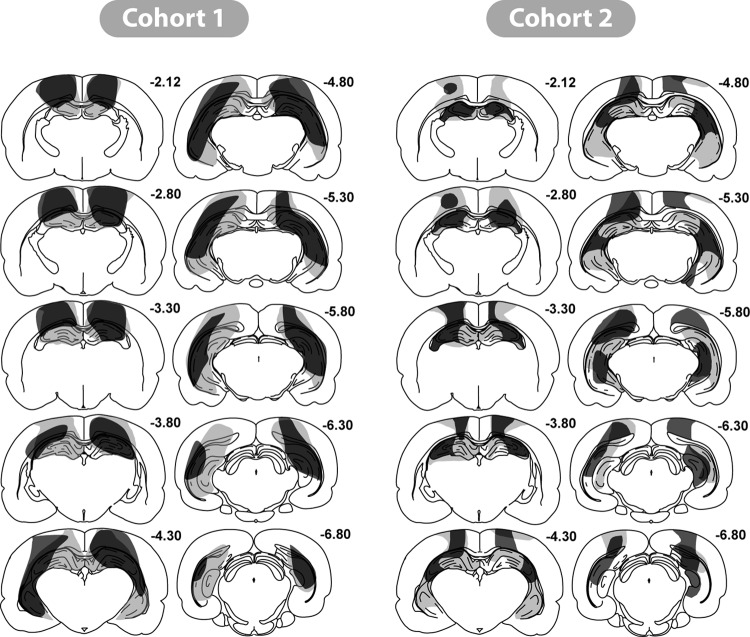
Figure 5. Coronal sections illustrating the hippocampal lesions in those cases in Cohort 1 and 2 with the smallest (dark gray) and largest (light gray) region of cell loss. The numbers refer to the approximate distance of each section in mm caudal to bregma. From The Rat Brain in Stereotaxic Coordinates (figures 26, 29, 31, 33, 35, 37, 39, 41, 43, 45) by G. Paxinos and C. Watson, 1997
Figure 6
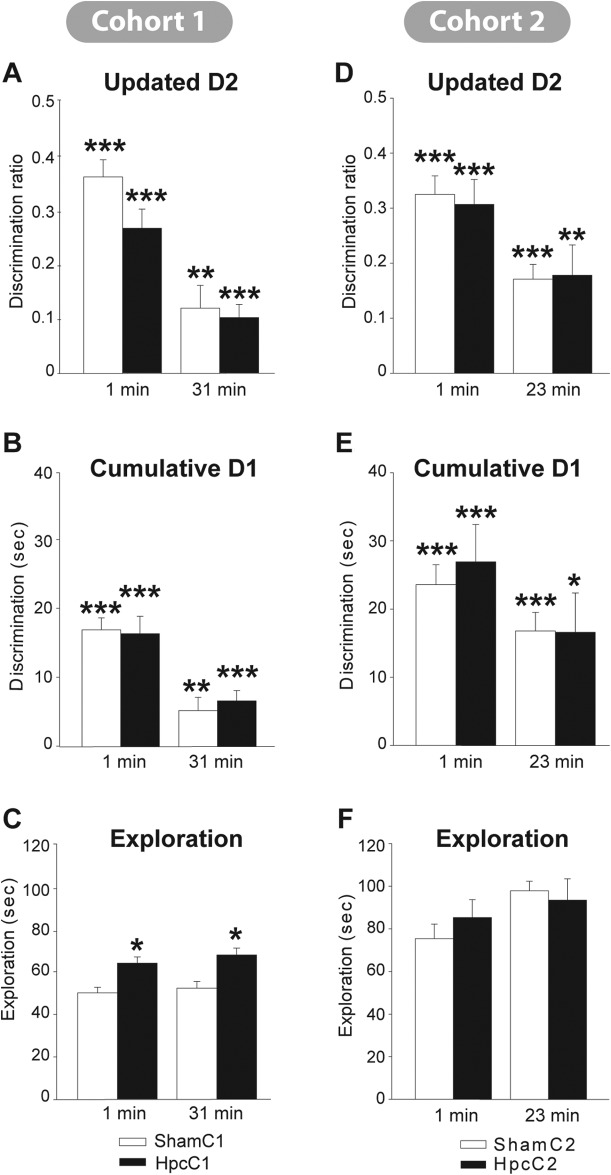
Figure 6. Object recognition performance in the dark after retention delays of 1 min, 23 mins (Cohort 2), or 31 mins (Cohort 1). The data from Cohort 1 are shown in the left half of the figure, with updated D2 (A.), cumulative D1 (B.), and total exploration times (C.). The corresponding data from Cohort 2 are shown in the right half of the figure (D.E.F.). The black bars show the mean scores (± 1 standard error) of the rats with hippocampal lesions, the white bars show the corresponding data for the sham controls. For D1 and D2 (A, B, D, E) the asterisks (* p < 0.05, ** p < 0.01, *** p < 0.001) refer to whether performance is above chance. For total exploration (C, F), the asterisks signify the presence of a group difference (* p < 0.05).

References

    1. Aggleton J. P. (2012). Multiple anatomical systems embedded within the primate medial temporal lobe: Implications for hippocampal function. Neuroscience and Biobehavioral Reviews, 36, 1579–1596. doi:10.1016/j.neubiorev.2011.09.005 - PubMed
    1. Aggleton J. P., & Brown M. W. (2005). Contrasting hippocampal and perirhinal cortex function using immediate early gene imaging. The Quarterly Journal of Experimental Psychology B: Comparative and Physiological Psychology, 58, 218–233. doi:10.1080/02724990444000131 - PubMed
    1. Aggleton J. P., Brown M. W., & Albasser M. M. (2012). Contrasting brain activity patterns for item recognition memory and associative recognition memory: Insights from immediate-early gene imaging. Neuropsychologia, 50, 3141–3155. doi:10.1016/j.neuropsychologia.2012.05.018 - PubMed
    1. Aggleton J. P., Hunt P. R., & Rawlins J. N. P. (1986). The effects of hippocampal lesions upon spatial and nonspatial tests of working memory. Behavioural Brain Research, 19, 133–146. doi:10.1016/0166-4328(86)90011-2 - PubMed
    1. Agster K. L., Fortin N. J., & Eichenbaum H. (2002). The hippocampus and disambiguation of overlapping sequences. The Journal of Neuroscience, 22, 5760–5768. - PMC - PubMed

Publication types

MeSH terms

Substances