. 2012 Dec 17;3(1):26.
doi: 10.1186/2042-6410-3-26.

Neural and psychosocial contributions to sex differences in knee osteoarthritic pain

Affiliations

Neural and psychosocial contributions to sex differences in knee osteoarthritic pain

Kathleen A Sluka et al. Biol Sex Differ. .

Abstract

People with osteoarthritis (OA) can have significant pain that interferes with function and quality of life. Women with knee OA have greater pain and greater reductions in function and quality of life than men. In many cases, OA pain is directly related to sensitization and activation of nociceptors in the injured joint and correlates with the degree of joint effusion and synovial thickening. In some patients, however, the pain does not match the degree of injury and continues after removal of the nociceptors with a total joint replacement. Growth of new nociceptors, activation of nociceptors in the subchondral bone exposed after cartilage degradation, and nociceptors innervating synovium sensitized by inflammatory mediators could all augment the peripheral input to the central nervous system and result in pain. Enhanced central excitability and reduced central inhibition could lead to prolonged and enhanced pain that does not directly match the degree of injury. Psychosocial variables can influence pain and contribute to pain variability. This review explores the neural and psychosocial factors that contribute to knee OA pain with an emphasis on differences between the sexes and gaps in knowledge.


Figures

Figure 1
Figure 1
Schematic diagram of the interactions between neural (peripheral and central) and psychosocial factors in the modulation of osteoarthritic (OA) pain.
Figure 2
Figure 2
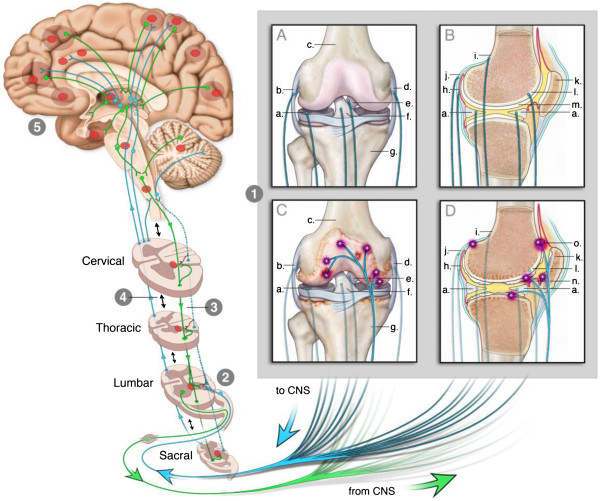
This figure illustrates how the knee can engage the nervous system to give rise to different types of pain associated with knee OA. Part 1 shows anterior (1A, 1C) and lateral (1B, 1D) views of the healthy (1A, 1B) and OA knee (1C, 1D). Blue lines emerging from the knee depict nociceptors conveying information from the knee to the CNS (lumbar spinal cord). Green lines depict postganglionic sympathetic fibers sending efferent information from the CNS to the knee. Only sensory fibers are shown in 1a-d. In the OA knee, sensory and sympathetic fibers sprout branches into articular cartilage (* in 1C, 1D). Part 2 illustrates the connection between the knee and the spinal cord. Sensitized afferent fibers can sensitize neurons in the lumbar dorsal horn. This ‘central sensitization’, shown by the red circle in the spinal cord, can become independent of and is modulated differently from ‘peripheral sensitization’. Part 3: Input from nociceptors to the spinal cord is concentrated in the segment associated with the body part the nociceptors innervate (lumbar segments). However, branches of nociceptors also extend to other rostral and caudal segments (blue lines) - normally, nociceptors have minimal impact on neurons in these segments. When nociceptors become sensitized they increase input to the spinal cord and sensitize central neurons in the innervated and uninnervated segments (green lines; red asterisks). Part 4: Multiple intersegmental excitatory and inhibitory spinal connections exist to coordinate nociceptive information (double-arrowed black lines). Central sensitization (red circles) is modulated by this inter-segmental communication. Part 5: Multiple connections exist that ascend from the spinal cord to the brain (blue lines) and descend from the brain to the spinal cord (green lines). Thus, input from the spinal cord engages neurons throughout the brain via complex ascending and descending systems. Input from sensitized spinal neurons can influence activity throughout the neuraxis altering normal processing of nociceptive and non-nociceptive information. Some regions that can be influenced are depicted by red circle. a, meniscus; b, lateral collateral ligament; c, distal femur; d, medial collateral ligament; e, posterior cruciate ligament; f, anterior cruciate ligament; g, proximal tibia; h, synovium; i, periosteum; j, joint capsule; k, patella; l, subchondral bone; m, normal articular cartilage; n, arthritic articular cartilage; o, osteophyte. Figure was adapted from [7].
Figure 3
Figure 3
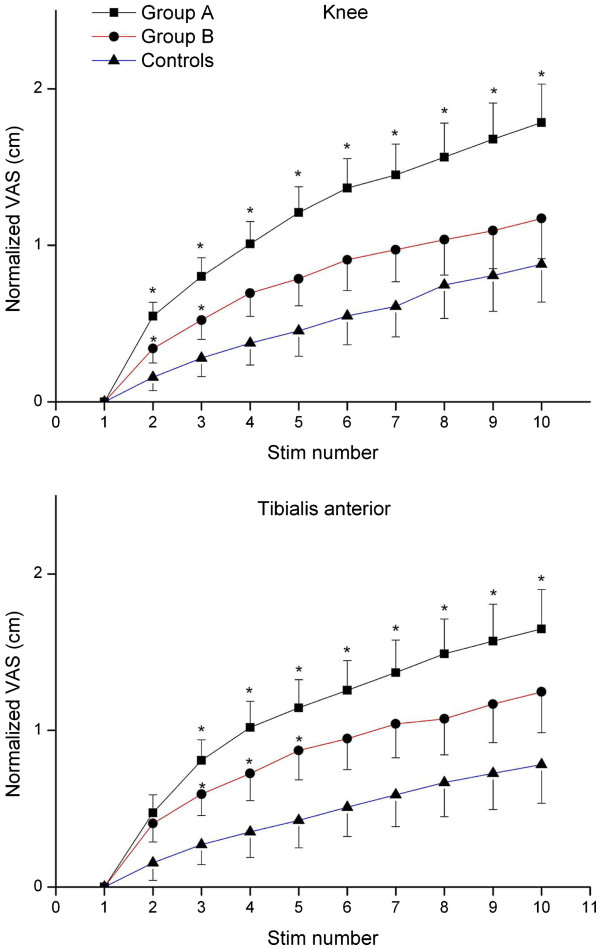
Example of temporal summation in response to pressure applied either to the knee joint or to the anterior tibialis muscle at the pressure-pain threshold in people with osteoarthritis. VAS scores were normalized for comparison by subtracting the first stimulus pain score from subsequent pain scores. Group A had more clinical pain with VAS scores of 6/10 or greater and Group B had clinical pain scored less than 6/10. These two groups were compared to age and sex-matched controls. The greatest temporal summation occurred in the group with the highest pain scores. *, p<0.05 Group A different from controls and Group B; Group B different from Controls. Reprinted from [5] with permission of the International Association for the Study of Pain.

References

    1. O'Connor MI. Implant survival, knee function, and pain relief after TKA. Are there differences between men and women? Clin Orthop Relat Res. 2011;469:1846–1851. doi: 10.1007/s11999-011-1782-5. - DOI - PMC - PubMed
    1. Singh JA, Gabriel S, Lewallen D. The impact of gender, age, and preoperative pain severity on pain after TKA. Clin Orthop Relat Res. 2008;466:2717–2723. doi: 10.1007/s11999-008-0399-9. - DOI - PMC - PubMed
    1. Beattie KA, Boulos P, Pui M, O'Neill J, Inglis D, Webber CE, Adachi JD. Abnormalities identified in the knees of asymptomatic volunteers using peripheral magnetic resonance imaging. Osteoarthritis Cartilage. 2005;13:181–186. doi: 10.1016/j.joca.2004.11.001. - DOI - PubMed
    1. Lethbridge-Cejku M, Scott WW Jr, Reichle R, Ettinger WH, Zonderman A, Costa P, Plato CC, Tobin JD, Hochberg MC. Association of radiographic features of osteoarthritis of the knee with knee pain: data from the Baltimore Longitudinal Study of Aging. Arthritis Care Res. 1995;8:182–188. doi: 10.1002/art.1790080311. - DOI - PubMed
    1. Arendt-Nielsen L, Nie H, Laursen MB, Laursen BS, Madeleine P, Simonsen OH, Graven-Nielsen T. Sensitization in patients with painful knee osteoarthritis. Pain. 2010;149:573–581. doi: 10.1016/j.pain.2010.04.003. - DOI - PubMed

LinkOut - more resources