. 2013 Feb 1;12(2):121-7.
doi: 10.1016/j.dnarep.2012.11.006. Epub 2012 Dec 12.

Ribonucleotide incorporation, proofreading and bypass by human DNA polymerase δ

Affiliations

Ribonucleotide incorporation, proofreading and bypass by human DNA polymerase δ

Anders R Clausen et al. DNA Repair (Amst). .

Abstract

In both budding and fission yeast, a large number of ribonucleotides are incorporated into DNA during replication by the major replicative polymerases (Pols α, δ and ɛ). They are subsequently removed by RNase H2-dependent repair, which if defective leads to replication stress and genome instability. To extend these studies to humans, where an RNase H2 defect results in an autoimmune disease, here we compare the ability of human and yeast Pol δ to incorporate, proofread, and bypass ribonucleotides during DNA synthesis. In reactions containing nucleotide concentrations estimated to be present in mammalian cells, human Pol δ stably incorporates one rNTP for approximately 2000 dNTPs, a ratio similar to that for yeast Pol δ. This result predicts that human Pol δ may introduce more than a million ribonucleotides into the nuclear genome per replication cycle, an amount recently reported to be present in the genome of RNase H2-defective mouse cells. Consistent with such abundant stable incorporation, we show that the 3'-exonuclease activity of yeast and human Pol δ largely fails to edit ribonucleotides during polymerization. We also show that, like yeast Pol δ, human Pol δ pauses as it bypasses ribonucleotides in DNA templates, with four consecutive ribonucleotides in a DNA template being more problematic than single ribonucleotides. In conjunction with recent studies in yeast and mice, this ribonucleotide incorporation may be relevant to impaired development and disease when RNase H2 is defective in mammals. As one tool to investigate ribonucleotide incorporation by Pol δ in human cells, we show that human Pol δ containing a Leu606Met substitution in the polymerase active site incorporates 7-fold more ribonucleotides into DNA than does wild type Pol δ.


Figures

Figure 1
Figure 1
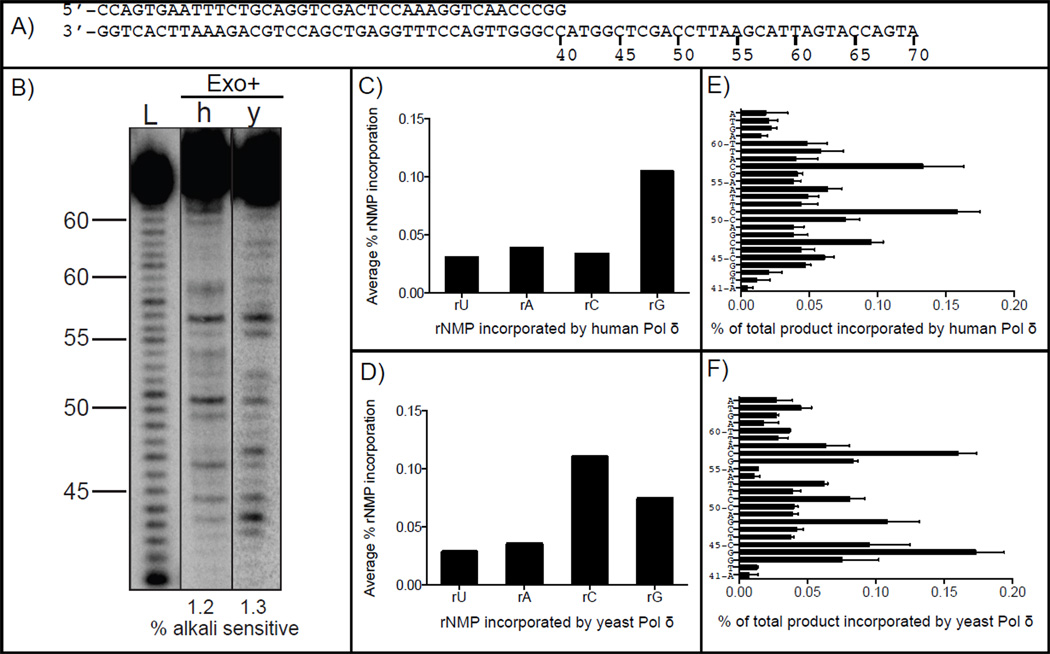
Stable incorporation of ribonucleotides into DNA by proofreading-proficient human (h) and yeast (y) Pol δ. (A) Primer-template sequences. (B) Alkali cleavage products of polymerase reactions with all eight NTPs at cellular concentrations by human and yeast Pol δ in the presence PCNA. The relative amount of ribonucleotides incorporated into the primer strand is indicated below each lane. L indicates the ladder. (C) Average frequency of ribonucleotide incorporation by human Pol δ according to the incorporated ribonucleotide. (D) Average frequency of ribonucleotide incorporation by yeast Pol δ according to the incorporated ribonucleotide. (E) Frequency of ribonucleotide incorporation by human Pol δ at each of 24 template positions. (F) Frequency of ribonucleotide incorporation by yeast Pol δ at each of 24 template positions. Results are from at least two independent experiments.
Figure 2
Figure 2
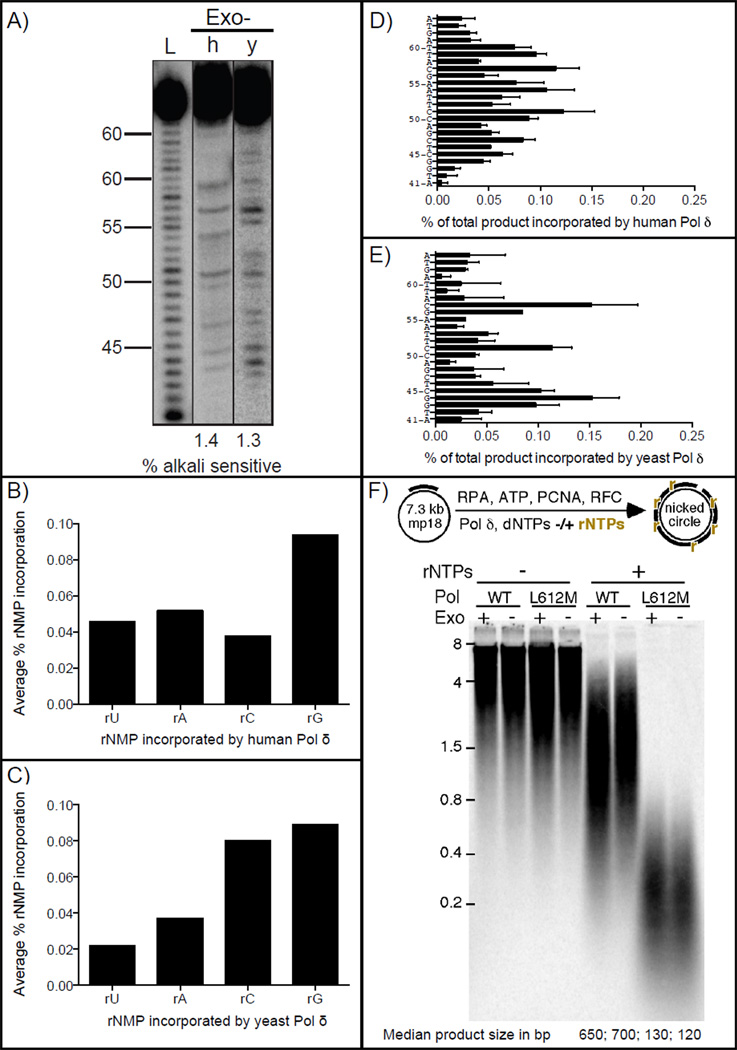
Stable incorporation of ribonucleotides into DNA by proofreading-deficient human (h) and yeast (y) Pol δ. (A) Alkali cleavage products of reactions with all eight NTPs at cellular concentrations by human and yeast Pol δ in the presence of PCNA. The relative amount of ribonucleotides incorporated into the primer strand is indicated below each lane. L indicates the ladder. (B) Average frequency of ribonucleotide incorporation by human Pol δ according to the incorporated ribonucleotide. (C) Average frequency of ribonucleotide incorporation by yeast Pol δ according to the incorporated ribonucleotide. (D) Frequency of ribonucleotide incorporation by human Pol δ at each of 24 template positions. (E) Frequency of ribonucleotide incorporation by yeast Pol δ at each of 24 template positions. (F) Primed RPA-coated SS-M13mp18 DNA was fully replicated by proofreading proficient and deficient yeast Pol δ or the Leu612Met mutant forms under standard conditions with or without rNTPs, as described before (6). Reactions were treated with 0.3 M NaOH. The products were recovered by ethanol precipitation and separated on a 1% alkaline agarose gel. Median product sizes are indicated below the gel image. Results are from at least two independent experiments.
Figure 3
Figure 3
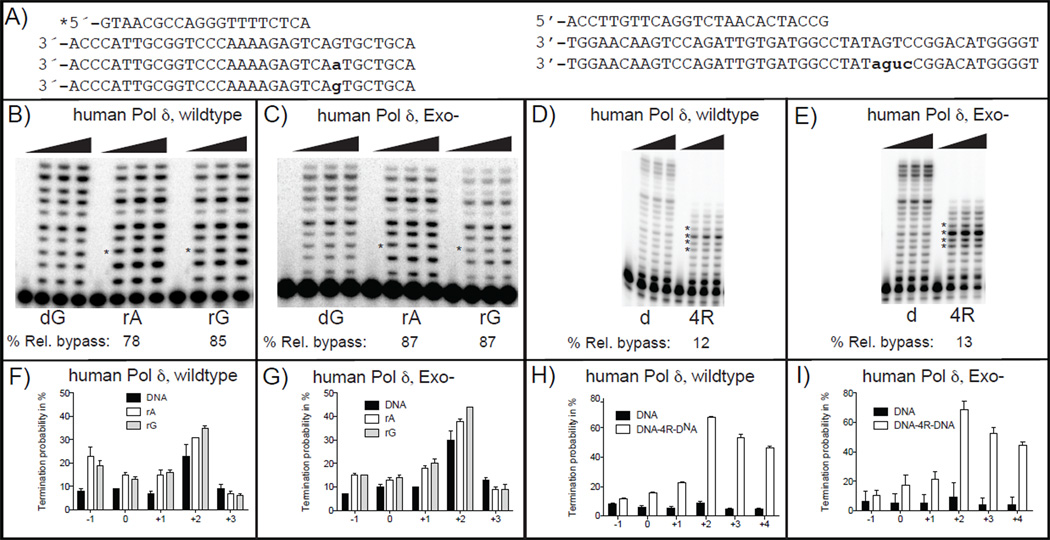
PAGE phosphorimages of bypass of a single or four consecutive ribonucleotides by proofreading proficient (Exo+) and deficient human Pol δ (Exo−). (A) Primer-template sequences, letters in bold face and small caps indicates positions of a ribonucleotide. (B) Proofreading proficient (Exo+) human Pol δ bypassing a single rA or rG. (C) Proofreading deficient Pol δ (Exo−) bypassing rA or rG. (D) Proofreading proficient human Pol δ (Exo+) bypassing four consecutive ribonucleotides. (E) Proofreading deficient Pol δ (Exo−) bypassing four consecutive ribonucleotides. Gel images of reaction products shown in Figures 3B–E were quantified as described in Methods and bar graph of termination probabilities at each incorporation is shown in Figures 3F–I, respectively. Position “0” corresponds to the location of the ribonucleotide, “−1” indicates the preceding incorporation, and “+1” and “+3” indicate sequential incorporations after insertion at “0”. Error bars represent the standard deviations. Results are from at least two independent experiments.
Figure 4
Figure 4
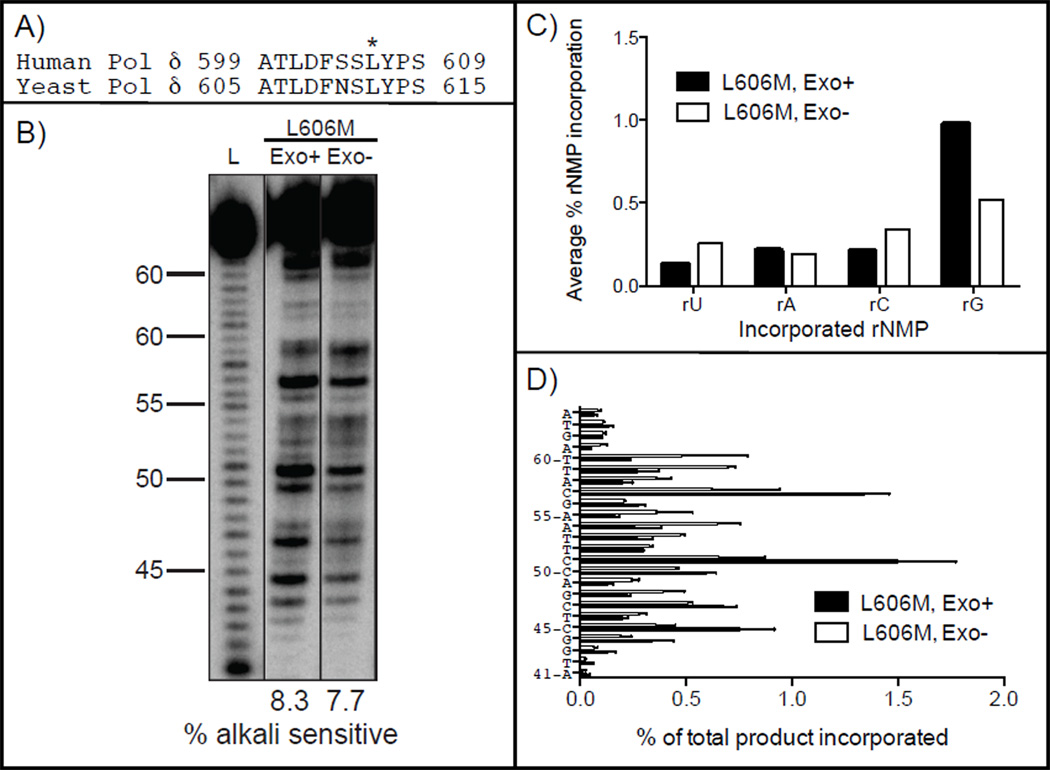
Stable incorporation of ribonucleotides into DNA by proofreading proficient (Exo+) and deficient (Exo−) Leu606Met human Pol δ. (A) An alignment of motif A for human and yeast Pol δ is shown and the asterisk indicates the position of the Leu606Met mutation for human Pol δ. (B) Alkali cleavage products of reactions with all eight NTPs at cellular concentrations Leu606Met human Pol δ in the presence of PCNA. The relative amount of ribonucleotides incorporated into the primer strand is indicated below each lane. L indicates the ladder. (C) Average frequency of ribonucleotide incorporation by human Pol δ according to the incorporated ribonucleotide. (D) Frequency of ribonucleotide incorporation by human Pol δ at each of 24 template positions. Results are from at least two independent experiments.

References

    1. Kornberg A, Baker TA. DNA Replication. Herndon, Virginia: University Science Books; 2005.
    1. Brown JA, Suo ZC. Unlocking the Sugar "Steric Gate" of DNA Polymerases. Biochemistry. 2011;50:1135–1142. - PMC - PubMed
    1. Joyce CM. Choosing the right sugar: How polymerases select a nucleotide substrate. Proceedings of the National Academy of Sciences. 1997;94:1619–1622. - PMC - PubMed
    1. McElhinny SAN, Watts BE, Kumar D, Watt DL, Lundstrom EB, Burgers PMJ, Johansson E, Chabes A, Kunkel TA. Abundant ribonucleotide incorporation into DNA by yeast replicative polymerases. Proc. Natl. Acad. Sci. U. S. A. 2010;107:4949–4954. - PMC - PubMed
    1. Traut TW. Physiological concentrations of purines and pyrimidines. Mol. Cell. Biochem. 1994;140:1–22. - PubMed

Publication types

LinkOut - more resources