


Design and synthesis of new tripeptide-type SARS-CoV 3CL protease inhibitors containing an electrophilic arylketone moiety
- PMID: 23245752
- PMCID: PMC7127713
- DOI: 10.1016/j.bmc.2012.11.017
Design and synthesis of new tripeptide-type SARS-CoV 3CL protease inhibitors containing an electrophilic arylketone moiety
Abstract
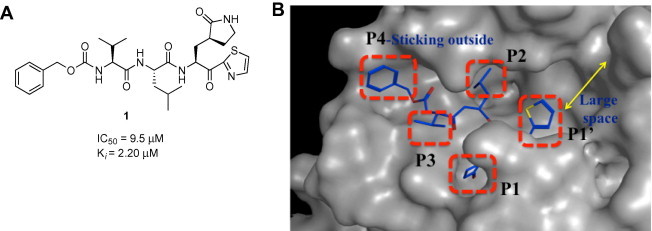
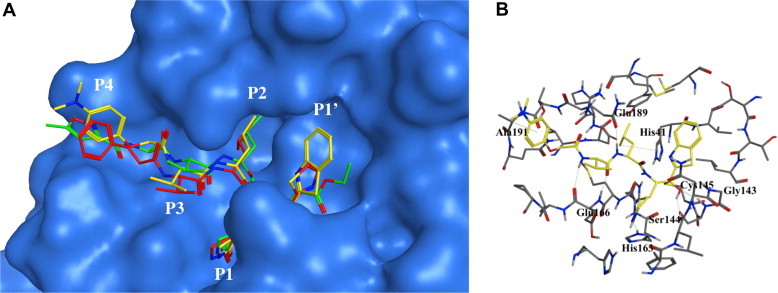
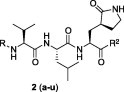
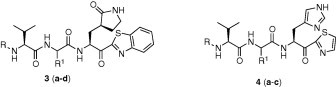
We describe here the design, synthesis and biological evaluation of a series of molecules toward the development of novel peptidomimetic inhibitors of SARS-CoV 3CL(pro). A docking study involving binding between the initial lead compound 1 and the SARS-CoV 3CL(pro) motivated the replacement of a thiazole with a benzothiazole unit as a warhead moiety at the P1' site. This modification led to the identification of more potent derivatives, including 2i, 2k, 2m, 2o, and 2p, with IC(50) or K(i) values in the submicromolar to nanomolar range. In particular, compounds 2i and 2p exhibited the most potent inhibitory activities, with K(i) values of 4.1 and 3.1 nM, respectively. The peptidomimetic compounds identified through this process are attractive leads for the development of potential therapeutic agents against SARS. The structural requirements of the peptidomimetics with potent inhibitory activities against SARS-CoV 3CL(pro) may be summarized as follows: (i) the presence of a benzothiazole warhead at the S1'-position; (ii) hydrogen bonding capabilities at the cyclic lactam of the S1-site; (iii) appropriate stereochemistry and hydrophobic moiety size at the S2-site and (iv) a unique folding conformation assumed by the phenoxyacetyl moiety at the S4-site.
Copyright © 2012 Elsevier Ltd. All rights reserved.
Figures

References
-
- Ksiazek T.G., Erdman D., Goldsmith C.S., Zaki S.R., Peret T., Emery S., Tong S., Urbani C., Comer J.A., Lim W., Rollin P.E., Dowell S.F., Ling A.E., Humphrey C.D., Shieh W.J., Guarner J., Paddock C.D., Roca P., Fields B., DeRisi J., Yang J.Y., Cox N., Hughes J.M., LeDuc J.W., Bellini W.J., Anderson L.J. N. Engl. J. Med. 2003;348:1953. - PubMed
-
- Drosten C., Gunther S., Preiser W., van der Werf S., Brodt H.R., Becker S., Rabenau H., Panning M., Kolesnikova L., Fouchier R.A.M., Berger A., Burguiere A.M., Cinatl J., Eickmann M., Escriou N., Grywna K., Kramme S., Manuguerra J.-C., Muller S., Rickerts V., Sturmer M., Vieth S., Klenk H.D., Osterhaus A.D.M.E., Schmitz H., Doerr H.W. N. Engl. J. Med. 2003;348:1967. - PubMed
-
- World Health Organization, Communicable Disease Surveillance & Response, website: http://www.who.int/csr/sars/archive/2003_05_07a/en and http://www.who.int/csr/sars/country/en/Country2003_08_15.pdf. Summary table of SARS cases by country (1 November 2002 to 7 August 2003).
-
- Lee N., Hui D., Wu A., Chan P., Cameron P., Joynt G.M., Ahuja A., Yung M.Y., Leung C.B., To K.F., Lui S.F., Szeto C.C., Chung S., Sung J.J.Y. N. Engl. J. Med. 2003;348:1986. - PubMed
Publication types
MeSH terms
Substances
LinkOut - more resources
Full Text Sources
Other Literature Sources
Molecular Biology Databases
Miscellaneous
