


Regioselective reactions of 3,4-pyridynes enabled by the aryne distortion model
- PMID: 23247178
- PMCID: PMC3531798
- DOI: 10.1038/nchem.1504
Regioselective reactions of 3,4-pyridynes enabled by the aryne distortion model
Abstract
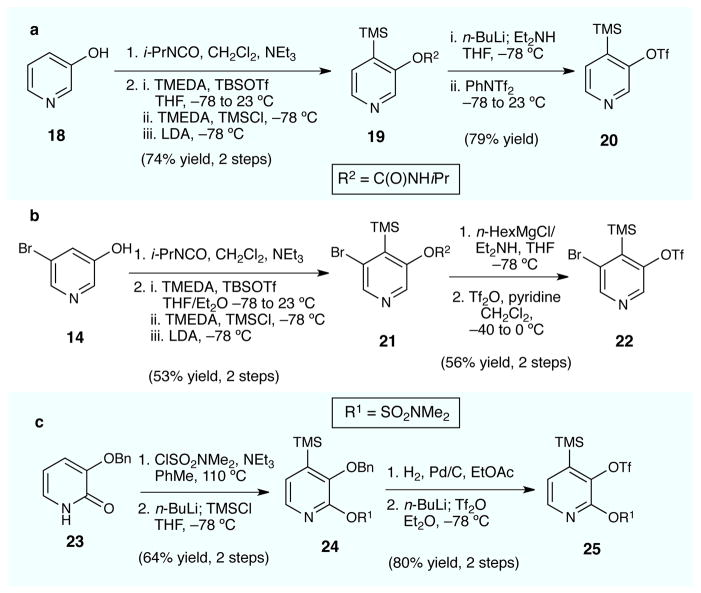
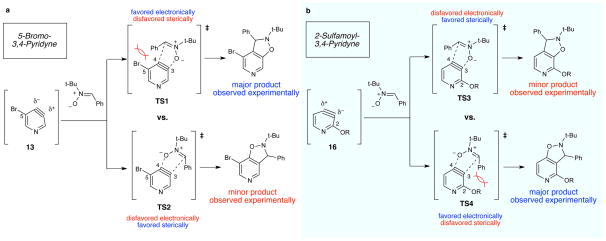
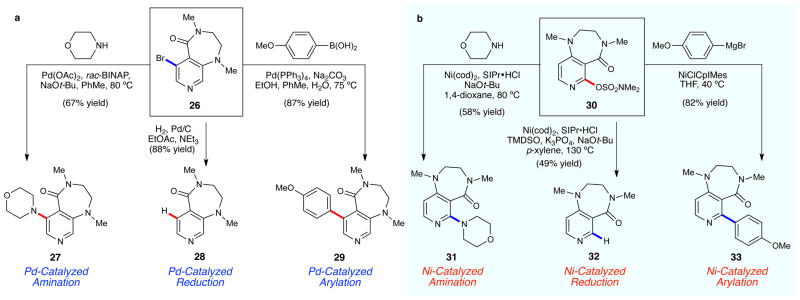
The pyridine heterocycle continues to play a vital role in the development of human medicines. More than 100 currently marketed drugs contain this privileged unit, which remains highly sought after synthetically. We report an efficient means to access di- and trisubstituted pyridines in an efficient and highly controlled manner using transient 3,4-pyridyne intermediates. Previous efforts to employ 3,4-pyridynes for the construction of substituted pyridines were hampered by a lack of regiocontrol or the inability to later manipulate an adjacent directing group. The strategy relies on the use of proximal halide or sulfamate substituents to perturb pyridyne distortion, which in turn governs regioselectivities in nucleophilic addition and cycloaddition reactions. After trapping of the pyridynes generated in situ, the neighbouring directing groups may be removed or exploited using versatile metal-catalysed cross-coupling reactions. This methodology now renders 3,4-pyridynes as useful synthetic building blocks for the creation of highly decorated derivatives of the medicinally privileged pyridine heterocycle.
Figures


References
-
- Pozharskii AF, Soldatenkov A, Katritzky AR. Heterocycles in Life and Society: An Introduction to Heterocyclic Chemistry, Biochemistry, and Applications. 2. Wiley; Chichester, U.K: 2011.
-
- Joule JA, Mills K. Heterocyclic Chemistry. 5. Wiley; Chichester, U.K: 2010.
Publication types
MeSH terms
Substances
Associated data
- PubChem-Substance/152187814
- PubChem-Substance/152187815
- PubChem-Substance/152187816
- PubChem-Substance/152187817
- PubChem-Substance/152187818
- PubChem-Substance/152187819
- PubChem-Substance/152187820
- PubChem-Substance/152187821
- PubChem-Substance/152187822
- PubChem-Substance/152187823
- PubChem-Substance/152187824
- PubChem-Substance/152187825
- PubChem-Substance/152187826
- PubChem-Substance/152187827
- PubChem-Substance/152187828
- PubChem-Substance/152187829
- PubChem-Substance/152187830
- PubChem-Substance/152187831
- PubChem-Substance/152187832
- PubChem-Substance/152187833
- PubChem-Substance/152187834
- PubChem-Substance/152187835
- PubChem-Substance/152187836
- PubChem-Substance/152187837
- PubChem-Substance/152187838
- PubChem-Substance/152187839
- PubChem-Substance/152187840
- PubChem-Substance/152187841
- PubChem-Substance/152187842
- PubChem-Substance/152187843
- PubChem-Substance/152187844
- PubChem-Substance/152187845
- PubChem-Substance/152187846
- PubChem-Substance/152187847
- PubChem-Substance/152187848
- PubChem-Substance/152187849
- PubChem-Substance/152187850
- PubChem-Substance/152187851
- PubChem-Substance/152187860
- PubChem-Substance/152187861
- PubChem-Substance/152187862
- PubChem-Substance/152187863
- PubChem-Substance/152187864
- PubChem-Substance/152187865
- PubChem-Substance/152187866
- PubChem-Substance/152187867
- PubChem-Substance/152187868
- PubChem-Substance/152187869
- PubChem-Substance/152187870
- PubChem-Substance/152187871
- PubChem-Substance/152187872
- PubChem-Substance/152187873
- PubChem-Substance/152187874
- PubChem-Substance/152187875
- PubChem-Substance/152187876
- PubChem-Substance/152187877
- PubChem-Substance/152187878
- PubChem-Substance/152187879
- PubChem-Substance/152187880
- PubChem-Substance/152187881
- PubChem-Substance/152187882
- PubChem-Substance/152187883
- PubChem-Substance/152187884
- PubChem-Substance/152187885
- PubChem-Substance/152187886
- PubChem-Substance/152187887
- PubChem-Substance/152187888
- PubChem-Substance/152187889
- PubChem-Substance/152187890
- PubChem-Substance/152187891
- PubChem-Substance/152187892
Grants and funding
LinkOut - more resources
Full Text Sources
Other Literature Sources
