


Cortisol and ghrelin concentrations following a cold pressor stress test in overweight individuals with and without night eating
- PMID: 23247680
- PMCID: PMC3610846
- DOI: 10.1038/ijo.2012.166
Cortisol and ghrelin concentrations following a cold pressor stress test in overweight individuals with and without night eating
Abstract
Objective: To explore appetite-related hormones following stress in overweight individuals, and their relationship with night eating (NE) status.
Method: We measured plasma cortisol and ghrelin concentrations, and recorded ratings of stress and hunger in response to a physiological laboratory stressor (cold pressor test, CPT), in overweight women with (n=11; NE) and without (n=17; non-NE) NE.
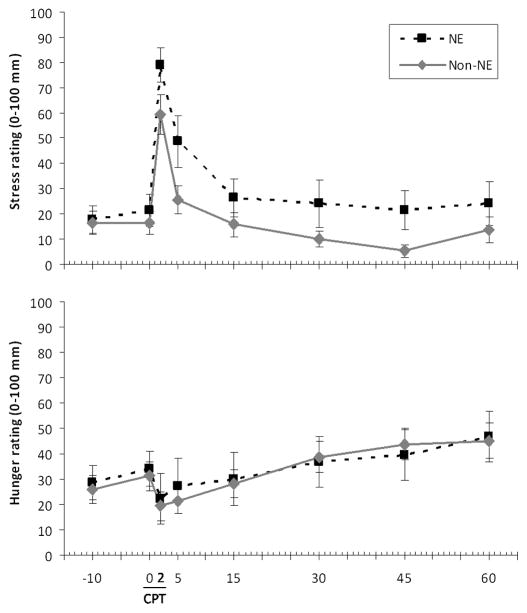
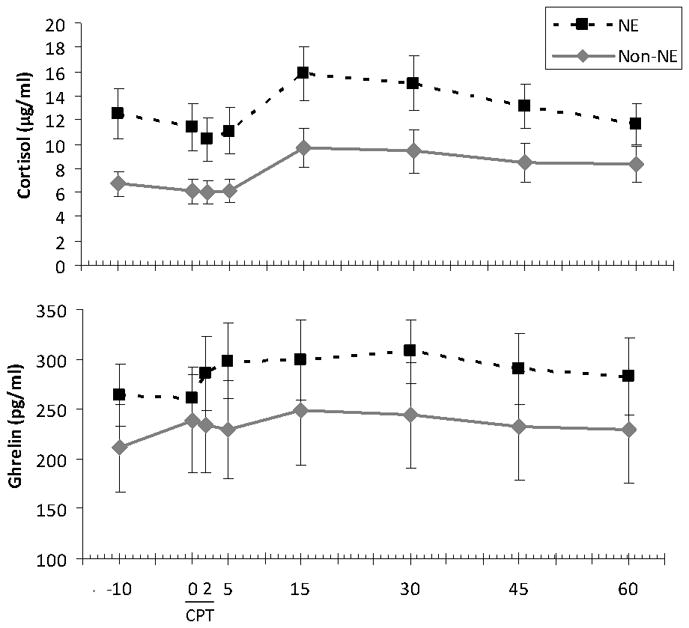
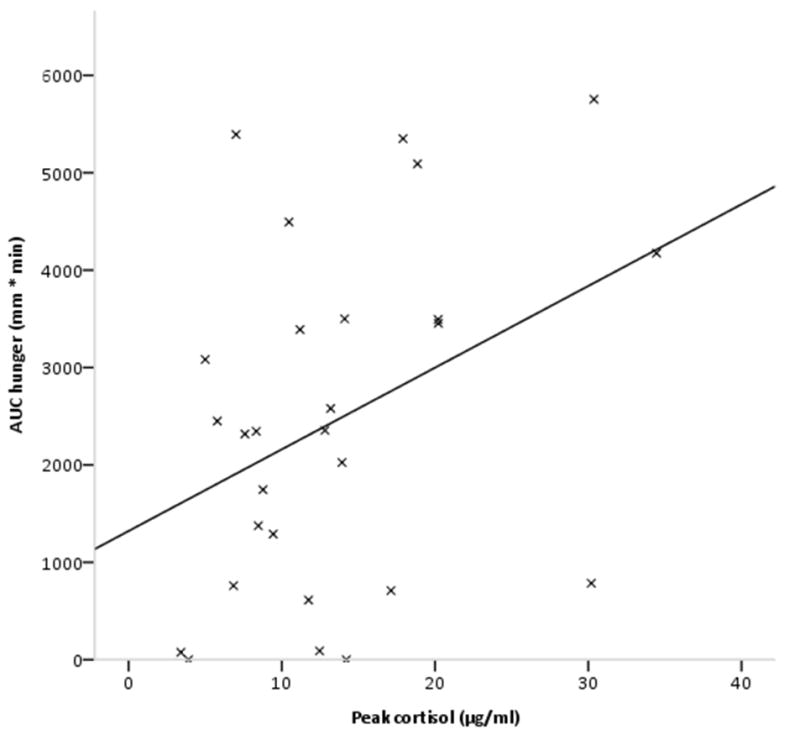
Results: Following the CPT, cortisol (P<0.001) and ghrelin (P<0.05) levels increased, as did stress and hunger ratings (all P<0.001), across all subjects (NE and non-NE). NE exhibited higher baseline cortisol (P<0.05) levels than non-NE. NE also had greater cortisol area under the curve (AUC) than non-NE (P=0.019), but not when controlling for baseline cortisol levels. Ghrelin baseline and AUC did not differ between groups. NE showed higher AUC stress (P<0.05), even when controlling for baseline stress.
Discussion: Overweight individuals showed increased cortisol, ghrelin, stress and hunger following a laboratory stressor, and there was some evidence for greater increases in cortisol and subjective stress among NE. The greater AUC cortisol level in NE was due to higher baseline levels, but the group difference in stress was in direct response to the stressor. Our results support a role for cortisol and stress in NE.
Conflict of interest statement
The authors declare no conflict of interest.
Figures
References
-
- Rand CS, Macgregor AM, Stunkard AJ. The night eating syndrome in the general population and among postoperative obesity surgery patients. Int J Eat Disord. 1997;22 (1):65–9. - PubMed
-
- Gluck ME, Geliebter A, Satov T. Night eating syndrome is associated with depression, low self-esteem, reduced daytime hunger, and less weight loss in obese outpatients 2001. Obes Res. 9(4):264–267. - PubMed
-
- Thompson OM, Ballew C, Resnicow K, Gillespie C, Must A, Bandini LG, et al. Dietary pattern as a predictor of change in BMI z-score among girls. Int J Obes (Lond) 2006;30 (1):176–82. - PubMed
-
- Marshall HM, Allison KC, O’Reardon JP, Birketvedt G, Stunkard AJ. Night eating syndrome among nonobese persons. Int J Eat Disord. 2004;35(2):217–22. - PubMed
Publication types
MeSH terms
Substances
Grants and funding
LinkOut - more resources
Full Text Sources
Other Literature Sources
Medical
