


Marked global reduction in mGluR5 receptor binding in smokers and ex-smokers determined by [11C]ABP688 positron emission tomography
- PMID: 23248277
- PMCID: PMC3545768
- DOI: 10.1073/pnas.1210984110
Marked global reduction in mGluR5 receptor binding in smokers and ex-smokers determined by [11C]ABP688 positron emission tomography
Abstract
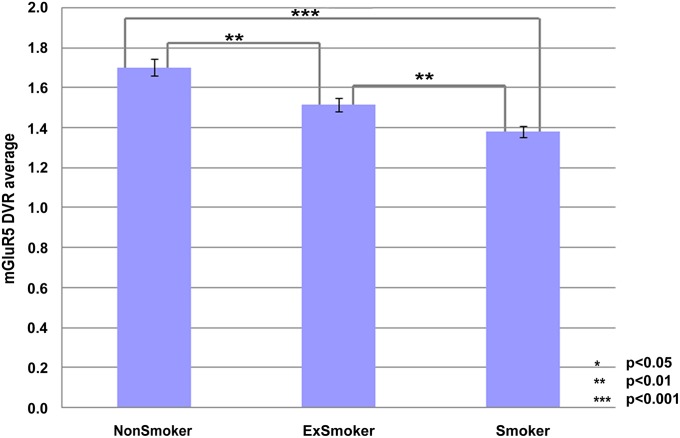
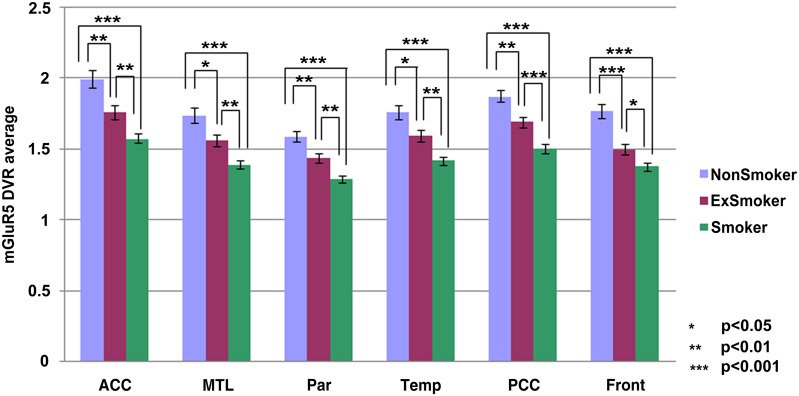
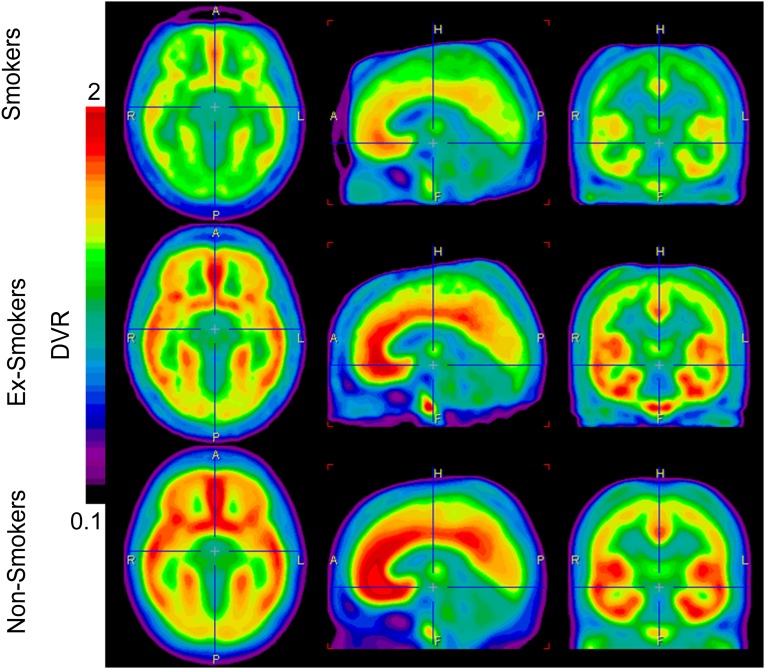
Nicotine addiction is a major public health problem, resulting in primary glutamatergic dysfunction. We measured the glutamate receptor binding in the human brain and provided direct evidence for the abnormal glutamate system in smokers. Because antagonism of the metabotropic glutamate receptor 5 (mGluR5) reduced nicotine self-administration in rats and mice, mGluR5 is suggested to be involved in nicotine addiction. mGluR5 receptor binding specifically to an allosteric site was observed by using positron emission tomography with [(11)C]ABP688. We found a marked global reduction (20.6%; P < 0.0001) in the mGluR5 distribution volume ratio (DVR) in the gray matter of 14 smokers. The most prominent reductions were found in the bilateral medial orbitofrontal cortex. Compared with 14 nonsmokers, 14 ex-smokers had global reductions in the average gray matter mGluR5 DVR (11.5%; P < 0.005), and there was a significant difference in average gray matter mGluR5 DVR between smokers and ex-smokers (9.2%; P < 0.01). Clinical variables reflecting current nicotine consumption, dependence and abstinence were not correlated with mGluR5 DVR. This decrease in mGluR5 receptor binding may be an adaptation to chronic increases in glutamate induced by chronic nicotine administration, and the decreased down-regulation seen in the ex-smokers could be due to incomplete recovery of the receptors, especially because the ex-smokers were abstinent for only 25 wk on average. These results encourage the development and testing of drugs against addiction that directly target the glutamatergic system.
Conflict of interest statement
Conflict of interest statement: B.G.M. and J.S. work for Novartis Pharma, which is developing and testing drugs targeting the mGlu5 receptor.
Figures
References
-
- Kalivas PW, Volkow ND. The neural basis of addiction: A pathology of motivation and choice. Am J Psychiatry. 2005;162(8):1403–1413. - PubMed
-
- Chiamulera C, et al. Reinforcing and locomotor stimulant effects of cocaine are absent in mGluR5 null mutant mice. Nat Neurosci. 2001;4(9):873–874. - PubMed
-
- Kenny PJ, et al. Metabotropic glutamate 5 receptor antagonist MPEP decreased nicotine and cocaine self-administration but not nicotine and cocaine-induced facilitation of brain reward function in rats. Ann N Y Acad Sci. 2003;1003:415–418. - PubMed
-
- Paterson NE, Semenova S, Gasparini F, Markou A. The mGluR5 antagonist MPEP decreased nicotine self-administration in rats and mice. Psychopharmacology (Berl) 2003;167(3):257–264. - PubMed
Publication types
MeSH terms
Substances
LinkOut - more resources
Full Text Sources
