. 2013 Jan 2;110(1):87-92.
doi: 10.1073/pnas.1216516110. Epub 2012 Dec 17.

Carboxylic acid reductase is a versatile enzyme for the conversion of fatty acids into fuels and chemical commodities

Affiliations

Carboxylic acid reductase is a versatile enzyme for the conversion of fatty acids into fuels and chemical commodities

M Kalim Akhtar et al. Proc Natl Acad Sci U S A. .

Abstract

Aliphatic hydrocarbons such as fatty alcohols and petroleum-derived alkanes have numerous applications in the chemical industry. In recent years, the renewable synthesis of aliphatic hydrocarbons has been made possible by engineering microbes to overaccumulate fatty acids. However, to generate end products with the desired physicochemical properties (e.g., fatty aldehydes, alkanes, and alcohols), further conversion of the fatty acid is necessary. A carboxylic acid reductase (CAR) from Mycobacterium marinum was found to convert a wide range of aliphatic fatty acids (C(6)-C(18)) into corresponding aldehydes. Together with the broad-substrate specificity of an aldehyde reductase or an aldehyde decarbonylase, the catalytic conversion of fatty acids to fatty alcohols (C(8)-C(16)) or fatty alkanes (C(7)-C(15)) was reconstituted in vitro. This concept was applied in vivo, in combination with a chain-length-specific thioesterase, to engineer Escherichia coli BL21(DE3) strains that were capable of synthesizing fatty alcohols and alkanes. A fatty alcohol titer exceeding 350 mg·L(-1) was obtained in minimal media supplemented with glucose. Moreover, by combining the CAR-dependent pathway with an exogenous fatty acid-generating lipase, natural oils (coconut oil, palm oil, and algal oil bodies) were enzymatically converted into fatty alcohols across a broad chain-length range (C(8)-C(18)). Together with complementing enzymes, the broad substrate specificity and kinetic characteristics of CAR opens the road for direct and tailored enzyme-catalyzed conversion of lipids into user-ready chemical commodities.


Conflict of interest statement

The authors declare no conflict of interest.

Figures

Fig. 1.
Fig. 1.
Conversion of biomass to fatty alcohols and alkanes. (A) Photoautotrophic organisms, via the harvesting of light energy, are able to generate primary carbon sources such as glucose or lipids that can be directed toward the synthesis of fatty alcohols and/or alkanes. AAR, acyl-ACP reductase; ACL, acyl-CoA ligase; ACP, acyl carrier protein; ACR, fatty acyl-CoA reductase [ACR1 (21) and ACR2 (25)]; ADC, cyanobacterial aldehyde decarbonylase; AHR, aldehyde reductase; CAR, carboxylic acid reductase; TES, thioesterase. (B) The catalytic cycle of CAR, adapted from ref. . (i) The fatty acid substrate enters the active site and binds within the vicinity of the ATP domain. (ii) An adenosyl moiety is added to the fatty acid, releasing diphosphate. (iii) The thiol group residing on the phosphopantetheine arm (angled solid line) reacts with the electrophilic carbonyl group, resulting in formation of a thioester bond. AMP is released in the process. (iv) The phosphopantetheine arm repositions the thioester intermediate within the NADPH domain. (v) The thioester intermediate is reduced, via hydride transfer from NADPH, to form the aldehyde product. The product along with NADP+ is released and the catalytic cycle is repeated.
Fig. 2.
Fig. 2.
The kinetic characterization of CARhis. (A) The observed and apparent kcat values were obtained for fatty acid substrates ranging from C4 to C18, including the C18 unsaturated counterparts. In addition, the (B) Km and (C) catalytic efficiencies (kcat/Km) were determined for the C4–C12 fatty acid substrates.
Fig. 3.
Fig. 3.
Application of the CAR enzyme for fatty alcohol and alkane synthesis. (A) In vivo production of fatty alcohols and alkanes. The introduced metabolic pathway is graphically illustrated at the top of A. The recombinant strains TPC- slr1192his (solid black line) and TPC-ADChis (solid blue line) were cultivated for 24 h at 30 °C, 180 rpm. A BL21 (DE3) control strain harboring “empty” plasmids was also included for comparison (solid gray line). After metabolite extraction (Methods), the following chromatographic peaks were identified: 1, C11 alkane; 2, C13 alkane ; 3, C12 aldehyde; 4, C12 alcohol; 5, C12:1 alcohol; 6, C15:1 alkene; 7, C14:1 aldehyde; 8, C14:1 alcohol; 9, C14 alcohol; 10, C17:1 alkene; 11, C14 fatty acid; 12, C16:1 alcohol; 13, C16 alcohol; 14, C16:1 fatty acid; 15, C16 fatty acid; 16, C18:1 alcohol; and 17, C18:1 fatty acid. (B) In vivo production of fatty alcohols in glucose-supplemented minimal media. Various E. coli strains (SI Appendix, Table S3) were cultivated in glucose-supplemented minimal media for up to 48 h. Intracellular fatty alcohol accumulation were determined at specific time intervals. (C) Effect of TesA, CAR, and Ahrhis on the in vivo production of fatty alcohols. All strains were cultivated in minimal media for 24 h at 180 rpm, 30 °C and the total fatty alcohol content was quantified from whole cell cultures (Methods).
Fig. 4.
Fig. 4.
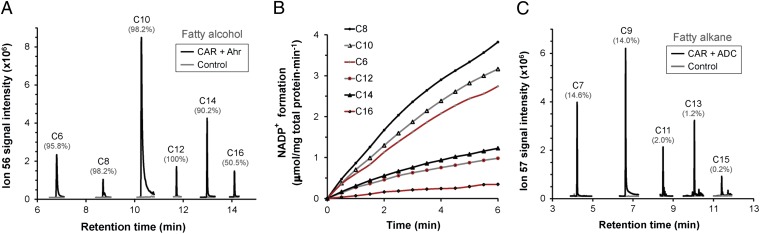
Broad-range conversion of fatty acids to fatty alcohols and alkanes. (A) In vitro formation of fatty alcohols. Reactions were carried out in 50 mM Tris⋅HCl buffer containing CARhis (10–200 μg·mL−1), Ahrhis (10 μg·mL−1), 1 mM ATP, 10 mM MgCl2, 1 mM NADPH, and 0.25 mM C6–C16 fatty acids. (B) In vitro rate of conversion of fatty acids to alcohols. Reactions were monitored at 340 nm for 6 min at 30-s intervals. (C) In vitro formation of alkanes. Same as A except Ahrhis was replaced with ADChis. In A and C, the percentage yield of product per substrate over a 4-h period is indicated in brackets above each peak.
Fig. 5.
Fig. 5.
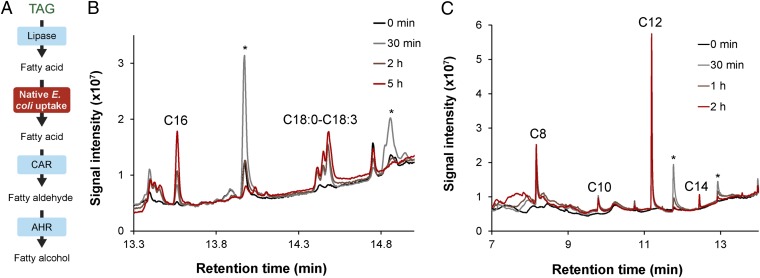
Conversion of natural oils to fatty alcohols. A simplified reaction scheme is shown in A. Harvested cells from a preinduced culture of PC-Ahr were resuspended in 50 mM potassium phosphate buffered medium, supplemented with glucose and lipase (0.1–1 mg·mL−1), and incubated at 30 °C with shaking at 150 rpm for up to 5 h in the presence of (B) algae (C. reinhardtii strain cc406) or (C) coconut oil. *Fatty acid intermediate.

References

    1. Keasling JD. Manufacturing molecules through metabolic engineering. Science. 2010;330(6009):1355–1358. - PubMed
    1. Keasling JD. Synthetic biology and the development of tools for metabolic engineering. Metab Eng. 2012;14(3):189–195. - PubMed
    1. Chan DI, Vogel HJ. Current understanding of fatty acid biosynthesis and the acyl carrier protein. Biochem J. 2010;430(1):1–19. - PubMed
    1. Liu T, Vora H, Khosla C. Quantitative analysis and engineering of fatty acid biosynthesis in E. coli. Metab Eng. 2010;12(4):378–386. - PubMed
    1. Liu X, Brune D, Vermaas W, Curtiss R., III Production and secretion of fatty acids in genetically engineered cyanobacteria. Proc Natl Acad Sci USA. 2010;108(17):6899–6904. - PubMed

Publication types

LinkOut - more resources