


The corneal volume and biomechanical corneal factors: Is there any orrelation?
- PMID: 23248654
- PMCID: PMC3523435
The corneal volume and biomechanical corneal factors: Is there any orrelation?
Abstract
Background: The aim of this study was to determine the correlation between corneal hysteresis (CH) and the corneal resistance factor (CRF), which are both novel methods of analyzing ocular rigidity/elasticity, and various corneal characteristics, mainly corneal volume in normal subjects.
Methods: This cross-sectional study included 500 normal eyes of volunteers. An ocular response analyzer (ORA) was used to measure CH and CRF. Patient age and the Pentacam-measured corneal volume (CV), posterior elevation, anterior elevation, corneal curvature, central corneal thickness (CCT), corneal thickness of apex (CTA), and corneal thinnest thickness (CTT) were compared with CH and CRF. Statistical significance was defined at p < 0.05.
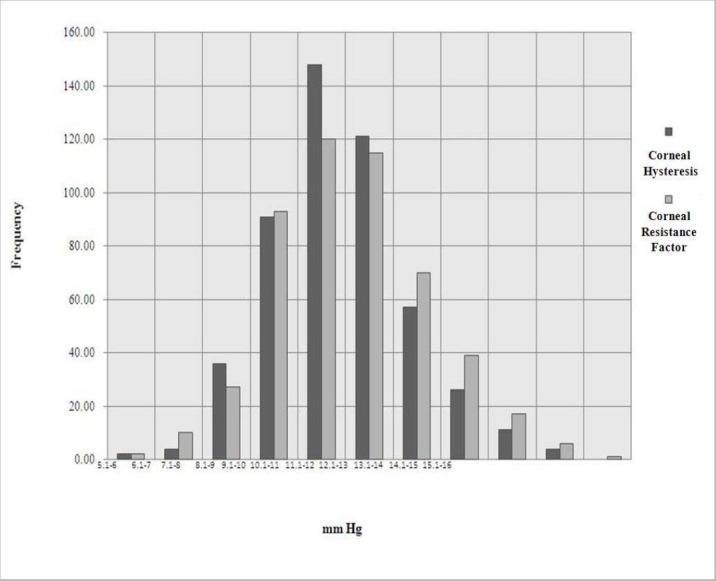
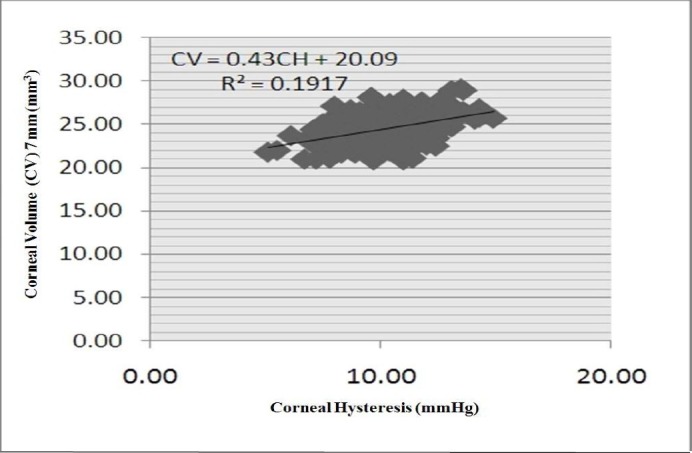
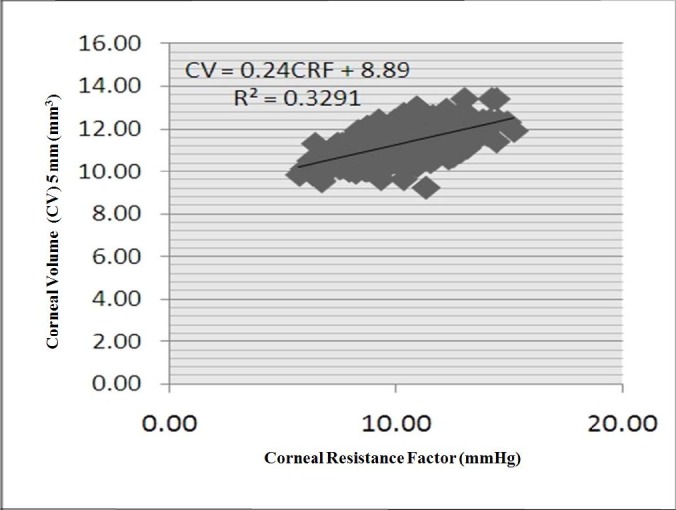
Results: The mean CH and CRF for all eyes were 9.9 ± 1.4 mmHg and 10.1 ± 1.6 mmHg, respectively. The mean CVs of the 3, 5, 7, and 10 mm zones for all eyes were 3.8 ± 0.2 mm(3), 11.2 ± 0.6 mm(3), 24.3 ± 1.4 mm(3), and 60.1 ± 3.5 mm(3), respectively. The correlations between CV and the hysteresis or CRF were significant in all zones. The CV of the 7-mm zone had the strongest correlation with CH (r = 0.438) and the CV of the 5-mm zone had the strongest correlation with CRF (r = 0.574).
Conclusions: CH and CRF correlate with CV. Moreover, the correlation between CV and CRF is stronger than that between CV and CH. The CV may be valuable for determining patient's qualification for and predicting the outcome of refractive surgery. It would also be helpful in other cases in which corneal biomechanics are important.
Keywords: Cornea; Corneal Biomechanics; Corneal Hysteresis; Corneal Resistance Factor; Corneal Thickness; Corneal Volume; Ocular Response Analyz-er; Pentacam.
Conflict of interest statement
Figures
References
-
- Hjortdal JO, Jensen PK. In vitro measurement of corneal strain, thickness, and curvature using digital image processing. Acta Ophthalmologica Scandinavica. 1995;73(1):5–11. - PubMed
-
- Shah S, Laiquzzaman M, Cunliffe I, Mantry S. The use of the Reichert ocular response analyser to establish the relationship between ocular hysteresis, corneal resistance factor and central corneal thickness in normal eyes. Cont Lens Anterior Eye. 2006;29(5):257–62. - PubMed
-
- Shah S, Laiquzzaman M, Yeung I, Pan X, Roberts C. The use of the Ocular Response Analyser to determine corneal hysteresis in eyes before and after excimer laser refractive surgery. Cont Lens Anterior Eye. 2009;32(3):123–8. - PubMed
-
- Luce DA. Determining in vivo biomechanical properties of the cornea with an ocular response analyzer. J Cataract Refract Surg. 2005;31(1):156–62. - PubMed
-
- Cervino A, Gonzalez-Meijome JM, Ferrer-Blasco T, Garcia-Resua C, Montes-Mico R, Parafita M. Determination of corneal volume from anterior topography and topographic pachymetry: application to healthy and keratoconic eyes. Ophthalmic Physiol Opt. 2009;29(6):652–60. - PubMed
LinkOut - more resources
Full Text Sources
Miscellaneous