Review
. 2013 Mar;9(3):457-61.
doi: 10.4161/hv.23220. Epub 2012 Dec 18.

Applications and challenges of multivalent recombinant vaccines

Affiliations
Review

Applications and challenges of multivalent recombinant vaccines

Hussein Y Naim. Hum Vaccin Immunother. 2013 Mar.

Abstract

The exceptional discoveries of antigen/gene delivery systems have allowed the development of novel prophylactic and therapeutic vaccine candidates. The vaccine candidates employ various antigen-delivery systems, particularly recombinant viral vectors. Recombinant viral vectors are experimental vaccines similar to DNA vaccines, but they use attenuated viruses or bacterium as a carrier "vector" to introduce microbial DNA to cells of the body. They closely mimic a natural infection and therefore can efficiently stimulate the immune system. Although such recombinant vectors may face extensive preclinical testing and will possibly have to meet stringent regulatory requirements, some of these vectors (e.g. measles virus vectors) may benefit from the profound industrial and clinical experience of the parent vaccine. Most notably, novel vaccines based on live attenuated viruses combine the induction of broad, strong and persistent immune responses with acceptable safety profiles. We assess certain technologies in light of their use against human immunodeficiency virus (HIV).

Keywords: DNA; HIV; SIV; live attenuated viruses; measles; recombinant vectors; reverse genetics; vaccines.


Figures
None
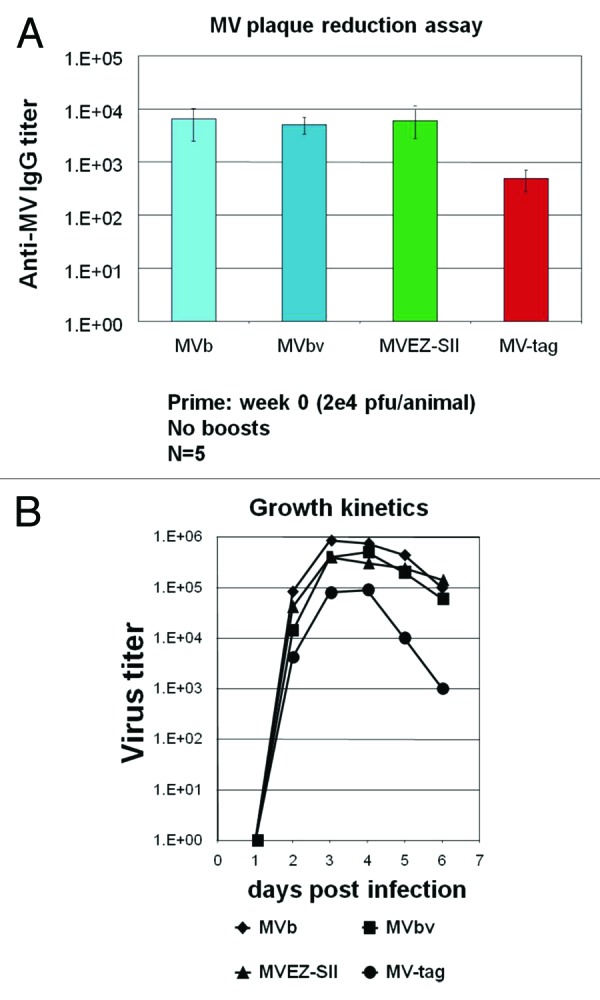
Figure 1. Comparison of the cloned MV vaccine with various commercially available MV vaccine strains and a “lab-strain.” (A) Transgenic mice expressing human CD46 were immunized i.m. with 1 × 10⁴ pfu of an authentic cloned vaccine (rMVb), a Moraten vaccine (MVbv), Edmonston Zagreb vaccine (MVEZII) and a “lab strain” MVtag. Measles end point titers are shown on a logarithmic scale. (B) Growth kinetic analyses. Comparison of the propagation kinetics of the standard MVbv, cloned MVb and the MVEZII compared to the “lab strain” MVtag. Sub-confluent Cells were infected with the designated viruses and incubated at 31°C, media were collected every day up to 6 days. The shed viruses were titrated by plaque assays.

References

    1. Plotkin SA. Vaccines: past, present and future. Nat Med. 2005;11(Suppl):S5–11. doi: 10.1038/nm1209. - DOI - PMC - PubMed
    1. Plotkin SA, Gilbert PB. Nomenclature for immune correlates of protection after vaccination. Clin Infect Dis. 2012;54:1615–7. doi: 10.1093/cid/cis238. - DOI - PMC - PubMed
    1. Girard MP, Plotkin SA. HIV vaccine development at the turn of the 21st century. Curr Opin HIV AIDS. 2012;7:4–9. doi: 10.1097/COH.0b013e32834ddc96. - DOI - PubMed
    1. Johnston MI, Fauci AS. An HIV vaccine--challenges and prospects. N Engl J Med. 2008;359:888–90. doi: 10.1056/NEJMp0806162. - DOI - PubMed
    1. Reyes-Sandoval A, Harty JT, Todryk SM. Viral vector vaccines make memory T cells against malaria. Immunology. 2007;121:158–65. doi: 10.1111/j.1365-2567.2006.02552.x. - DOI - PMC - PubMed

Publication types

MeSH terms

LinkOut - more resources
