Review
. 2013 May;15(5):701-8.
doi: 10.1111/cmi.12091. Epub 2013 Jan 14.

Two unlike cousins: Candida albicans and C. glabrata infection strategies

Affiliations
Free PMC article
Review

Two unlike cousins: Candida albicans and C. glabrata infection strategies

Sascha Brunke et al. Cell Microbiol. 2013 May.
Free PMC article

Abstract

Candida albicans and C. glabrata are the two most common pathogenic yeasts of humans, yet they are phylogenetically, genetically and phenotypically very different. In this review, we compare and contrast the strategies of C. albicans and C. glabrata to attach to and invade into the host, obtain nutrients and evade the host immune response. Although their strategies share some basic concepts, they differ greatly in their outcome. While C. albicans follows an aggressive strategy to subvert the host response and to obtain nutrients for its survival, C. glabrata seems to have evolved a strategy which is based on stealth, evasion and persistence, without causing severe damage in murine models. However, both fungi are successful as commensals and as pathogens of humans. Understanding these strategies will help in finding novel ways to fight Candida, and fungal infections in general.


Figures

Fig. 1
Fig. 1
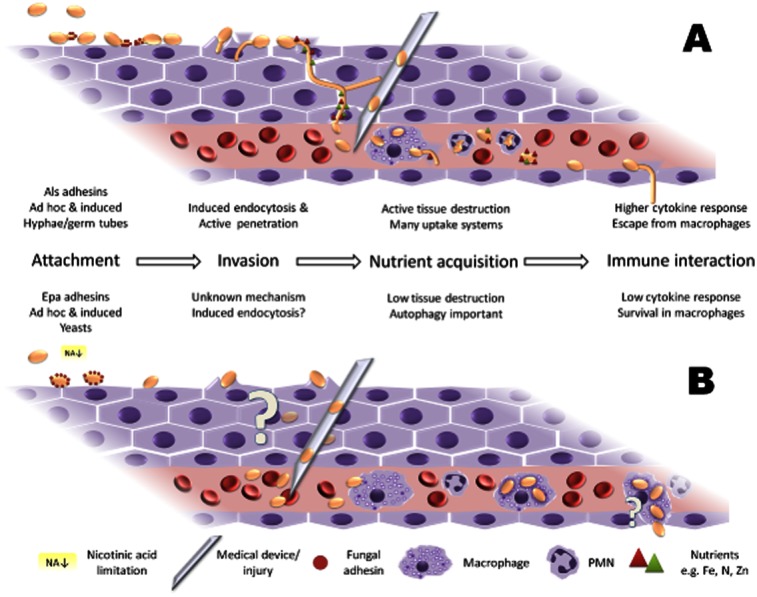
Schematic overview of the two different infection strategies of C. albicans and C. glabrata. A. C. albicans forms hyphae and aggressively destroys tissue, eliciting a strong immune response. B. Many aspects of C. glabrata pathogenicity are still unknown, like the precise mechanism of invasion. Active host tissue damage is low, as is the immune response. For a detailed description of the individual steps, see the related sections in the text.

References

    1. Almeida RS, Brunke S, Albrecht A, Thewes S, Laue M, Edwards JE, et al. The hyphal-associated adhesin and invasin Als3 of Candida albicans mediates iron acquisition from host ferritin. PLoS Pathog. 2008;4:e1000217. - PMC - PubMed
    1. Almeida RS, Wilson D, Hube B. Candida albicans iron acquisition within the host. FEMS Yeast Res. 2009;9:1000–1012. - PubMed
    1. Alvarez M, Casadevall A. Phagosome extrusion and host-cell survival after Cryptococcus neoformans phagocytosis by macrophages. Curr Biol. 2006;16:2161–2165. - PubMed
    1. Argimon S, Wishart JA, Leng R, Macaskill S, Mavor A, Alexandris T, et al. Developmental regulation of an adhesin gene during cellular morphogenesis in the fungal pathogen Candida albicans. Eukaryot Cell. 2007;6:682–692. - PMC - PubMed
    1. Bain JM, Lewis LE, Okai B, Quinn J, Gow NA, Erwig LP. Non-lytic expulsion/exocytosis of Candida albicans from macrophages. Fungal Genet Biol. 2012;49:677–678. - PMC - PubMed

Publication types

MeSH terms