. 2013 Jan 15;12(2):346-52.
doi: 10.4161/cc.23199. Epub 2012 Jan 15.

Spermidine promotes mating and fertilization efficiency in model organisms

Affiliations

Spermidine promotes mating and fertilization efficiency in model organisms

Maria Anna Bauer et al. Cell Cycle. .

Abstract

Spermidine is a naturally occurring polyamine involved in multiple biological processes, including DNA metabolism, autophagy and aging. Like other polyamines, spermidine is also indispensable for successful reproduction at several stages. However, a direct influence on the actual fertilization process, i.e., the fusion of an oocyte with a spermatocyte, remains uncertain. To explore this possibility, we established the mating process in the yeast Saccharomyces cerevisiae as a model for fertilization in higher eukaryotes. During human fertilization, the sperm capacitates and the acrosome reaction is necessary for penetration of the oocyte. Similarly, sexually active yeasts form a protrusion called "shmoo" as a prerequisite for mating. In this study, we demonstrate that pheromone-induced shmoo formation requires spermidine. In addition, we show that spermidine is essential for mating in yeast as well as for egg fertilization in the nematode Caenorhabditis elegans. In both cases, this occurs independently from autophagy. In synthesis, we identify spermidine as an important mating component in unicellular and multicellular model organisms, supporting an unprecedented evolutionary conservation of the mechanisms governing fertilization-related cellular fusion.

Keywords: Caenorhabditis elegans; Saccharomyces cerevisiae; autophagy; fertilization; mating; sexual reproduction; shmoo; spermidine.


Figures
None
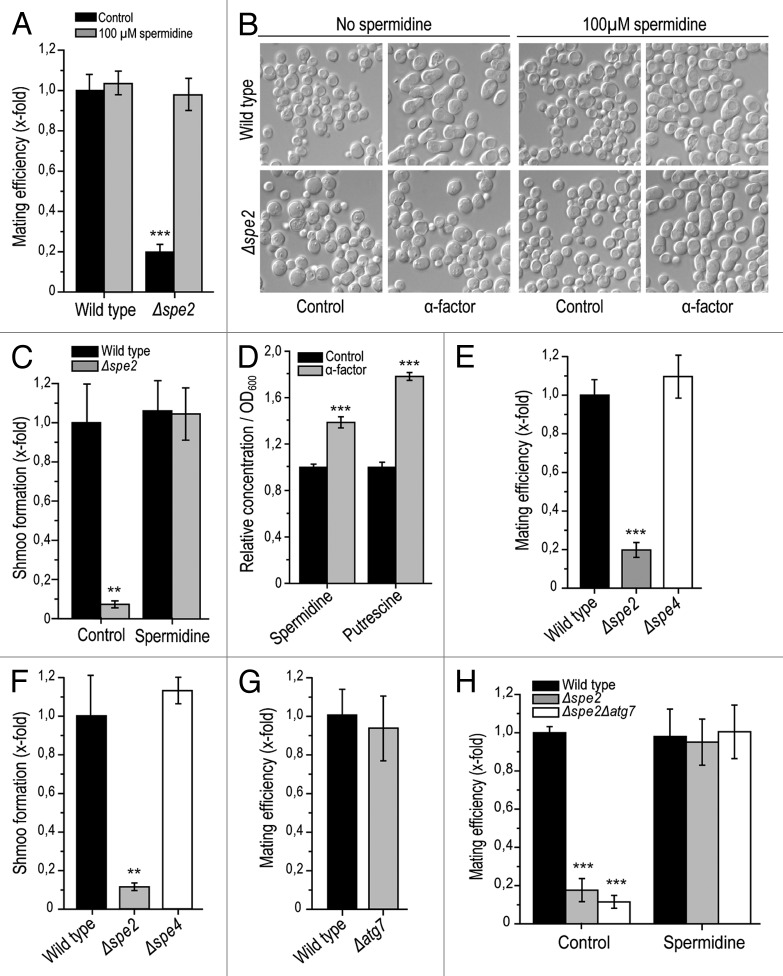
Figure 1. Yeast mating efficiency and shmoo formation depends on the availability of spermidine but is autophagy-independent. (A) Mating efficiency of wild-type and Δspe2 cells with or without external administration of 100 µM spermidine as determined via clonogenic mating assay. Mating efficiency of wild-type control was set at 1. Data represent mean ± S.E.M. (n = 3; ***p < 0.001). (B) Representative sample pictures of wild-type and Δspe2 cells (MATa) after treatment with 1 µM α -pheromone for 3 h with or without external administration of 100 µM spermidine. (C) Microscopic quantification of cells treated as described in (B) and displaying a shmoo. Only viable cells were considered, and at least 3,000 cells per strain and experiment were manually counted. The portion of cells displaying a shmoo was normalized to that of the untreated wild type control, which was set at 1. Data represent means ± S.E.M (n = 4; **p < 0.01). (D) Relative intracellular concentration of spermidine and its precursor putrescine per OD600 of wild-type cells (mating type a) either treated with 1 µM α-pheromone or left untreated (control), as determined using LC/MS/MS and normalized to the intracellular concentrations of the untreated control. Data represent means ±S.E.M. (n = 5; ***p < 0.001). (E) Mating efficiency of wild-type, Δspe2 and Δspe4 strains. Data were determined via clonogenic mating assay and represent means ± S.E.M. (n = 3; ***p < 0.001). (F) Shmoo-formation in wild-type, Δspe2 and Δspe4 cells (mating type a) after treatment with 1 µM α-pheromone for 3 h (compare to Fig. 1B). Data represent means ± S.E.M. (n = 4; **p < 0.01). (G) Mating efficiency of wild-type and Δatg7 cells. Data were determined via clonogenic mating assay and represent means ± S.E.M. (n = 3; ***p < 0.001). Mating efficiency of wild-type control was set at 1. (H) Mating efficiency of wild-type, Δspe2 and Δspe2Δatg7 strains with or without external administration of 100 µM spermidine. Data was determined via clonogenic mating assays and represent means ± S.E.M. (n = 3; ***p < 0.001). Mating efficiency of wild-type control was set at 1.
None
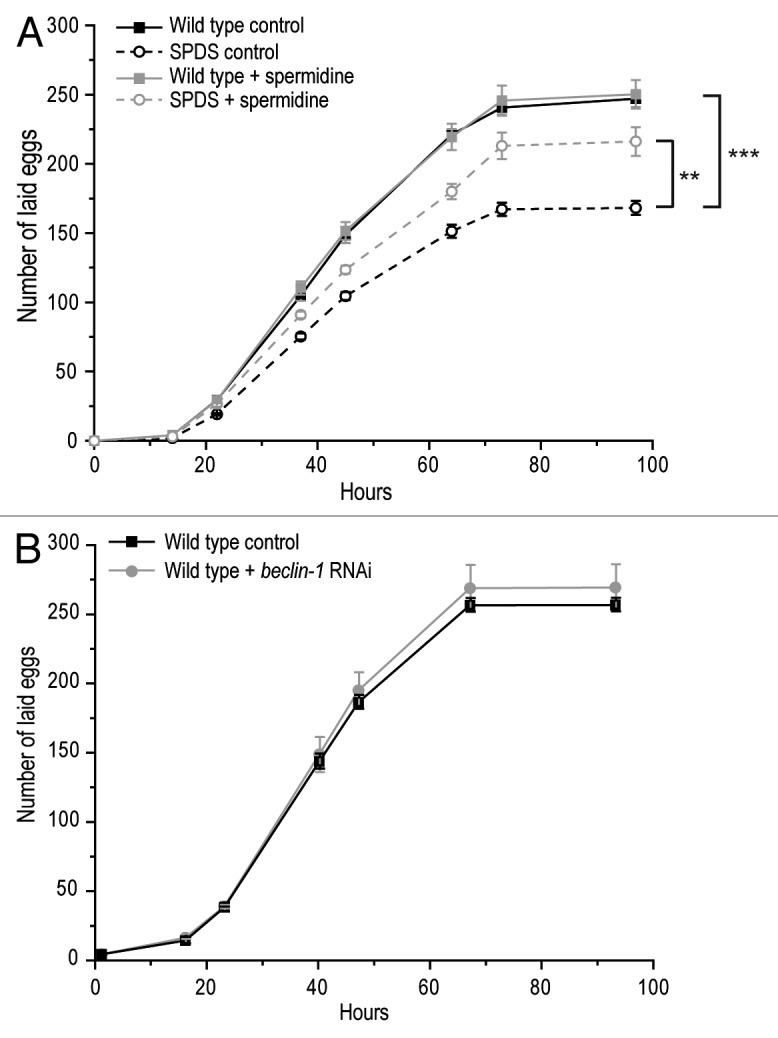
Figure 2. Fertilization in C. elegans is modulated by spermidine. (A) Total number of fertilized eggs laid by wild-type and spermidine synthase (SPDS-1)-deficient worms, fed with or without 50 µM spermidine-supplemented food. Data represent mean ± S.E.M. (n = 5; **p < 0.01, ***p < 0.001). (B) Total number of fertilized eggs laid by wild-type and bec-1-deficient worms. Data represent mean ±S.E.M. (n = 5).

Comment in

  • Sperm(idine) answers the next generation.
    Gupta VK, Sigrist SJ. Gupta VK, et al. Cell Cycle. 2013 Feb 15;12(4):542-3. doi: 10.4161/cc.23676. Epub 2013 Jan 31. Cell Cycle. 2013. PMID: 23370387 Free PMC article. No abstract available.

References

    1. Phillips KP, Tanphaichitr N. Human exposure to endocrine disrupters and semen quality. J Toxicol Environ Health B Crit Rev. 2008;11:188–220. doi: 10.1080/10937400701873472. - DOI - PubMed
    1. Lefèvre PL, Palin MF, Murphy BD. Polyamines on the reproductive landscape. Endocr Rev. 2011;32:694–712. doi: 10.1210/er.2011-0012. - DOI - PubMed
    1. Calandra RS, Rulli SB, Frungieri MB, Suescun MO, González-Calvar SI. Polyamines in the male reproductive system. Acta Physiol Pharmacol Ther Latinoam. 1996;46:209–22. - PubMed
    1. Shohat B, Maayan R, Singer R, Sagiv M, Kaufman H, Zukerman Z. Immunosuppressive activity and polyamine levels of seminal plasma in azo-ospermic, oligospermic, and normospermic men. Arch Androl. 1990;24:41–50. doi: 10.3109/01485019008986857. - DOI - PubMed
    1. Stewart AF, Kim ED. Fertility concerns for the aging male. Urology. 2011;78:496–9. doi: 10.1016/j.urology.2011.06.010. - DOI - PubMed

Publication types