Review
. 2013;5(4):348-57.
doi: 10.1159/000345943. Epub 2012 Dec 21.

Tissue-specific neutrophil recruitment into the lung, liver, and kidney

Affiliations
Review

Tissue-specific neutrophil recruitment into the lung, liver, and kidney

Jan Rossaint et al. J Innate Immun. 2013.

Abstract

The recruitment of immune cells is crucial for the development of inflammatory processes. The classical recruitment cascade of neutrophils into inflamed tissues is well understood and consists of capturing, rolling, slow rolling, arrest, postadhesion strengthening, crawling, and transmigration. While this commonly agreed paradigm might be applicable to most peripheral tissues, recruitment mechanisms may substantially vary in different organs such as the lung, liver, and kidney. These organs are highly specialized tissues with unique cell populations and structural organization, which enables them to fulfill their individual functions. The published research over the last decade has shed some light on organ-specific mechanisms of neutrophil recruitment and helped to generate a deeper understanding of the specific recruitment mechanisms involved in this process. The aim of this review is to highlight current concepts of tissue-specific differences and similarities of neutrophil recruitment into the lung, liver, and kidney.


Figures

Fig. 1
Fig. 1
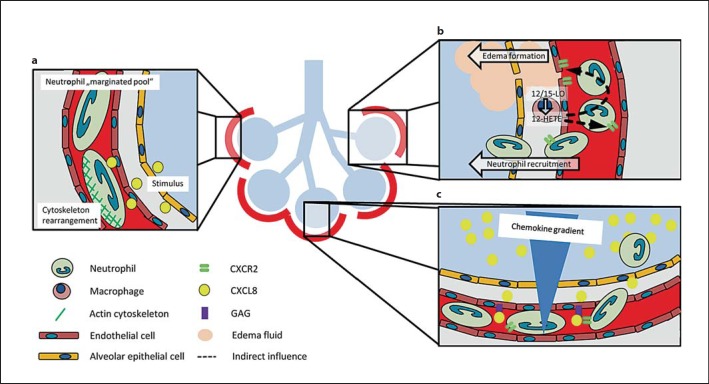
Neutrophil recruitment into the lung. a Neutrophils have to change their shape to squeeze through the small vessels of the pulmonary microcirculation. The increased transit time results in a marginated neutrophil pool in the lung. Neutrophil stiffening by cytoskeleton rearrangement after stimulation participates in neutrophil recruitment into the lung. b The lipid mediator 12-HETE produced by 12/15-LO in lung macrophages modulates chemokine-chemokine receptor balance and increases vascular permeability and neutrophil recruitment in ALI. c A chemokine gradient with the highest chemokine concentration in the alveolar compartment and the presentation of chemokines by glycosaminoglycans facilitate neutrophil recruitment into the alveolar compartment.
Fig. 2
Fig. 2
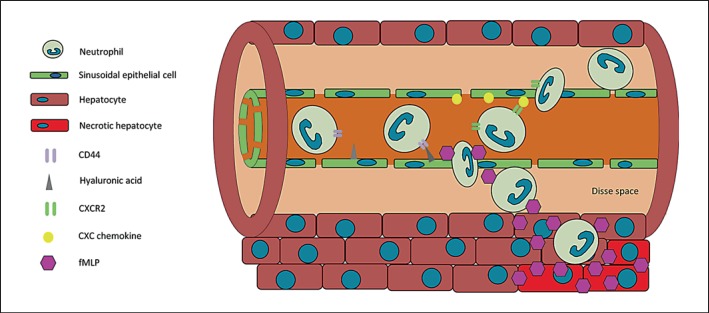
Neutrophil recruitment into the liver. Neutrophils are recruited in the sinusoids of the liver by chemokines and by binding of CD44 to hyaluronic acid on sinusoidal endothelial cells. The release of inflammatory mediators, such as fMLP, participates in the recruitment of intravascular neutrophils to sites of liver injury.
Fig. 3
Fig. 3
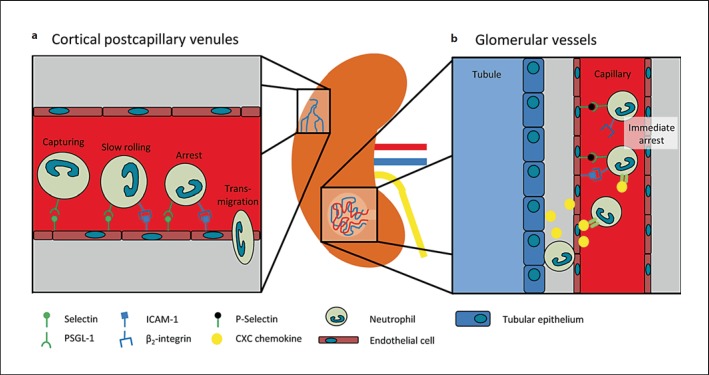
Neutrophil recruitment into the kidney. a Neutrophil recruitment in the cortical vessels of the kidney is E-selectin dependent and involves selectin-mediated capturing and the transition from rolling to slow rolling by the binding of the β2-integrin LFA-1 on neutrophils to ICAM-1 on endothelial cells. b Neutrophil recruitment in the glomerular capillaries is mediated by the interaction of P-selectin binding to PSGL-1 on neutrophils and results in chemokine-triggered β2-integrin-dependent arrest without prior rolling.
None

References

    1. Hanna S, Etzioni A. Leukocyte adhesion deficiencies. Ann NY Acad Sci. 2012;1250:50–55. - PubMed
    1. Pinheiro da Silva F, Soriano FG. Neutrophils recruitment during sepsis: critical points and crossroads. Front Biosci. 2009;14:4464–4476. - PubMed
    1. Ley K, Laudanna C, Cybulsky MI, Nourshargh S. Getting to the site of inflammation: the leukocyte adhesion cascade updated. Nat Rev Immunol. 2007;7:678–689. - PubMed
    1. Zarbock A, Ley K, McEver RP, Hidalgo A. Leukocyte ligands for endothelial selectins: specialized glycoconjugates that mediate rolling and signaling under flow. Blood. 2011;118:6743–6751. - PMC - PubMed
    1. Zarbock A, Lowell CA, Ley K. Spleen tyrosine kinase Syk is necessary for E-selectin-induced alpha(L)beta(2) integrin-mediated rolling on intercellular adhesion molecule-1. Immunity. 2007;26:773–783. - PMC - PubMed

Publication types