


Microevolutionary analysis of Clostridium difficile genomes to investigate transmission
- PMID: 23259504
- PMCID: PMC4056369
- DOI: 10.1186/gb-2012-13-12-r118
Microevolutionary analysis of Clostridium difficile genomes to investigate transmission
Abstract
Background: The control of Clostridium difficile infection is a major international healthcare priority, hindered by a limited understanding of transmission epidemiology for these bacteria. However, transmission studies of bacterial pathogens are rapidly being transformed by the advent of next generation sequencing.
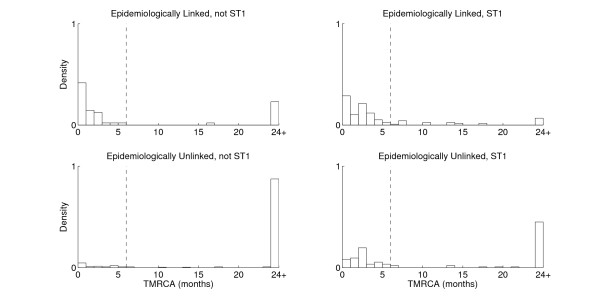
Results: Here we sequence whole C. difficile genomes from 486 cases arising over four years in Oxfordshire. We show that we can estimate the times back to common ancestors of bacterial lineages with sufficient resolution to distinguish whether direct transmission is plausible or not. Time depths were inferred using a within-host evolutionary rate that we estimated at 1.4 mutations per genome per year based on serially isolated genomes. The subset of plausible transmissions was found to be highly associated with pairs of patients sharing time and space in hospital. Conversely, the large majority of pairs of genomes matched by conventional typing and isolated from patients within a month of each other were too distantly related to be direct transmissions.
Conclusions: Our results confirm that nosocomial transmission between symptomatic C. difficile cases contributes far less to current rates of infection than has been widely assumed, which clarifies the importance of future research into other transmission routes, such as from asymptomatic carriers. With the costs of DNA sequencing rapidly falling and its use becoming more and more widespread, genomics will revolutionize our understanding of the transmission of bacterial pathogens.
Figures

References
-
- Bartlett JG. The new epidemic of Clostridium difficile - associated enteric disease. Ann Intern Med. 2006;13:758–764. - PubMed
-
- Killgore G, Thompson A, Johnson S, Brazier J, Kuijper E, Pepin J, Frost EH, Savelkoul P, Nicholson B, van den Berg RJ, Kato H, Sambol SP, Zukowski W, Woods C, Limbago B, Gerding DN, McDonald LC. Comparison of seven techniques for typing international epidemic strains of Clostridium difficile: restriction endonuclease analysis, pulsed-field gel electrophoresis, PCR-ribotyping, multilocus sequence typing, multilocus variable-number tandem-repeat analysis, amplified fragment length polymorphism, and surface layer protein A gene sequence typing. J Clin Microbiol. 2008;13:431–437. doi: 10.1128/JCM.01484-07. - DOI - PMC - PubMed
-
- Loo VG, Poirier L, Miller MA, Oughton M, Libman MD, Michaud S, Bourgault A-M, Nguyen T, Frenette C, Kelly M, Vibien A, Brassard P, Fenn S, Dewar K, Hudson TJ, Horn R, René P, Monczak Y, Dascal A. A predominantly clonal multi-institutional outbreak of Clostridium difficile-associated diarrhea with high morbidity and mortality. N Engl J Med. 2005;13:2442–2449. doi: 10.1056/NEJMoa051639. - DOI - PubMed
Publication types
MeSH terms
Associated data
Grants and funding
LinkOut - more resources
Full Text Sources
Other Literature Sources
