. 2012 Dec;45(12):724-9.
doi: 10.5483/bmbrep.2012.45.12.039.

The effects of Caffeoylserotonin on inhibition of melanogenesis through the downregulation of MITF via the reduction of intracellular cAMP and acceleration of ERK activation in B16 murine melanoma cells

Affiliations

The effects of Caffeoylserotonin on inhibition of melanogenesis through the downregulation of MITF via the reduction of intracellular cAMP and acceleration of ERK activation in B16 murine melanoma cells

Hye-Eun Kim et al. BMB Rep. 2012 Dec.

Abstract

In this study, we evaluated the anti-melanogenesis effects of Caffeoylserotonin (CaS) in B16 melanoma cells. Treatment with CaS reduced the melanin content and tyrosinase (TYR) activity in B16 melanoma cells in a dose-dependent manner. CaS inhibited the expression of melanogenesis-related proteins, including microphthalmia- associated transcription factor (MITF), TYR, and tyrosinase-related protein-1 (TRP-1), but not TRP-2. α-MSH is known to interact with melanocortin 1 receptor (MC1R) thus activating adenylyl cyclase and increasing intracellular cyclic AMP (cAMP) levels. Furthermore, cAMP activates extracellular signal-regulated kinase 2 (ERK2) via phosphorylation, which phosphorylates MITF, thereby targeting the transcription factor to proteasomes for degradation. The CaS reduced intracellular cAMP levels to unstimulated levels and activated ERK phosphorylation within 30 min. The ERK inhibitor PD98059 abrogated the suppressive effect of CaS on α-MSH-induced melanogenesis. Based on this study, the inhibitory effects of CaS on melanogenesis are derived from the downregulation of MITF signaling via the inhibition of intracellular cAMP levels, as well as acceleration of ERK activation.


Figures
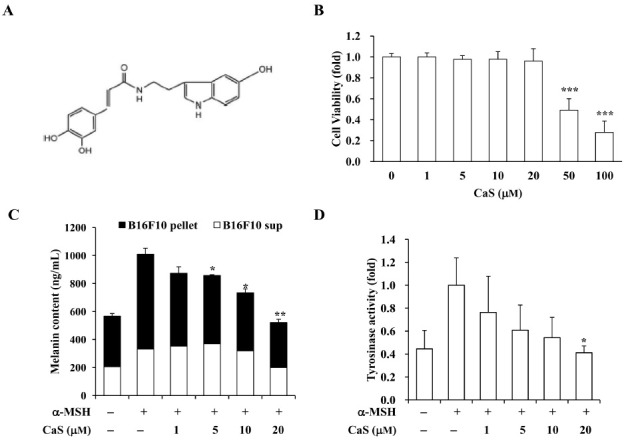
Fig. 1.
Fig. 1.. The inhibitory effects of CaS on melanogenesis in B16F10 melanocytes. (A) The structure of CaS. (B) Cellular toxicity of CaS. The B16F10 cells were treated with various concentrations of CaS (1-100 μM) for 24 h. The data are expressed as the means ± SD of three independent experiments. ***P < 0.0001 vs. the untreated control. CaS reduces melanin content (C) and TYR activity (D). The B16F10 cells were incubated in the presence or absence of α-MSH (100 nM) and then treated with different concentrations of CaS (1, 5, 10, and 20 mM) for 24 h. The white bar indicates the melanin content of the supernatant, while the black bar indicates the melanin content of the cell pellets. The total melanin content was calculated as the sum of the melanin content from the supernatant and its cell pellet for each sample. The data are expressed as the means ± SD of three independent experiments. *P < 0.01, **P < 0.001 vs. the α-MSH-treated control.
Fig. 2.
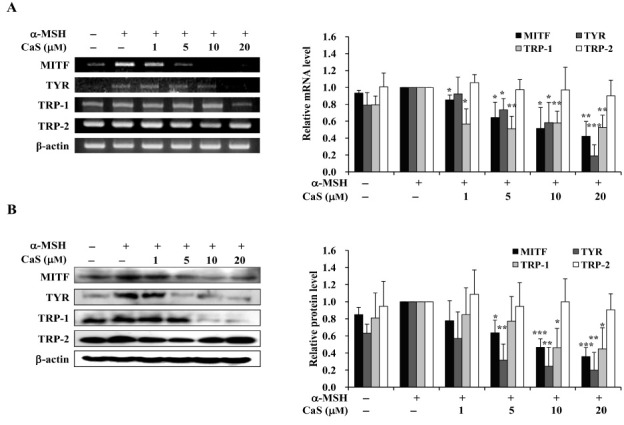
Fig. 2.. Effects of CaS on the expression of melanogenesis-related genes. The B16F10 cells were incubated in the presence of α-MSH and then treated with different concentrations of CaS (1, 5, 10, and 20 μM) for 24 h. (A) Total RNA was extracted and analyzed by RT-PCR for the expression of MITF, TYR, TRP-1, and TRP-2. PCR product levels were measured by densitometry, with the values from CaS-treated cells being quantified relative to the α-MSH-treated control. (B) Intracellular TYR, TRP-2, TRP-1, and MITF levels were measured by Western blotting. Protein levels were quantified by densitometry relative to those of the α-MSH-treated control (after normalisation relative to β-actin, shown just below the gel data). *P < 0.01, **P < 0.001, and ***P < 0.0001 vs. the α-MSH-treated control.
Fig. 3.
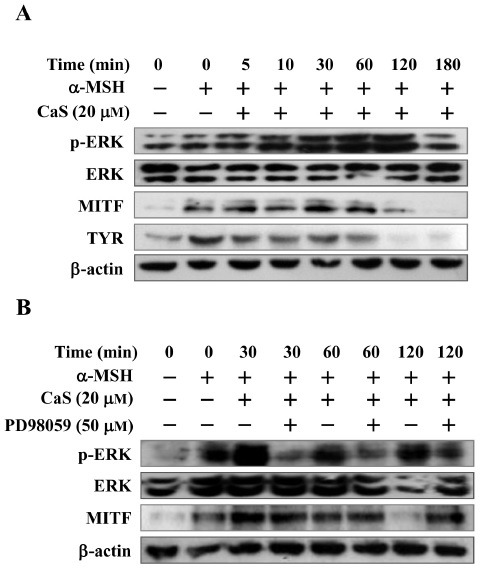
Fig. 3.. Effects of CaS on the phosphorylation of ERK in B16F10 cells. (A) Melanocytes were treated with α-MSH and 20 μM CaS for the indicated times. (B) Cells were treated with α-MSH and 20 μM CaS for the indicated times in the presence or absence of PD98059 (50 μM). Whole-cell lysates were then subjected to Western blotting using antibodies against ERK, p-ERK, MITF, and TYR. Equal protein loading was confirmed by reaction with β-actin.
Fig. 4.
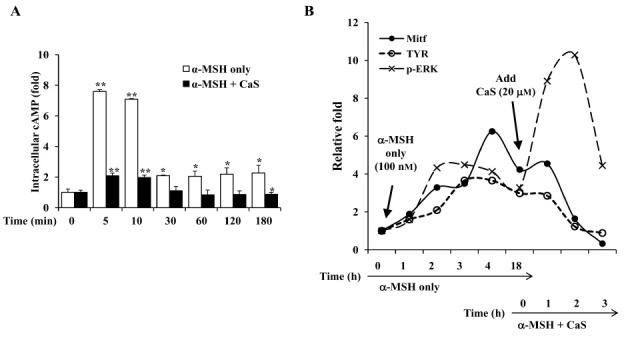
Fig. 4.. Effects of CaS on the intracellular cAMP levels and expression of melanogenesis-related proteins in B16F10 cells. (A) Effects of α-MSH on intracellular cAMP levels. Cells were treated with α-MSH in a time-dependent manner. The cAMP concentrations in the samples were determined based on a standard curve and expressed as relative to the control without any treatment. *P < 0.05, and **P < 0.005 vs. the α-MSHuntreated control. (B) Summary of effects of CaS on the expression of MITF, TYR, and p-ERK in a time-dependent manner. Protein levels as shown in Fig. 3A were measured by densitometry and their relative levels were compared with the α-MSH-treated sample

References

    1. Marmol V., Beermann F. Tyrosinase and related proteins in mammalian pigmentation. FEBS Lett. (1996);381:165–168. doi: 10.1016/0014-5793(96)00109-3. - DOI - PubMed
    1. Lee Y., Kim H., Lee K., Jeon H., Chi S., Lee Y., Moon B., Kim Y., Lee Y. Inhibitory effect of glyceollin isolated from soybean against melanogenesis in B16 melanoma cells. BMB Rep. (2010);43:461–467. doi: 10.5483/BMBRep.2010.43.7.461. - DOI - PubMed
    1. Park S., Kim Y., Kim Y., Park G., Lee S. Beta-carboline alkaloids harmaline and harmalol incude melanogenesis through p38 mitogen-activated protein kinase in B16F10 mouse melanoma cells. BMB Rep. (2010);43:824–829. doi: 10.5483/BMBRep.2010.43.12.824. - DOI - PubMed
    1. Gaggioli C., Buscà R., Abbe P., Ortonne J. P., Ballotti R. Microphthalmia-associated transcription factor (MITF) is required but is not sufficient to induce the expression of melanogenic genes. Pigment. Cell Res. (2003);16:374–382. doi: 10.1034/j.1600-0749.2003.00057.x. - DOI - PubMed
    1. Buscà R., Ballotti R. Cyclic AMP a key messenger in the regulation of skin pigmentation. Pigment. Cell Res. (2000);12:60–69. - PubMed

Publication types

MeSH terms