


Relationships between serum and urine phosphorus with all-cause and cardiovascular mortality: the Osteoporotic Fractures in Men (MrOS) Study
- PMID: 23261120
- PMCID: PMC3815620
- DOI: 10.1053/j.ajkd.2012.11.033
Relationships between serum and urine phosphorus with all-cause and cardiovascular mortality: the Osteoporotic Fractures in Men (MrOS) Study
Abstract
Background: Serum phosphorus is associated with cardiovascular disease (CVD) in the general population, but may not comprehensively reflect phosphorus homeostasis. Whether urine phosphorus-creatinine ratio (a marker of intestinal absorption) or urine fractional excretion of phosphorus (FEPi; a marker of urinary phosphorus handling) is associated with risk of mortality or CVD is uncertain.
Study design: Prospective observational study.
Setting & participants: 1,325 community-dwelling men 65 years or older participating in the MrOS Study.
Predictor: Serum phosphorus, urine phosphorus-creatinine ratio, and FEPi.
Outcomes: All-cause and CVD death.
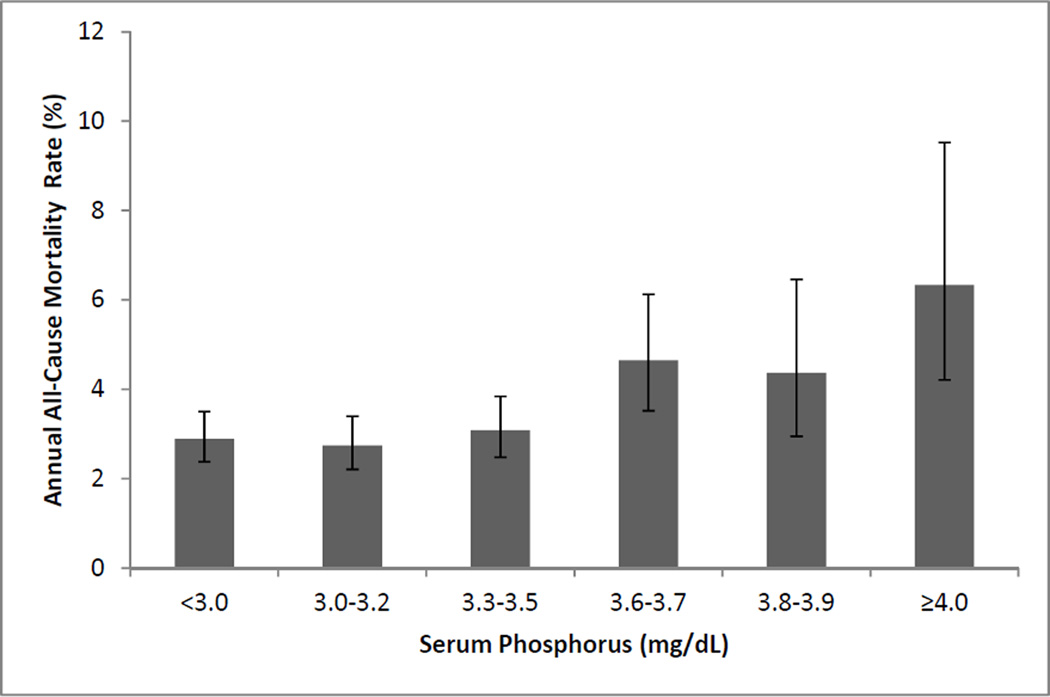
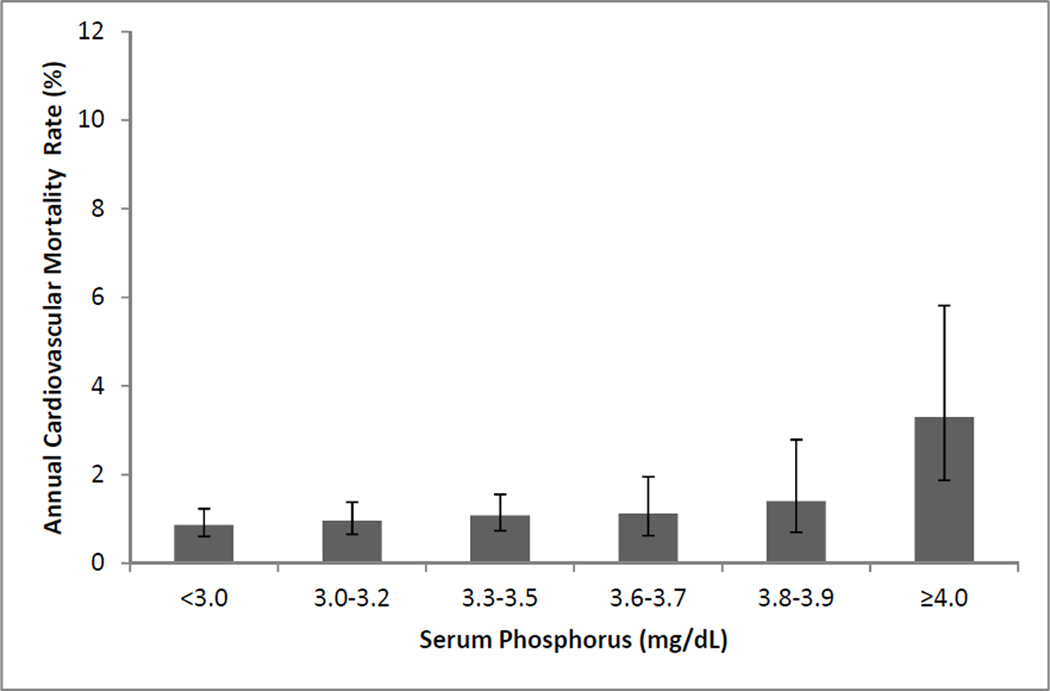
Results: Mean age was 74 ± 6 (SD) years, estimated glomerular filtration rate was 75 ± 16 mL/min/1.73 m(2), and serum phosphorus level was 3.2 ± 0.4 mg/dL. During a median follow-up of 9.3 years, there were 364 (120 CVD) deaths. After adjustment for demographics, CVD risk factors, and kidney function, the risks of all-cause death in the highest quartiles of serum phosphorus (≥3.6 mg/dL), urine phosphorus-creatinine ratio (≥0.55), and FEPi (≥18%) were 1.63 (95% CI, 1.23-2.17), 1.22 (95% CI, 0.90-1.65), and 0.88 (95% CI, 0.64-1.23), respectively, compared to the lowest quartiles of each. Results were similar for CVD death. Results also were similar in those with estimated glomerular filtration rate ≥60 and <60 mL/min/1.73 m(2).
Limitations: Older all-male cohort. Few had advanced chronic kidney disease. Spot urine specimens were used.
Conclusions: In community-living older men, higher serum phosphorus concentrations are associated with all-cause and CVD death. In contrast, urine phosphorus-creatinine ratio and FEPi are not. These findings do not support using urine phosphorus-creatinine ratio or FEPi as adjuvant measures to predict risk of mortality or CVD in the general population.
Published by Elsevier Inc.
Conflict of interest statement
The authors have no conflicts of interest to disclose.
Figures
References
-
- Jono S, McKee MD, Murry CE, et al. Phosphate regulation of vascular smooth muscle cell calcification. Circ Res. 2000;87((7)):E10–E17. - PubMed
-
- Block GA, Klassen PS, Lazarus JM, et al. Mineral metabolism, mortality, and morbidity in maintenance hemodialysis. J Am Soc Nephrol. 2004;15(8):2208–2218. - PubMed
-
- Block GA, Raggi P, Bellasi A, Kooienga L, Spiegel DM. Mortality effect of coronary calcification and phosphate binder choice in incident hemodialysis patients. Kidney Int. 2007;71(5):438–441. - PubMed
-
- Goodman WG, Goldin J, Kuizon BD, et al. Coronary-artery calcification in young adults with end-stage renal disease who are undergoing dialysis. N Engl J Med. 2000;342((20)):1478–1483. - PubMed
Publication types
MeSH terms
Substances
Grants and funding
- U01 AR45632/AR/NIAMS NIH HHS/United States
- R01 HL096851/HL/NHLBI NIH HHS/United States
- U01 AR45647/AR/NIAMS NIH HHS/United States
- U01 AG042124/AG/NIA NIH HHS/United States
- U01 AR045654/AR/NIAMS NIH HHS/United States
- T32 HL079891/HL/NHLBI NIH HHS/United States
- U01 AG042168/AG/NIA NIH HHS/United States
- U01 AR045583/AR/NIAMS NIH HHS/United States
- U01 AR45615/AR/NIAMS NIH HHS/United States
- T32 HL007261/HL/NHLBI NIH HHS/United States
- U01 AR45583/AR/NIAMS NIH HHS/United States
- R01HL096851/HL/NHLBI NIH HHS/United States
- U01 AR045632/AR/NIAMS NIH HHS/United States
- R01 HL116395/HL/NHLBI NIH HHS/United States
- U01 AR45654/AR/NIAMS NIH HHS/United States
- U01 AR045647/AR/NIAMS NIH HHS/United States
- U01 AR45580/AR/NIAMS NIH HHS/United States
- U01 AG027810/AG/NIA NIH HHS/United States
- UL1 RR024140/RR/NCRR NIH HHS/United States
- U01 AR045580/AR/NIAMS NIH HHS/United States
- U01 AG18197/AG/NIA NIH HHS/United States
- U01 AG018197/AG/NIA NIH HHS/United States
LinkOut - more resources
Full Text Sources
Other Literature Sources
Medical
