


Project reduce: reducing alcohol and marijuana misuse: effects of a brief intervention in the emergency department
- PMID: 23261491
- PMCID: PMC3558591
- DOI: 10.1016/j.addbeh.2012.09.006
Project reduce: reducing alcohol and marijuana misuse: effects of a brief intervention in the emergency department
Abstract
Study objective: Brief interventions (BI) for alcohol misuse and recently for marijuana use for emergency department patients have demonstrated effectiveness. We report a 12-month outcome data of a randomized controlled trial of emergency department (ED) patients using a novel model of BI that addresses both alcohol and marijuana use.
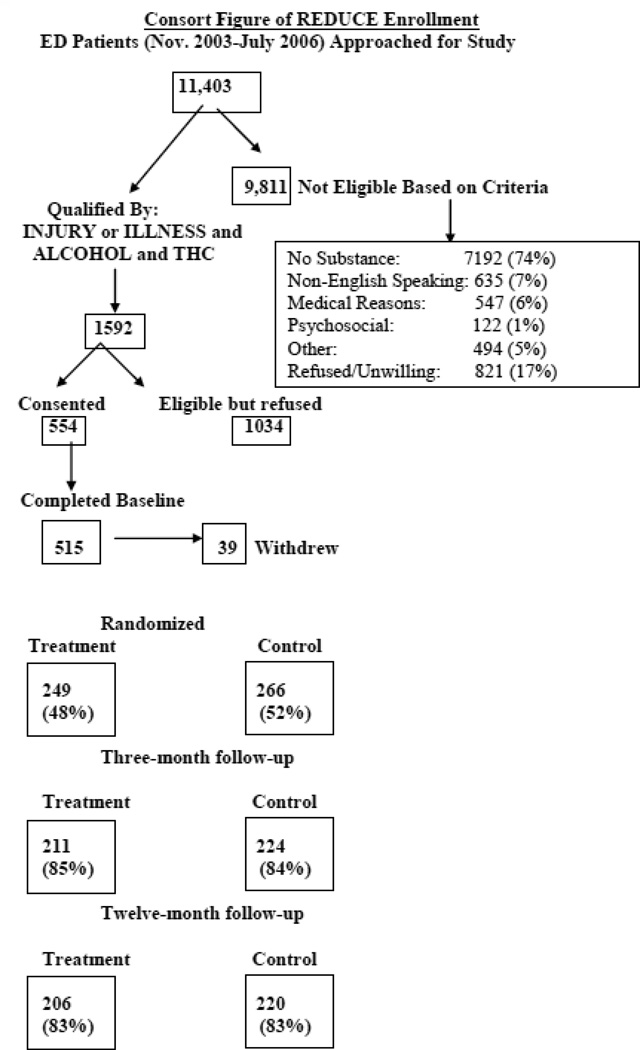
Methods: ED research assistants recruited adult patients who admitted alcohol use in the last month, and marijuana use in the last year. In the ED, patients received an assessment of alcohol and marijuana use and were randomized to treatment (n=249) or standard care (n=266). Treatment consisted of two sessions of BI. At 3 and 12months, both groups had an assessment of alcohol and marijuana use and negative consequences of use.
Results: 515 patients were randomized. We completed a 12-month follow-up assessments on 83% of those randomized. Measures of binge drinking and conjoint marijuana and alcohol use significantly decreased for the treatment group compared to the standard care group. At 12-month binge alcohol use days per month in the treatment group were (M=0.72:95% CI=0.36-1.12) compared to standard care group (M=1.77:95% CI=1.19-1.57) Conjoint use days in the treatment group (M=1.25.1:95% CI=0.81-1.54) compared to standard care group (M=2.16:95% CI=1.56-2.86). No differences in negative consequences or injuries were seen between the treatment and standard care groups.
Conclusions: BI for alcohol and marijuana decreased binge drinking and conjoint use in our treatment group. BI appears to offer a mechanism to reduce risky alcohol and marijuana use among ED patients but expected reductions in consequences of use such as injury were not found 12months after the ED visit.
Copyright © 2012 Elsevier Ltd. All rights reserved.
References
-
- Babor T, Stephens R, Marlatt G. Verbal report methods in clinical research on alcoholism: Response bias and its minimization. Journal of Studies on Alcohol. 1987;48:410–424. - PubMed
-
- Baird J, Harrington M. Wellness Questionnaire: Unpublished Survey. 2004
-
- Benyamina A, Lecacheux M, Blecha L, Reynaud M, Lukasiewcz M. Pharmacotherapy and psychotherapy in cannabis withdrawal and dependence. Expert Review of Neurotherapeutics. 2008;8:479–491. - PubMed
-
- Bien TH, Miller WR, Boroughs JM. Motivational interviewing with alcohol outpatients. Behavioural and Cognitive Psychotherapy. 1993;21(4):347–356.
Publication types
MeSH terms
Grants and funding
LinkOut - more resources
Full Text Sources
Other Literature Sources
Medical
