Review
. 2013 Jul:31:105-14.
doi: 10.1016/j.bbi.2012.12.008. Epub 2012 Dec 20.

The inflammasome: pathways linking psychological stress, depression, and systemic illnesses

Affiliations
Review

The inflammasome: pathways linking psychological stress, depression, and systemic illnesses

Masaaki Iwata et al. Brain Behav Immun. 2013 Jul.

Abstract

Stress is a common occurrence in everyday life and repeated or traumatic stress can be a precipitating factor for illnesses of the central nervous system, as well as peripheral organ systems. For example, severe or long-term psychological stress can not only induce depression, a leading illness worldwide, but can also cause psychosomatic diseases such as asthma and rheumatoid arthritis. Related key questions include how psychological stress influences both brain and peripheral systems, and what detection mechanisms underlie these effects? A clue is provided by the discovery of the pathways underlying the responses to host "danger" substances that cause systemic diseases, but can also contribute to depression. The inflammasome is a protein complex that can detect diverse danger signals and produce the accompanying immune-inflammatory reactions. Interestingly, the inflammasome can detect not only pathogen-associated molecules, but also cell damage-associated molecules such as ATP. Here, we propose a new inflammasome hypothesis of depression and related comorbid systemic illnesses. According to this hypothesis, the inflammasome is a central mediator by which psychological and physical stressors can contribute to the development of depression, and as well as a bridge to systemic diseases. This hypothesis includes an explanation for how psychological stress can influence systemic diseases, and conversely how systemic diseases can lead to psychiatric illnesses. The evidence suggests that the inflammasome may be a new target for the development of treatments for depression, as well as psychosomatic and somato-psycho diseases.


Figures

Fig. 1
Fig. 1
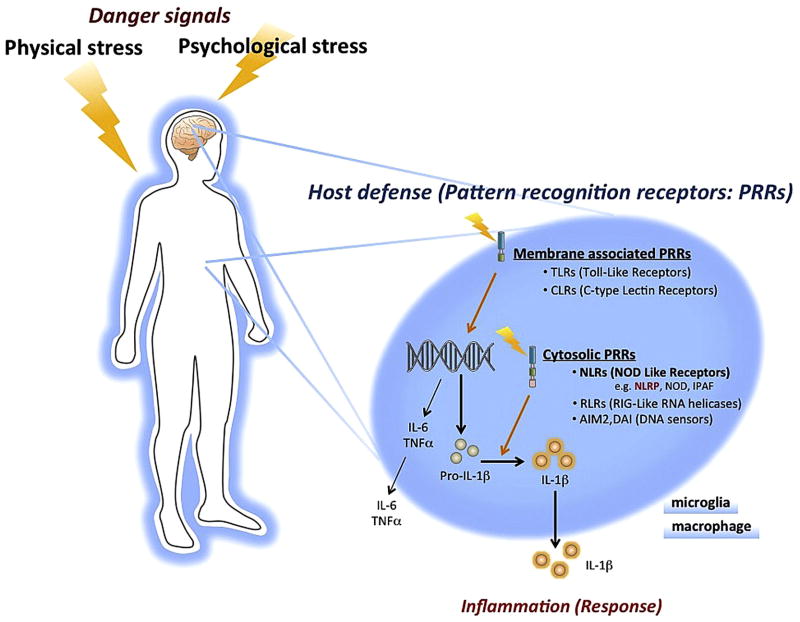
Danger signals and host defense mechanisms. Danger signals are detected via pattern recognition receptors (PRRs) to prepare defensive responses. PRRs can be classified into two main groups, membrane associated and cytosolic. NOD-like receptors (NLRs) are cytosolic PRRs, and can detect diverse ligands including ATP, fatty acids and amyloid β. NLRP3, one of the best characterized NLRs, forms large multiprotein complexes termed inflammasomes. However, the mechanism by which the NLRP3 inflammasome detects such diverse ligands is unclear. Shown in this figure is the pathway for regulation of IL-1β. Danger signals such as PAMPs are detected by TLRs and induce the synthesis of pro-IL-1β. Pro-IL-1β is processed by the oligomerized NLRP3 complex leading to secretion of IL-1β. Although psychological stress is known to increase plasma levels of IL-1β, the mechanism by which psychological stress is detected by the innate immune system is not known. Abbreviations: AIM, absent in melanoma; DAI, DNA-dependent activator of interferon (IFN)-regulatory factors; IPAF, ICE-protease activating factor; NLRP, NLR family, pyrin domain-containing; NOD, nucleotide-binding oligomerization domain.
Fig. 2
Fig. 2
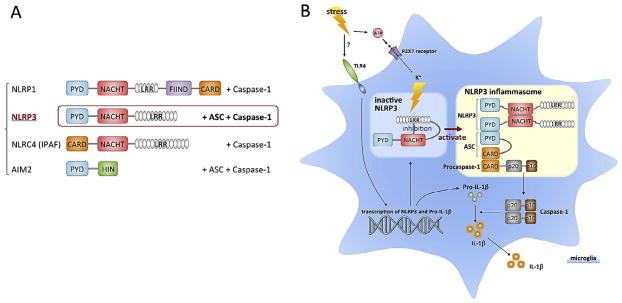
Inflammasome subtypes and activation of NLRP3. A. There are four cytosolic pattern recognition receptors that can form inflammasomes that subsequently activate caspase-1 and produce IL-1β. B. The NLRP3 inflammasome undergoes autoinhibition by binding of the LRR domain to the NACHT domain, resulting in blockade of oligomerization and ASC binding. Stimulation relieves this inhibition and enables NLRP3 to bind with pro-caspase-1 through the adaptor protein ASC. Pro-caspase-1 is then cleaved, and the activated caspase-1 cleaves pro-IL-1β, resulting in the release of IL-1β. Interestingly, the NLRP3 inflammasome can detect not only PAMPs, but also DAMPs, which include endogenous danger signals such as ATP. Extracellular ATP binds to the P2X7 receptor ionophore, causing K + efflux, which leads to oligomerization NLRP3. ATP may be associated with stimuli that can cause damage to cells, such as high levels of the excitatory neurotransmitter glutamate, which can cause excitotoxicity. Abbreviations: ASC, apoptosis-associated speck-like protein containing a caspase recruitment domain; CARD, caspase-recruitment domain; FIIND, domain with function to find; LRRs, leucine-rich repeats; NACHT, nucleotide-binding oligomerizetion; NLRP3, NLR family, pyrin domain-containing 3; PYD, Pyrin domain.
Fig. 3
Fig. 3
Pro inflammatory cytokines activate the HPA axis. Hypothalamic CRH stimulates the pituitary, which in turn releases ACTH, leading to stimulation of the adrenal cortex. Released glucocorticoid provides negative feedback on the HPA axis via the hypothalamus and pituitary, as well as hippocampus. Glucocorticoids also suppress pro-inflammatory cytokines under normal conditions, although paradoxically cytokine levels remain high in depressed patients. Cytokine-activation of the HPA axis in the presence of elevated glucocorticoid levels could result from disruption of HPA axis homeostatic mechanisms: that is, inflammatory cytokines activate each step of the HPA axis, including the hypothalamus, pituitary and adrenal cortex. This occurs at the same time that cytokines disrupt glucocorticoid receptor-mediated negative feedback (see text). In this model, inflammatory cytokines in the brain are directly activated by stress. Also, brain pro-inflammatory cytokines can reciprocally affect peripheral cytokines, which can activate the HPA axis and also influence other brain regions via several possible mechanisms (see text). Increased pro-inflammatory cytokines in both brain and periphery disturb negative feedback by glucocorticoids. Abbreviations: ACTH, adrenocorticotropic hormone; CORT, corticosterone; CRH, corticotropin-releasing hormone.
Fig. 4
Fig. 4
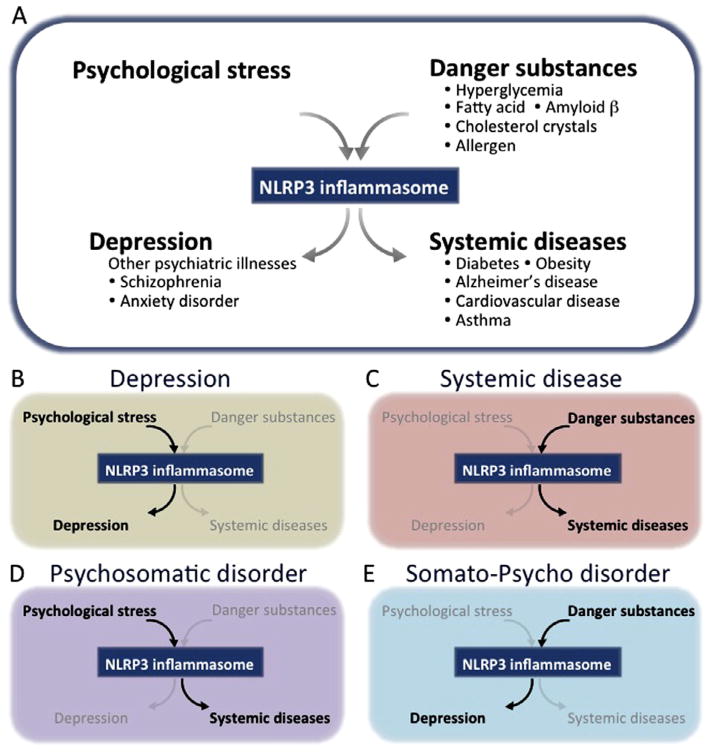
NLRP3 inflammasome is a central mediator of depression and comorbid disease. Top panel: (A) Psychological stress could cause activation the NLRP3 inflammasome, which may lead to release of IL-1β and the development of depression. Danger substances also activate the NLRP3 inflammasome and contribute to the pathology of several comorbid diseases. Thus, the NLRP3 could be a central mediator of both psychological and systemic diseases. In support of this, it is well known that psychological stress can affect systemic, peripheral diseases, and these diseases frequently accompany depression. Bottom panel: (B) depression is caused by psychological stress via the NLRP3 inflammasome; (C) systemic diseases can be caused by danger substances via the NLRP3 inflammasome; (D) the NLRP3 inflammasome may also explain how psychological stress can contribute to the development of systemic diseases (psychosomatic disorder); and (E) how intra- and extra- cellular danger substances can lead to the development of depression (somato-psycho disorder). Taken together, it is hypothesized that NLRP3 serves as a bridge between psychological stress and depression, as well as bidirectional pathway between depression and systemic comorbid illnesses.

References

    1. Adams SD, Radhakrishnan RS, Helmer KS, Mercer DW. Effects of anesthesia on lipopolysaccharide-induced changes in serum cytokines. J Trauma. 2008;65:170–174. - PubMed
    1. Ader R, Cohen N. Psychoneuroimmunology: conditioning and stress. Annu Rev Psychol. 1993;44:53–85. - PubMed
    1. Amiot F, Fitting C, Tracey KJ, Cavaillon JM, Dautry F. Lipopolysaccharide-induced cytokine cascade and lethality in LT alpha/TNF alpha-deficient mice. Mol Med. 1997;3:864–875. - PMC - PubMed
    1. Anisman H, Kokkinidis L, Borowski T, Merali Z. Differential effects of interleukin (IL)-1beta, IL-2 and IL-6 on responding for rewarding lateral hypothalamic stimulation. Brain Res. 1998;779:177–187. - PubMed
    1. Bachen EA, Chesney MA, Criswell LA. Prevalence of mood and anxiety disorders in women with systemic lupus erythematosus. Arthritis Rheum. 2009;61:822–829. - PMC - PubMed

MeSH terms