


Perfusion pressure and movement-induced hyperemia: evidence of limited vascular function and vasodilatory reserve with age
- PMID: 23262136
- PMCID: PMC3566486
- DOI: 10.1152/ajpheart.00656.2012
Perfusion pressure and movement-induced hyperemia: evidence of limited vascular function and vasodilatory reserve with age
Abstract
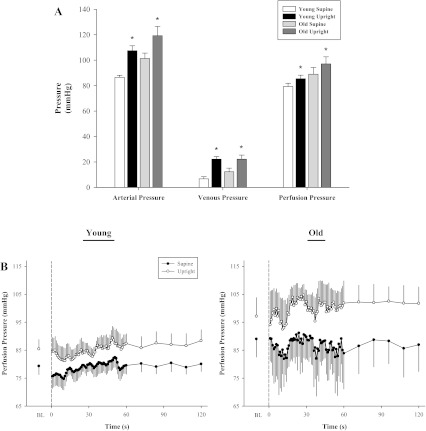
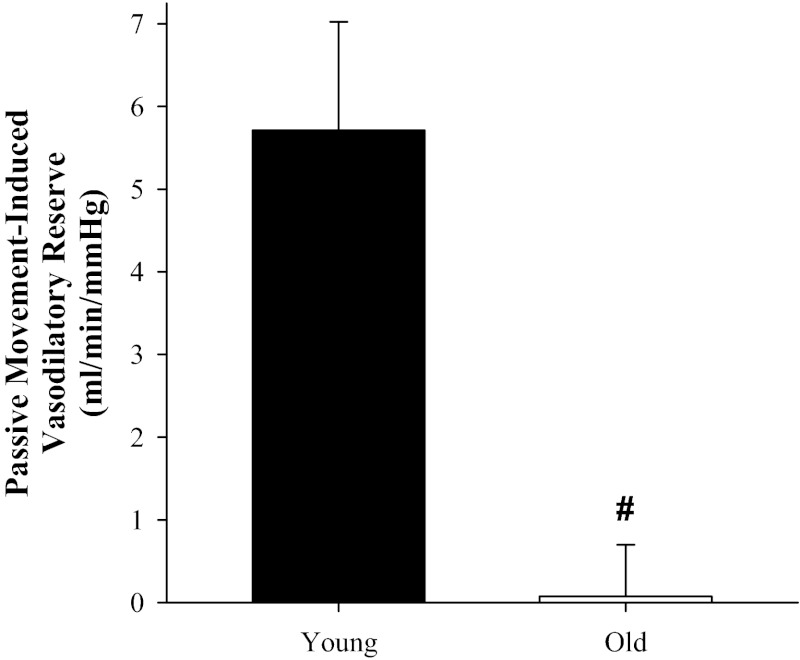
To better understand the mechanisms contributing to reduced blood flow with age, this study sought to elucidate the impact of altered femoral perfusion pressure (FPP) on movement-induced hyperemia. Passive leg movement was performed in 10 young (22 ± 1 yr) and 12 old (72 ± 2 yr) healthy men for 2 min, with and without a posture-induced change in FPP (~7 ± 1 ΔmmHg). Second-by-second measurements of central and peripheral hemodynamic responses were acquired noninvasively (finger photoplethysmography and Doppler ultrasound, respectively), with FPP confirmed in a subset of four young and four old subjects with arterial and venous catheters. Central hemodynamic responses (heart rate, stroke volume, cardiac output, mean arterial pressure) were not affected by age or position. The young exhibited a ~70% greater movement-induced peak change in leg blood flow (ΔLBF(peak)) in the upright-seated posture (supine: 596±68 ml/min; upright: 1,026 ± 85 ml/min). However, in the old the posture change did not alter ΔLBF(peak) (supine: 417±42 ml/min; upright: 412±56 ml/min), despite the similar increases in FPP. Similarly, movement-induced peak change in leg vascular conductance was ~80% greater for the young in the upright-seated posture (supine: 7.1 ± 0.8 ml·min(-1)·mmHg(-1); upright: 12.8 ± 1.3 ml·min(-1)·mmHg(-1)), while the old again exhibited no difference between postures (supine: 4.7 ± 0.4 ml·min(-1)·mmHg(-1); upright: 4.8 ± 0.5 ml·min(-1)·mmHg(-1)). Thus this study reveals that, unlike the young, increased FPP does not elicit an increase in movement-induced hyperemia or vasodilation in the old. In light of recent evidence that the majority of the first minute of passive movement-induced hyperemia is predominantly nitric oxide (NO) dependent in the young, these findings in the elderly may be largely due to decreased NO bioavailability, but this remains to be definitively determined.
Figures


References
-
- Abel MG, Hannon JC, Sell K, Lillie T, Conlin G, Anderson D. Validation of the Kenz Lifecorder EX and ActiGraph GT1M accelerometers for walking and running in adults. Appl Physiol Nutr Metab 33: 1155–1164, 2008 - PubMed
-
- Caspersen CJ, Pereira MA, Curran KM. Changes in physical activity patterns in the United States, by sex and cross-sectional age. Med Sci Sports Exerc 32: 1601–1609, 2000 - PubMed
-
- Celermajer DS, Sorensen KE, Spiegelhalter DJ, Georgakopoulos D, Robinson J, Deanfield JE. Aging is associated with endothelial dysfunction in healthy men years before the age-related decline in women. J Am Coll Cardiol 24: 471–476, 1994 - PubMed
Publication types
MeSH terms
Grants and funding
LinkOut - more resources
Full Text Sources
Other Literature Sources
Medical
Miscellaneous
