


Surgical staples compared with subcuticular suture for skin closure after cesarean delivery: a randomized controlled trial
- PMID: 23262925
- PMCID: PMC3875219
- DOI: 10.1097/aog.0b013e31827a072c
Surgical staples compared with subcuticular suture for skin closure after cesarean delivery: a randomized controlled trial
Erratum in
- Obstet Gynecol. 2013 May;121(5):1113
Abstract
Objective: To compare the risk of cesarean wound disruption or infection after closure with surgical staples compared with subcuticular suture.
Methods: Women with viable pregnancies at 24 weeks of gestation or greater undergoing scheduled or unscheduled cesarean delivery were randomized to wound closure with surgical staples or absorbable suture. Staples were removed at postoperative days 3-4 for low transverse incisions and days 7-10 for vertical incisions. Standardized wound evaluations were performed at discharge (days 3-4) and 4-6 weeks postoperatively. The primary outcome was a composite of wound disruption or infection within 4-6 weeks. Secondary outcomes included operative time, highest pain score on analog scale, cosmesis score, and patient scar satisfaction score. Analyses were by intent to treat.
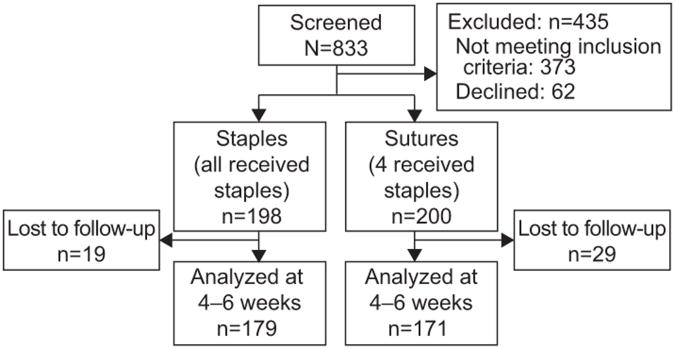
Results: Of 398 patients, 198 were randomized to staples and 200 to suture (but four received staples). Baseline characteristics including body mass index, prior cesarean delivery, labor, and type of skin incision were similar by group. The primary outcome incidence at hospital discharge was 7.1% for staples and 0.5% for suture (P<.001, relative risk 14.1, 95% confidence interval [CI] 1.9-106). Of 350 (87.9%) with follow-up at 4-6 weeks, the cumulative risk of the primary outcome at 4-6 weeks was 14.5% for staples and 5.9% for suture (P=.008, relative risk 2.5, 95% CI 1.2-5.0). Operative time was longer with suture closure (median time of 58 versus 48 minutes; P<.001). Pain scores at 72-96 hours and at 6 weeks, cosmesis score, and patient satisfaction score did not differ by group.
Conclusion: Staples closure compared with suture is associated with significantly increased composite wound morbidity after cesarean delivery.
Clinical trial registration: : ClinicalTrials.gov, www.clinicaltrials.gov, NCT01008449.
Level of evidence: : I.
References
-
- Martin JA, Hamilton BE, Ventura SJ, Osterman MJK, Kirmeyer S, Matthews TJ, et al. Births: Final Data for 2009. National Vital Statistics Reports. 2011;60:1. - PubMed
-
- Owen J, Andrews WW. Wound complications after cesarean sections. Clin Obstet Gynecol. 1994;37:842–55. - PubMed
-
- Smyth ET, Emmerson AM. Surgical site infection surveillance. J Hosp Infect. 2000;45:173–84. - PubMed
-
- Reilly J, Twaddle S, McIntosh J, Kean L. An economic analysis of surgical wound infection. J Hosp Infect. 2001;49:245–249. - PubMed
-
- Ramsey PS, White AM, Guinn DA, Lu GC, Ramin SM, Davies JK, et al. Subcutaneous Tissue Reapproximation, Alone or in Combination With Drain, in Obese Women Undergoing Cesarean Delivery. Obstet Gynecol. 2005;105:967–73. - PubMed
Publication types
MeSH terms
Associated data
Grants and funding
LinkOut - more resources
Full Text Sources
Other Literature Sources
Medical
