


The aryl hydrocarbon receptor: a novel target for immunomodulation in organ transplantation
- PMID: 23263608
- PMCID: PMC3700727
- DOI: 10.1097/TP.0b013e31827a3d1d
The aryl hydrocarbon receptor: a novel target for immunomodulation in organ transplantation
Abstract
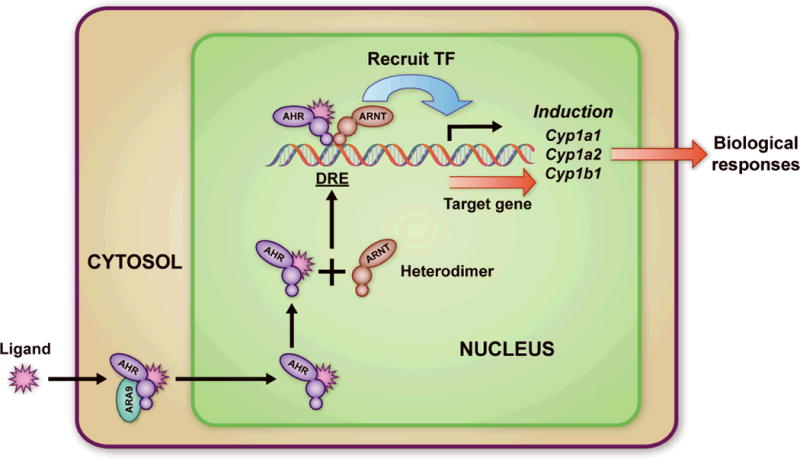
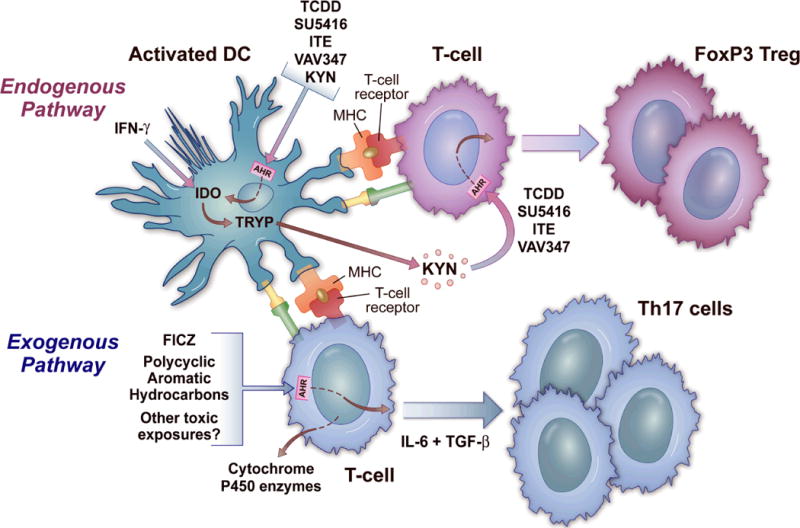
The aryl hydrocarbon receptor (AHR), which has been central to studies in toxicology for years as the receptor for the toxicant dioxin, is rapidly gaining interest in immunology based on its ability to influence T-cell differentiation. Multiple studies have documented that binding of this receptor with certain ligands favors T-cell differentiation toward regulatory T cells, and paradoxically, binding of this same receptor with different ligands enhances Th17 effector cell differentiation. This finding has been confirmed in both in vitro and in vivo models, where different ligands are able to either ameliorate or conversely aggravate autoimmunity in experimental autoimmune encephalomyelitis. The AHR has both an endogenous role that is important in development and normal physiology and an exogenous role as a receptor for manmade toxicants, with their binding leading to transcription of cytochrome P450 enzymes that metabolize these same ligands. Based on recent reports that will be summarized in this overview, we will consider the role that the AHR might play as a sensor to the outside environment, leading to alteration of the acquired immune system that might have relevance in transplantation or other medical conditions. In addition to describing the data in normal physiology and T-cell differentiation, we will present examples of the importance of this receptor in preclinical models of disease and highlight specific ligands that target the AHR and will have efficacy in treating transplant rejection and in tolerance protocols.
Conflict of interest statement
There are no conflicts of interest for any of these authors.
Figures
Similar articles
-
The aryl hydrocarbon receptor meets immunology: friend or foe? A little of both.Front Immunol. 2014 Oct 2;5:458. doi: 10.3389/fimmu.2014.00458. eCollection 2014. Front Immunol. 2014. PMID: 25324842 Free PMC article. Review.
-
Use of natural AhR ligands as potential therapeutic modalities against inflammatory disorders.Nutr Rev. 2013 Jun;71(6):353-69. doi: 10.1111/nure.12024. Epub 2013 Apr 1. Nutr Rev. 2013. PMID: 23731446 Free PMC article. Review.
-
The aryl hydrocarbon receptor in immunity.Trends Immunol. 2009 Sep;30(9):447-54. doi: 10.1016/j.it.2009.06.005. Epub 2009 Aug 21. Trends Immunol. 2009. PMID: 19699679 Review.
-
The emerging roles of AhR in physiology and immunity.Biochem Pharmacol. 2013 Sep 1;86(5):561-70. doi: 10.1016/j.bcp.2013.07.004. Epub 2013 Jul 12. Biochem Pharmacol. 2013. PMID: 23856287
-
AhR Ligands Modulate the Differentiation of Innate Lymphoid Cells and T Helper Cell Subsets That Control the Severity of a Pulmonary Fungal Infection.Front Immunol. 2021 Apr 16;12:630938. doi: 10.3389/fimmu.2021.630938. eCollection 2021. Front Immunol. 2021. PMID: 33936043 Free PMC article.
Cited by
-
Functions of the aryl hydrocarbon receptor in the skin.Semin Immunopathol. 2013 Nov;35(6):677-91. doi: 10.1007/s00281-013-0394-4. Epub 2013 Aug 16. Semin Immunopathol. 2013. PMID: 23949496 Review.
-
Environmental Factors Impacting Bone-Relevant Chemokines.Front Endocrinol (Lausanne). 2017 Feb 14;8:22. doi: 10.3389/fendo.2017.00022. eCollection 2017. Front Endocrinol (Lausanne). 2017. PMID: 28261155 Free PMC article.
-
Myeloid-Derived Suppressor Cells as a Regulator of Immunity in Organ Transplantation.Int J Mol Sci. 2018 Aug 10;19(8):2357. doi: 10.3390/ijms19082357. Int J Mol Sci. 2018. PMID: 30103447 Free PMC article. Review.
-
Modeling the Effect of the Aryl Hydrocarbon Receptor on Transplant Immunity.Transplant Direct. 2017 Apr 25;3(5):e157. doi: 10.1097/TXD.0000000000000666. eCollection 2017 May. Transplant Direct. 2017. PMID: 28573192 Free PMC article.
-
The aryl hydrocarbon receptor meets immunology: friend or foe? A little of both.Front Immunol. 2014 Oct 2;5:458. doi: 10.3389/fimmu.2014.00458. eCollection 2014. Front Immunol. 2014. PMID: 25324842 Free PMC article. Review.
References
-
- Denison MS, Pandini A, Nagy SR, Baldwin EP, Bonati L. Ligand binding and activation of the Ah receptor. Chem Biol Interact. 2002;141(1–2):3. - PubMed
-
- Denison MS, Nagy SR. Activation of the aryl hydrocarbon receptor by structurally diverse exogenous and endogenous chemicals. Annu Rev Pharmacol Toxicol. 2003;43:309. - PubMed
-
- Kitamura M, Kasai A. Cigarette smoke as a trigger for the dioxin receptor-mediated signaling pathway. Cancer Lett. 2007;252(2):184. - PubMed
-
- Hahn ME. Biomarkers and bioassays for detecting dioxin-like compounds in the marine environment. Sci Total Environ. 2002;289(1–3):49. - PubMed
Publication types
MeSH terms
Substances
Grants and funding
LinkOut - more resources
Full Text Sources
Other Literature Sources
