Novel bilobe components in Trypanosoma brucei identified using proximity-dependent biotinylation
- PMID: 23264645
- PMCID: PMC3571296
- DOI: 10.1128/EC.00326-12
Novel bilobe components in Trypanosoma brucei identified using proximity-dependent biotinylation
Abstract
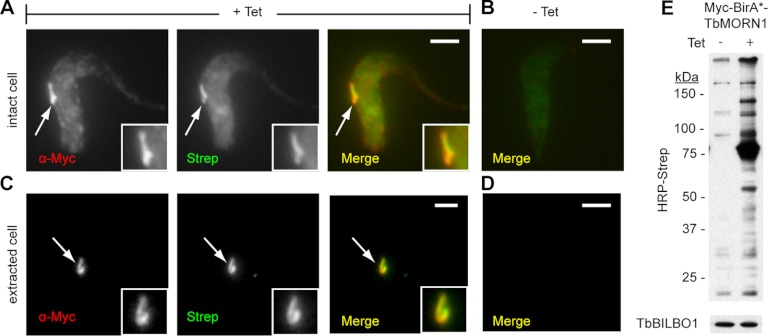
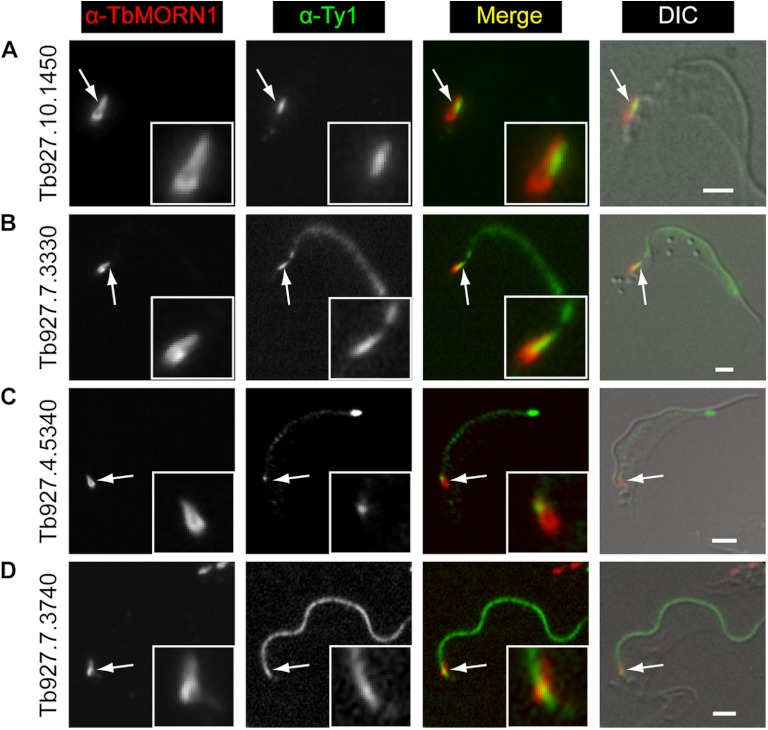
The trypanosomes are a family of parasitic protists of which the African trypanosome, Trypanosoma brucei, is the best characterized. The complex and highly ordered cytoskeleton of T. brucei has been shown to play vital roles in its biology but remains difficult to study, in large part owing to the intractability of its constituent proteins. Existing methods of protein identification, such as bioinformatic analysis, generation of monoclonal antibody panels, proteomics, affinity purification, and yeast two-hybrid screens, all have drawbacks. Such deficiencies-troublesome proteins and technical limitations-are common not only to T. brucei but also to many other protists, many of which are even less well studied. Proximity-dependent biotin identification (BioID) is a recently developed technique that allows forward screens for interaction partners and near neighbors in a native environment with no requirement for solubility in nonionic detergent. As such, it is extremely well suited to the exploration of the cytoskeleton. In this project, BioID was adapted for use in T. brucei. The trypanosome bilobe, a discrete cytoskeletal structure with few known protein components, represented an excellent test subject. Use of the bilobe protein TbMORN1 as a probe resulted in the identification of seven new bilobe constituents and two new flagellum attachment zone proteins. This constitutes the first usage of BioID on a largely uncharacterized structure, and demonstrates its utility in identifying new components of such a structure. This remarkable success validates BioID as a new tool for the study of unicellular eukaryotes in particular and the eukaryotic cytoskeleton in general.
Figures





References
Publication types
MeSH terms
Substances
Grants and funding
LinkOut - more resources
Full Text Sources
Other Literature Sources
Molecular Biology Databases
Research Materials