Review
. 2013 Feb 6;105(3):166-74.
doi: 10.1093/jnci/djs505. Epub 2012 Dec 21.

Postpartum remodeling, lactation, and breast cancer risk: summary of a National Cancer Institute-sponsored workshop

Affiliations
Review

Postpartum remodeling, lactation, and breast cancer risk: summary of a National Cancer Institute-sponsored workshop

Jessica M Faupel-Badger et al. J Natl Cancer Inst. .

Abstract

The pregnancy-lactation cycle (PLC) is a period in which the breast is transformed from a less-developed, nonfunctional organ into a mature, milk-producing gland that has evolved to meet the nutritional, developmental, and immune protection needs of the newborn. Cessation of lactation initiates a process whereby the breast reverts to a resting state until the next pregnancy. Changes during this period permanently alter the morphology and molecular characteristics of the breast (molecular histology) and produce important, yet poorly understood, effects on breast cancer risk. To provide a state-of-the-science summary of this topic, the National Cancer Institute invited a multidisciplinary group of experts to participate in a workshop in Rockville, Maryland, on March 2, 2012. Topics discussed included: 1) the epidemiology of the PLC in relation to breast cancer risk, 2) breast milk as a biospecimen for molecular epidemiological and translational research, and 3) use of animal models to gain mechanistic insights into the effects of the PLC on breast carcinogenesis. This report summarizes conclusions of the workshop, proposes avenues for future research on the PLC and its relationship with breast cancer risk, and identifies opportunities to translate this knowledge to improve breast cancer outcomes.


Figures
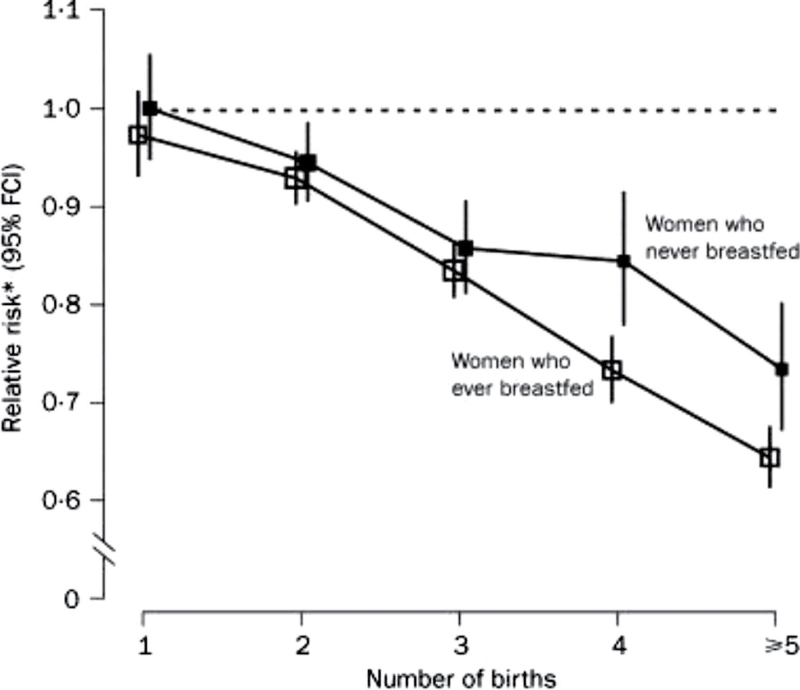
Figure 1.
Figure 1.
Relative risk of breast cancer in parous women according to breastfeeding history and number of births. Estimates from reanalysis of 47 epidemiological studies (cohort and case–control) conducted in 30 different countries, with parity, lactation, and breast cancer status available for more than 122000 women. Risk estimates diverge based on breastfeeding status at four or more births. Women who ever breastfed and had four children (for a median duration of breastfeeding of 16 months) had a floating absolute risk of 0.73 (floating standard error [FSE] = 0.020), whereas women who had four children but never breastfed had a floating absolute risk of 0.84 (FSE = 0.038). At five births, floating absolute risk was 0.73 (FSE = 0.039) for parous women who did not breastfeed and 0.64 (FSE = 0.020) for women who breastfed a median duration of 30 months. *Relative risk was calculated as floating absolute risk and stratified by study, age, age at first birth, and menopausal status. FCI = floating confidence interval. Permission for reproduction from (8).
Figure 2.
Figure 2.
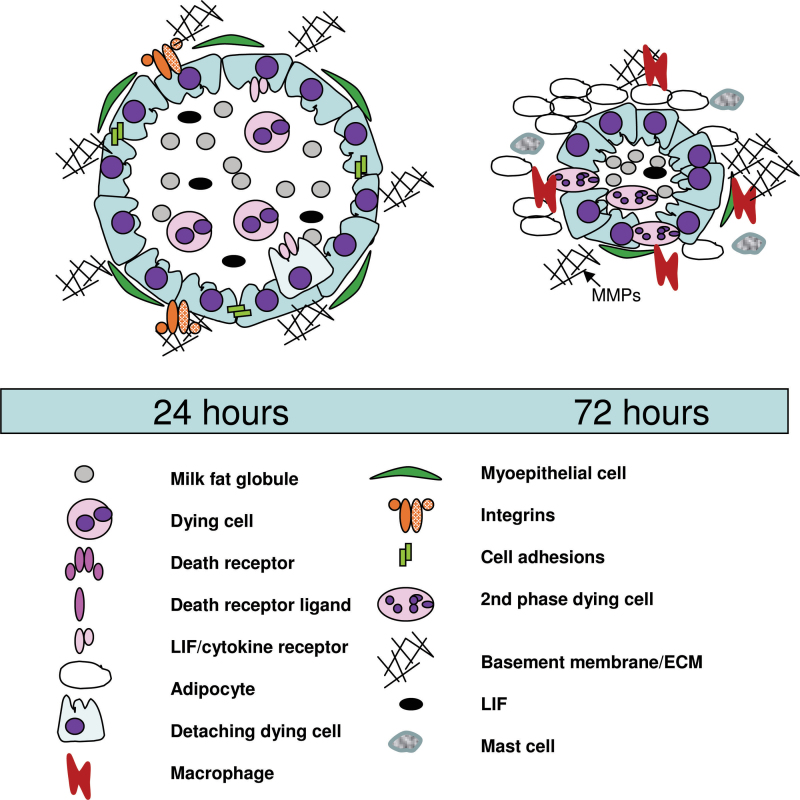
Schematic representation of the involution process. Involution occurs in two phases. The first phase is reversible phase, lasting up to 48 hours in the mouse, that is characterized by extensive cell death, which results in detachment of dying cells into the alveolar lumen. These cells upregulate cell surface markers such as CD14 in a Stat3-dependent manner and are subsequently phagocytosed by the viable epithelium. In the second phase of involution, tissue remodeling and redifferentiation of adipocytes is associated with a second wave of cell death that returns the gland to a near-prepregnant state. The second phase is associated with an influx of macrophages and mast cells that facilitate tissue remodeling and with extracellular matrix (ECM) breakdown by matrix metalloproteases (MMP). LIF = leukemia inhibitory factor. Adapted from (73).
Figure 3.
Figure 3.
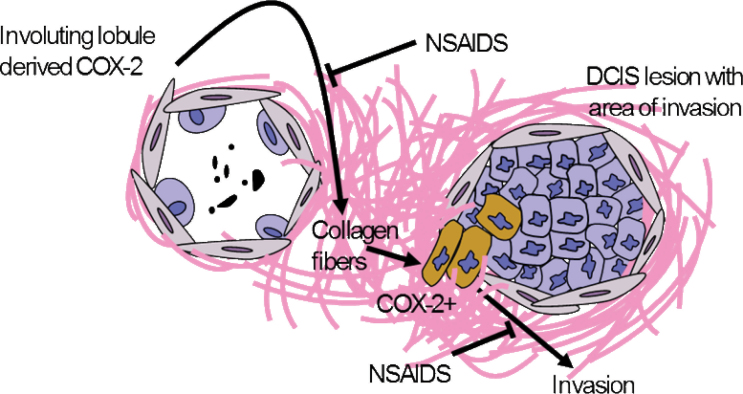
Proinflammatory involution environment promoting breast carcinogenesis. A model depicting COX-2, derived from the involuting mammary gland, mediating collagen fibrillogenesis and COX-2 promoting invasion (brown cells) of tumor cells exposed to involution collagen. NSAIDS = Nonsteroidal anti-inflammatory drugs; DCIS = Ductal carcinoma in situ. Reproduced with permission from (75).

References

    1. Sherman ME, Figueroa JD, Henry JE, et al. The Susan G. Komen for the Cure Tissue Bank at the IU Simon Cancer Center: a unique resource for defining the “molecular histology” of the breast. Cancer Prev Res (Phila). 2012; 5(4):528–535 - PMC - PubMed
    1. Figueroa JD, Linville L, Brinton LA, et al. Breast cancer risk factor associations with breast tissue morphometry: results from the Komen for the Cure Tissue Bank. Paper presented at the American Association for Cancer Research Annual Meeting; April 2012; Chicago, IL
    1. Ip S, Chung M, Raman G, et al. Breastfeeding and maternal and infant health outcomes in developed countries. Evid Rep Technol Assess (Full Rep). 2007;XX(153):1–186 - PMC - PubMed
    1. Stuebe A. The risks of not breastfeeding for mothers and infants. Rev Obstet Gynecol. 2009; 2(4):222–231 - PMC - PubMed
    1. Tse A, Michels KB. Maternal and offspring benefits of breast-feeding. In Symonds M, Ramsay MM.eds. Maternal-Fetal Nutrition During Pregnancy and Lactation. Cambridge: Cambridge University Press; 2010; 106–118

Publication types