. 2013 Feb;24(2):209-16.
doi: 10.1681/ASN.2012080795. Epub 2012 Dec 20.

Cubilin and amnionless mediate protein reabsorption in Drosophila nephrocytes

Affiliations

Cubilin and amnionless mediate protein reabsorption in Drosophila nephrocytes

Fujian Zhang et al. J Am Soc Nephrol. 2013 Feb.

Abstract

The insect nephrocyte and the mammalian glomerular podocyte are similar with regard to filtration, but it remains unclear whether there is an organ or cell type in flies that reabsorbs proteins. Here, we show that the Drosophila nephrocyte has molecular, structural, and functional similarities to the renal proximal tubule cell. We screened for genes required for nephrocyte function and identified two Drosophila genes encoding orthologs of mammalian cubilin and amnionless (AMN), two major receptors for protein reabsorption in the proximal tubule. In Drosophila, expression of dCubilin and dAMN is specific to nephrocytes, where they function as co-receptors for protein uptake. Targeted expression of human AMN in Drosophila nephrocytes was sufficient to rescue defective protein uptake induced by dAMN knockdown, suggesting evolutionary conservation of Cubilin/AMN co-receptors function from flies to humans. Furthermore, we found that Cubilin/AMN-mediated protein reabsorption is required for the maintenance of nephrocyte ultrastructure and fly survival under conditions of toxic stress. In conclusion, the insect nephrocyte combines filtration with protein reabsorption, using evolutionarily conserved genes and subcellular structures, suggesting that it can serve as a simplified model for both podocytes and the renal proximal tubule.


Figures
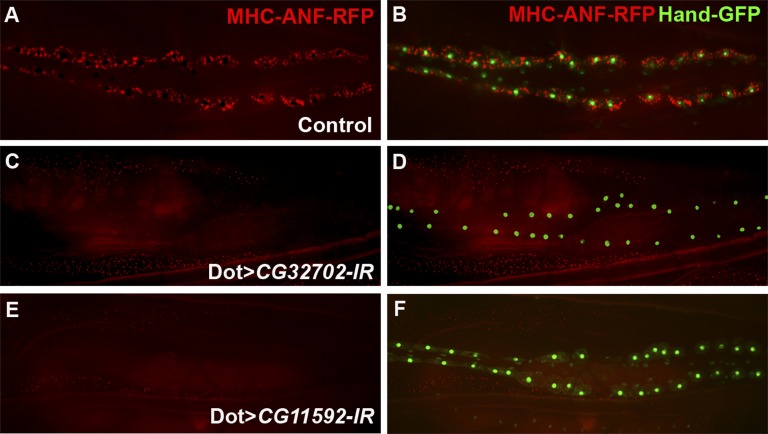
Figure 1.
Figure 1.
Two novel Drosophila genes, CG32702 and CG11592, are required for nephrocyte function. (A and B) Secreted ANF-RFP (red) is accumulated in pericardial nephrocytes labeled with Hand-GFP (green). (C–F) Pericardial nephrocyte-specific RNAi knockdown of (C and D) CG32702 or (E and F) CG11592 completely blocked the accumulation of ANF-RFP (red), but the survival of pericardial nephrocytes was not affected based on Hand-GFP (green) expression in the nephrocytes.
Figure 2.
Figure 2.
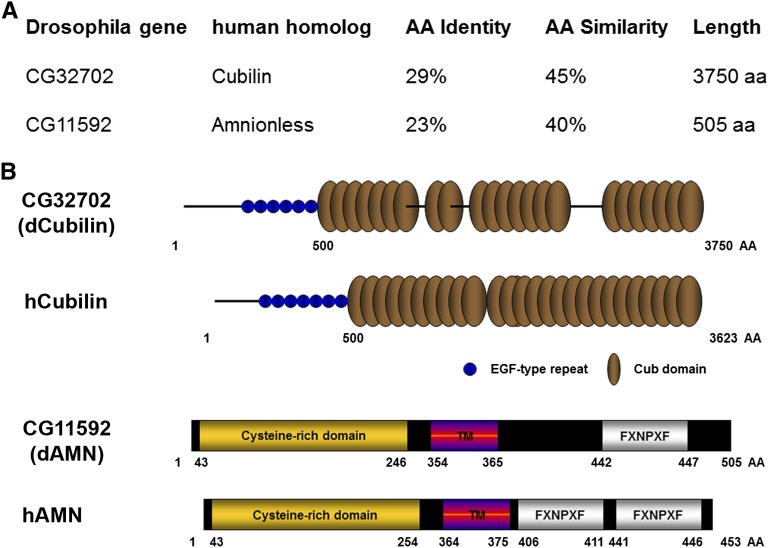
CG32702 and CG11592 encode Drosophila orthologs of human Cubilin and Amn, respectively. (A) Amino acid sequence analysis of Drosophila CG32702 and CG11592 showing their identity and similarity to human Cubilin and AMN, respectively. (B) Protein domain structure analysis of Drosophila CG32702 and CG11592. TM, transmembrane domain.
Figure 3.
Figure 3.
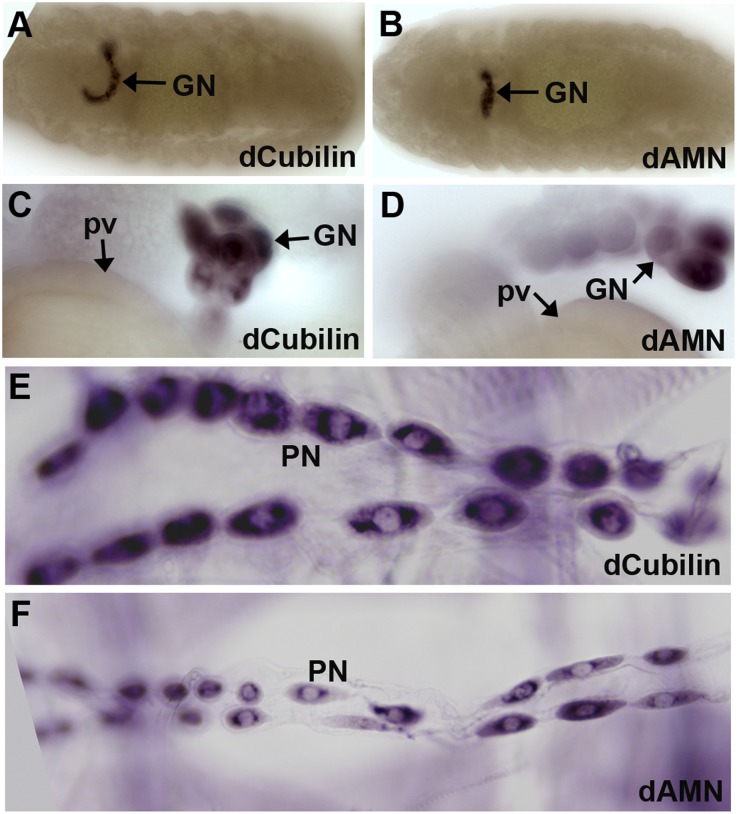
Drosophila Cubilin and AMN are specifically expressed in nephrocytes. (A and B) In situ hybridization showed that dCubilin and dAMN are specifically expressed in garland nephrocytes (GNs) at embryonic stage. (C–F) dCubilin and dAMN are specifically expressed in (C and D) GNs and (E and F) pericardial nephrocytes (PNs) at larval stage. pv, proventriculus.
Figure 4.
Figure 4.
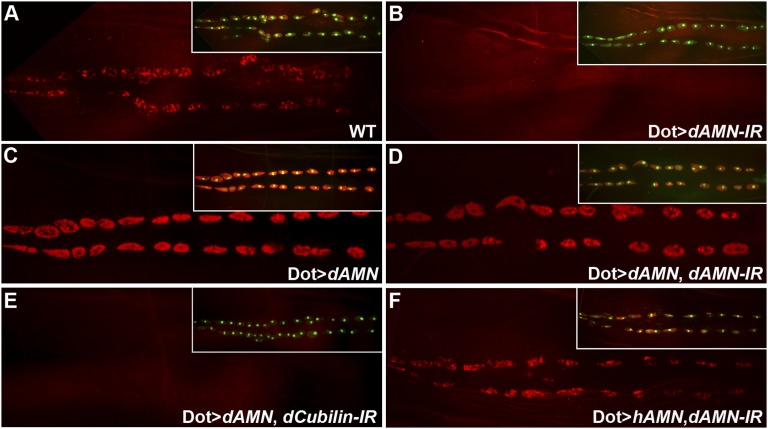
Drosophila Cubilin and AMN function together as a receptor complex for protein uptake in nephrocytes. (A) Pericardial nephrocytes of wild-type (WT) larvae efficiently uptake ANF-RFP. (B) Pericardial nephrocyte-specific RNAi knockdown of dAMN completely blocked ANF-RFP uptake. (C) Overexpression of dAMN in pericardial nephrocytes increased ANF-RFP uptake. (D and E) Overexpression of dAMN in pericardial nephrocytes (D) could rescue the blocked ANF-RFP uptake caused by dAMN RNAi knockdown but (E) could not rescue defect caused by dCubilin RNAi knockdown. (F) Overexpression of human AMN in pericardial nephrocytes rescued the ANF-RFP uptake defect caused by dAMN RNAi knockdown. Insets show combined Hand-GFP (green) and ANF-RFP (red) for the same larva as depicted in each panel.
Figure 5.
Figure 5.
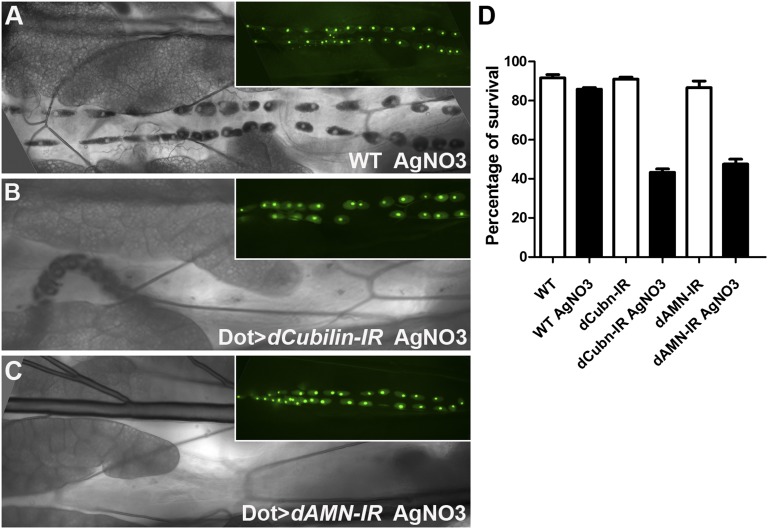
Cubilin/AMN-mediated protein uptake in nephrocytes is required for toxin resistance. (A) Silver nitrate (AgNO3) is efficiently collected by pericardial nephrocytes in wild-type (WT) Drosophila larvae. (B and C) Pericardial nephrocyte-specific RNAi knockdown of (B) dCubilin or (C) dAMN completely blocked silver nitrate uptake. Insets in A–C show Hand-GFP (green) for the same larva as depicted in each panel. (D) Toxin treatment did not affect wild-type fly survivability but significantly reduced the survivability of flies with pericardial nephrocyte-specific knockdown of dCubilin or dAMN.
Figure 6.
Figure 6.
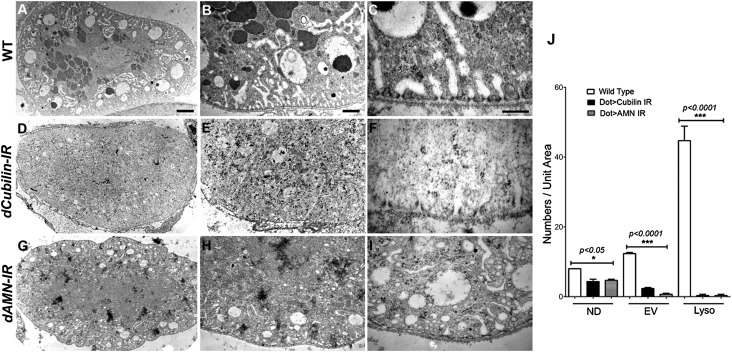
Cubilin/AMN-mediated protein uptake is essential for maintaining subcellular structures of Drosophila nephrocytes. (A–C) The wild-type (WT) Drosophila nephrocytes show distinct layers of (A and B) lacuna network and endocytic vacuoles and lysosomes. (C) Nephrocyte diaphragms and lacunae densely populate the nephrocyte surface. (D–F) Pericardial nephrocytes with dCubilin RNAi knockdown have (D and E) fewer endocytic vesicles and vacuoles and almost no electron-dense lysosomes. (F) The number of nephrocyte diaphragms is reduced, and the lacunae become much shorter. (G–I) dAMN RNAi knockdown also reduced the number of (G and H) endocytic vacuoles and electron-dense lysosomes, with (I) a reduced number of nephrocyte diaphragms and shorter lacunae. There is no dramatic change of basement membrane. Scale bars, 4 μm in A, D, and G; 1 μm in B, E, and H; 200 nm in C, F, and I. (J) Quantification of the ultrastructure changes in nephrocytes with dCubilin or dAMN RNAi. ND, nephrocyte diaphragm; EV, endocytic vacuole; Lyso, lysosomes.
Figure 7.
Figure 7.
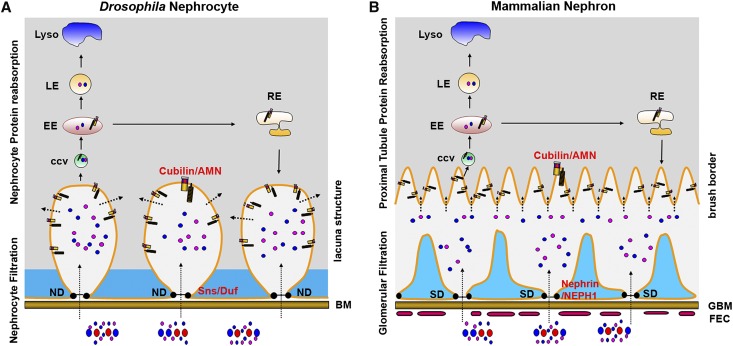
The Drosophila nephrocyte combines podocyte filtration with renal proximal tubule protein reabsorption using conserved molecules and similar subcellular structures. Essential molecules and subcellular structures involved in filtration and protein reabsorption in (A) Drosophila nephrocytes and (B) the mammalian glomerulus and renal proximal tubules are shown. Ultrafiltration is indicated by long dotted arrows, and protein reabsorption is shown by short dotted arrows. BM, basement membrane; ND, nephrocyte diaphragm; CCV, clatherin-coated vesicles; EE, early endosome; LE, late endosome; RE, recycling endosome; FEC, fenestrated endothelium cell; GBM, glomerular basement membrane; SD, slit diaphragm.

Comment in

  • The Drosophila nephrocyte: back on stage.
    Na J, Cagan R. Na J, et al. J Am Soc Nephrol. 2013 Feb;24(2):161-3. doi: 10.1681/ASN.2012121227. Epub 2013 Jan 18. J Am Soc Nephrol. 2013. PMID: 23334393 No abstract available.

References

    1. Pavenstädt H, Kriz W, Kretzler M: Cell biology of the glomerular podocyte. Physiol Rev 83: 253–307, 2003 - PubMed
    1. Christensen EI, Verroust PJ, Nielsen R: Receptor-mediated endocytosis in renal proximal tubule. Pflugers Arch 458: 1039–1048, 2009 - PubMed
    1. D’Agati VD, Kaskel FJ, Falk RJ: Focal segmental glomerulosclerosis. N Engl J Med 365: 2398–2411, 2011 - PubMed
    1. Hildebrandt F: Genetic kidney diseases. Lancet 375: 1287–1295, 2010 - PMC - PubMed
    1. Weavers H, Prieto-Sánchez S, Grawe F, Garcia-López A, Artero R, Wilsch-Bräuninger M, Ruiz-Gómez M, Skaer H, Denholm B: The insect nephrocyte is a podocyte-like cell with a filtration slit diaphragm. Nature 457: 322–326, 2009 - PMC - PubMed

Publication types

MeSH terms