. 2013 Jan 2;105(1):69-73.
doi: 10.1093/jnci/djs458. Epub 2012 Dec 23.

Genetic variant as a selection marker for anti-prostate stem cell antigen immunotherapy of bladder cancer

Affiliations

Genetic variant as a selection marker for anti-prostate stem cell antigen immunotherapy of bladder cancer

Indu Kohaar et al. J Natl Cancer Inst. .

Abstract

A monoclonal antibody against prostate stem cell antigen (PSCA) has emerged as a novel cancer therapy currently being tested in clinical trials for prostate and pancreatic cancers, but this treatment is likely to be efficient only in patients with PSCA-expressing tumors. The present study demonstrates that a genetic variant (rs2294008) discovered by bladder cancer genome-wide association studies is a strong predictor of PSCA protein expression in bladder tumors, as measured by two-sided multivariable linear regression (P = 6.46×10(-11); n = 278). The association pattern is similar in non-muscle-invasive tumors, stages Ta (P = 3.10×10(-5); n = 173) and T1 (P = 2.64×10(-5); n = 60), and muscle-invasive tumors, stages T2 (P =.01; n = 23) and T3/4 (P =.03; n = 22). The study suggests that anti-PSCA immunotherapy might be beneficial for bladder cancer patients with high tumor PSCA expression, which is statistically significantly associated with the presence of CT and TT genotypes of a common genetic variant, rs2294008. Future clinical studies will be needed to validate PSCA as a therapeutic target for bladder cancer.


Figures
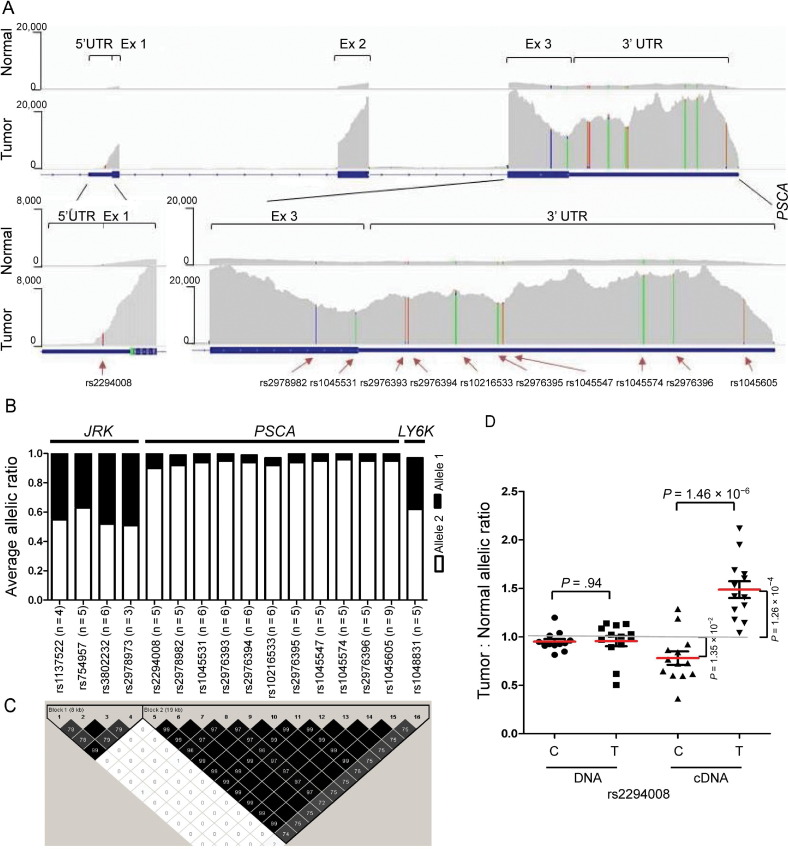
Figure 1.
Figure 1.
Allelic expression imbalance (AEI) in bladder tissue samples (see Supplementary Methods, available online). A) RNA sequencing analysis of PSCA expression in representative unpaired normal (n = 1) and tumor (n = 1) bladder tissue samples heterozygous for rs2294008. PSCA exon structure, level of mRNA expression, and location of transcribed heterozygous genetic variants are shown. B) Summary of AEI analysis in RNA sequencing of normal (n = 6) and tumor (n = 6) bladder tissue samples. Numbers of samples heterozygous for each of the transcribed single nucleotide polymorphisms (SNPs) within PSCA and surrounding genes, JRK and LY6K, are indicated in parenthesis. Strong AEI is suggested by the 90%:10% allelic ratio for 11 heterozygous transcribed variants within PSCA but not for variants within JRK and LY6K, which showed the expected 50%:50% allelic ratio. C) Linkage disequilibrium plot for 16 SNPs from JRK, PSCA, and Ly6K genes included in the AEI analysis. The PSCA variants with strong AEI are strongly correlated, as indicated by high pair-wise r 2 values (black shading on plot), calculated based on 3532 case patients and 5120 control subjects of European ancestry from the bladder cancer genome-wide association studies (21). D) Different sample types (DNA, cDNA, C and T alleles of rs2294008) are marked by circles, squares and triangles. Red bars mark mean values within each sample group. A grey line at the T:N allelic ratio “1” indicates allelic expression balance, whereas significant deviations from this line indicate allelic expression imbalance. Results of AEI measured by a TaqMan allele-specific expression/genotyping assay in DNA and cDNA from 14 normal and 13 tumor bladder tissue samples heterozygous for rs2294008. The analysis shows that AEI is detected in cDNA but not DNA samples. The Tumor:Normal expression ratio indicates increased expression of risk T allele, whereas decreased expression on nonrisk C allele in tumors compared with normal tissue samples.
Figure 2.
Figure 2.
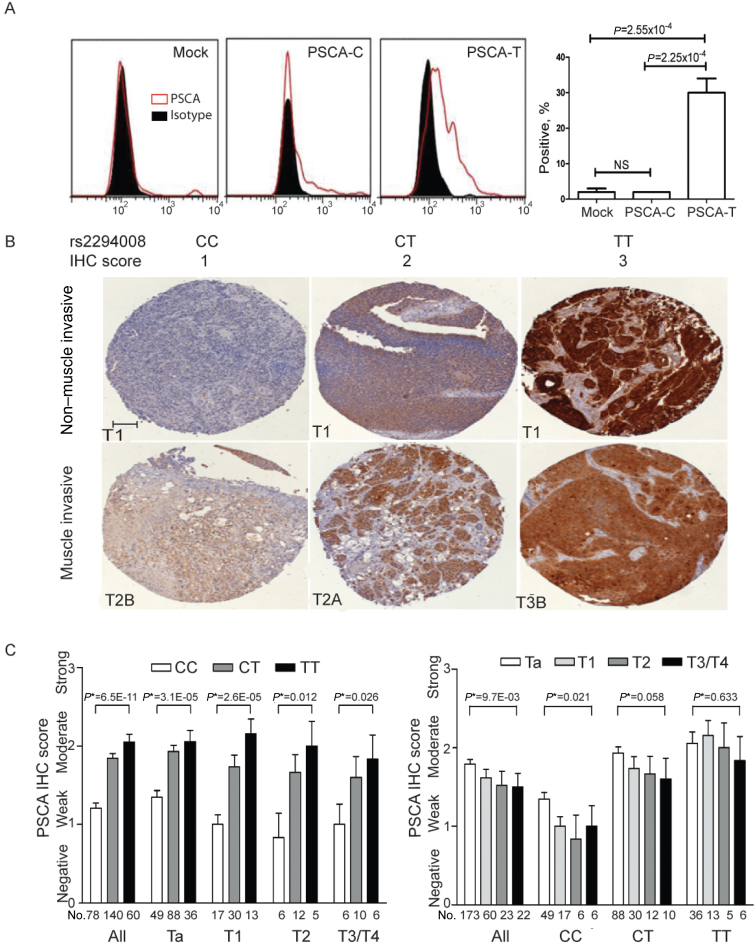
Effect of rs2294008 on prostate stem cell antigen (PSCA) protein expression (see Supplementary Methods, available online). A) Fluorescence activated cell sorting (FACS) analysis of cell surface PSCA expression in HeLa cells. The cells were transiently transfected with an empty vector (mock) or PSCA expression constructs with C and T alleles of rs2294008, encoding PSCA proteins with leader peptides of 11 (C allele) or 20 amino acids (T allele). The staining with anti-PSCA antibody 1G8 (red curves) is compared with isotype control (black area). Percentage of positive cells (y axis) is plotted against fluorescence intensity in logarithmic scale (x axis). The graphic representation of FACS results (right panel) shows mean values of three biological replicates with standard errors of the mean; P values are from a two-sided unpaired t test. Cell surface PSCA expression is statistically significantly increased in cells transfected with an expression construct carrying the risk T allele of rs2294008 compared with the construct with a nonrisk C allele of rs2294008 and mock control, which also shows negligible endogenous level of PSCA expression in HeLa cells. NS = not statistically significant. B) Immunohistochemistry (IHC) analysis of PSCA expression using bladder tumor tissue microarrays. Representative images are from groups of samples stratified by rs2294008 genotypes (CC, CT, TT) and tumor stages—non-muscle-invasive tumors (stages Ta and T1) and muscle-invasive tumors (stages T2–T4). PSCA expression was detected with 1G8 anti-PSCA monoclonal antibody (brown staining) and scored as 0 (negative), 1 (weak), 2 (moderate), and 3 (strong), based on overall intensity. Scale bar corresponds to 0.1mm, and all images are presented in the same scale. C) Association between PSCA IHC scores and rs2294008 genotypes, stratified by tumor stage (left panel) or, for tumor stages, stratified by rs2294008 genotypes (right panel). PSCA IHC scores are shown as mean values with standard errors; two-sided P* values were estimated from multivariable linear models, assuming additive genetic effect of rs2294008, adjusted for age, sex, study site, and smoking status (ever or never). Single nucleotide polymorphism rs2294008 was found to be the strongest predictor for PSCA expression, regardless of all other factors tested, such as age, sex, smoking status, and tumor grade and stage.

References

    1. Chung CC, Chanock SJ. Current status of genome-wide association studies in cancer. Hum Genet. 2011; 130(1):59–78 - PubMed
    1. Rothman N, Garcia-Closas M, Chatterjee N, et al. A multi-stage genome-wide association study of bladder cancer identifies multiple susceptibility loci. Nat Genet. 2010; 42(11):978–984 - PMC - PubMed
    1. Wu X, Ye Y, Kiemeney LA, et al. Genetic variation in the prostate stem cell antigen gene PSCA confers susceptibility to urinary bladder cancer. Nat Genet. 2009; 41(9):991–995 - PMC - PubMed
    1. Amara N, Palapattu GS, Schrage M, et al. Prostate stem cell antigen is overexpressed in human transitional cell carcinoma. Cancer Res. 2001; 61(12):4660–4665 - PubMed
    1. Barbisan F, Mazzucchelli R, Santinelli A, et al. Expression of prostate stem cell antigen in high-grade prostatic intraepithelial neoplasia and prostate cancer. Histopathology. 2010; 57(4):572–579 - PubMed

Publication types

MeSH terms