


Phylogeography and seed dispersal in islands: the case of Rumex bucephalophorus subsp. canariensis (Polygonaceae)
- PMID: 23267005
- PMCID: PMC3555536
- DOI: 10.1093/aob/mcs284
Phylogeography and seed dispersal in islands: the case of Rumex bucephalophorus subsp. canariensis (Polygonaceae)
Abstract
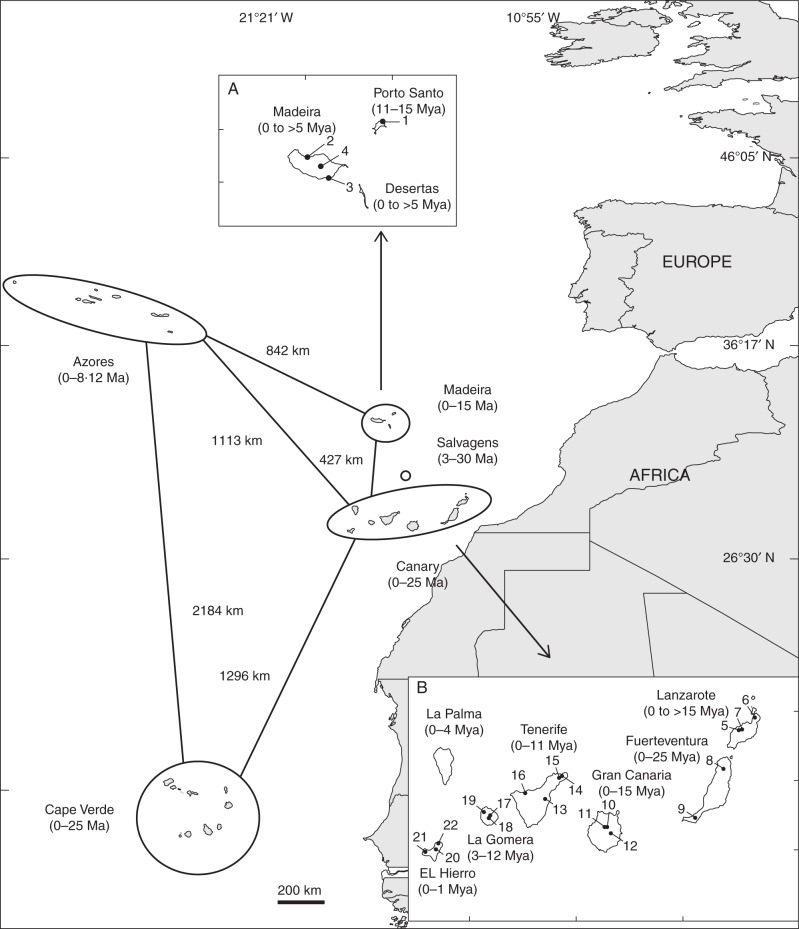
Background and aims: Rumex bucephalophorus subsp. canariensis is an endemic taxon to Macaronesia with diaspore polymorphism. The origin and colonizing route of this taxon in Macaronesia was studied using molecular data and information on diaspore types.
Methods: Amplified fragment length polymorphism (AFLP) was used in 260 plants from 22 populations of R. bucephalophorus subsp. canariensis, four from the Madeiran archipelago and 18 from the Canary archipelago. Diaspore production was analysed in 9-50 plants from each population used for AFLP analysis. One hundred and one plants from the Madeiran archipelago and 375 plants from the Canary Islands were studied. For each plant the type of diaspore produced was recorded.
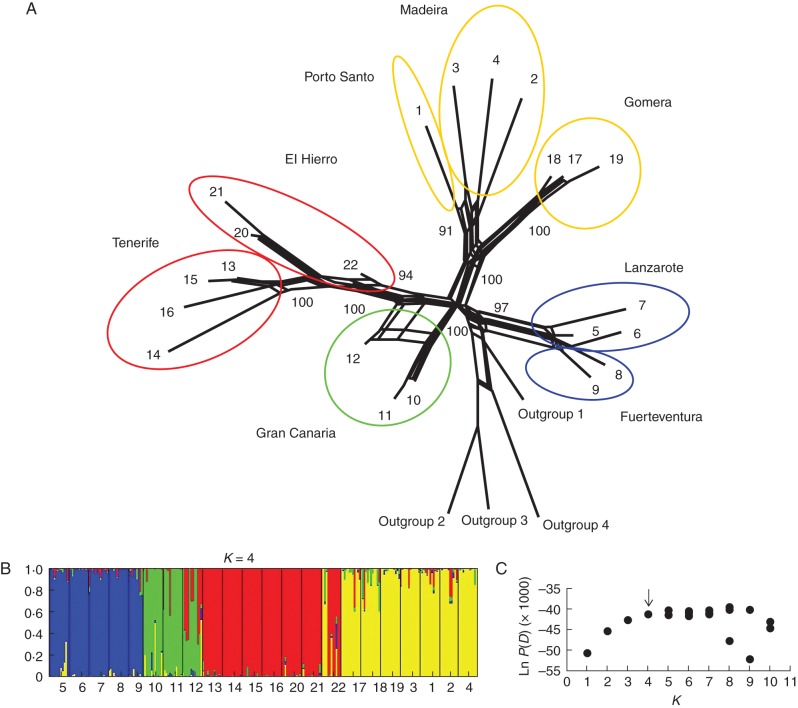
Key results: Overall populations had low genetic diversity but they showed a geographical pattern of genetic diversity that was higher in the older eastern islands than in the younger western ones. Two types of dispersible diaspores were found: in the eastern Canary islands (Lanzarote, Fuerteventura and Gran Canaria), plants produced exclusively long-dispersible diaspores, whereas in the western Canary islands (Tenerife, La Gomera, El Hierro) and the Madeiran archipelago plants produced exclusively short-dispersible diaspores. Genetically, the studied populations fell into four main island groups: Lanzarote-Fuerteventura, Gran Canaria, Tenerife-El Hierro and La Gomera-Madeira archipelago.
Conclusions: A Moroccan origin of R. bucephalophorus subsp. canariensis is hypothesized with a colonization route from the eastern to the western islands. In addition, at least one gene flow event from La Gomera to the Madeiran archipelago has taken place. During the colonization process the type of dispersible diaspore changed so that dispersability decreased in populations of the westernmost islands.
Figures
References
-
- Allan GJ, Francisco-Ortega J, Santos-Guerra A, Boerner E, Zimmer EA. Molecular phylogenetic evidence for the geographic origin and classification of Canary Island Lotus (Fabaceae: Loteae) Molecular Phylogenetics and Evolution. 2004;32:123–138. - PubMed
-
- Andersen H. Research on islands: classic, recent and prospective approaches. In: Vitousek PM, Loope LL, Adsersen H, editors. Berlin: Springer: Islands: biological diversity and ecosystem function; 1995. pp. 7–21.
-
- Balao F, Valente LM, Vargas P, Herrera J, Talavera S. Radiative evolution of polyploid races of the Iberian carnation Dianthus broteri (Caryophyllaceae) New Phytologist. 2010;187:542–551. - PubMed
-
- Baldwin BG, Crawford DJ, Francisco-Ortega J, Kim S-C, Sang T, Stuessy TF. Molecular phylogenetics insights on the origin and evolution of oceanic island plants. In: Soltis DE, Soltis PS, Doyle JJ, editors. New York: Kluwer: Molecular systematics of plants, II: ADN sequencing; 1998. pp. 410–441.
-
- Barber JC, Francisco-Ortega J, Santos-Guerra A, Turner KG, Jansen RK. Origin of Macaronesian Sideritis L. (Lamioideae: Lamiaceae) inferred from nuclear and chloroplast sequence datasets. Molecular Phylogenetics and Evolution. 2002;23:293–306. - PubMed
