. 2012 Dec:2:243-248.
doi: 10.1016/j.ijpddr.2012.01.002.

The Entamoeba histolytica serum-inducible transmembrane kinase EhTMKB1-9 is involved in intestinal amebiasis

Affiliations

The Entamoeba histolytica serum-inducible transmembrane kinase EhTMKB1-9 is involved in intestinal amebiasis

Mayuresh M Abhyankar et al. Int J Parasitol Drugs Drug Resist. 2012 Dec.

Abstract

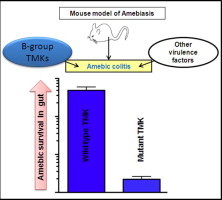
Entamoeba histolytica possesses a family of approximately 100 putative transmembrane kinases (TMKs), indicating that the parasite has an extensive means of environmental sensing. The TMKs have been divided into nine sub-groups based on the sequence composition of their intracellular kinase as well as extracellular cysteine-rich domains. EhTMKB1-9 has been recently shown to be expressed in proliferating trophozoites and induced by serum. Interference with EhTMKB1-9 by antisense RNA knockdown or expression of a truncated protein diminished proliferation, adhesion and cytotoxicity. Here we report the involvement of EhTMKB1-9 in phagocytosis and its virulence function in the formation of amebic colitis. Trophozoites induced to express higher levels of wild type EhTMKB1-9 showed increased capacity for endocytosis. In contrast, cells compromised for the EhTMKB1-9 expression through antisense inhibition showed significantly lower levels of phagocytosis and endocytosis under the experimental conditions. The role of EhTMKB1-9 as a virulence factor was studied using animal models of amebiasis. Trophozoites expressing high levels of mutant protein lacking the kinase domain showed a competitive disadvantage with regard to survival as well as invasive phenotype in the murine model of amebic colitis. The same parasites however, were not compromised in their ability to generate abscess in the gerbil model of invasive liver amebiasis. EhTMKB1-9 is the second member from the "B" group of EhTMKs which seems to be deployed by the parasite during intestinal infection. TMKs are attractive targets for drug development because of their requirement in virulence and proliferation.


Figures
None
Graphical abstract
Fig. 1
Fig. 1
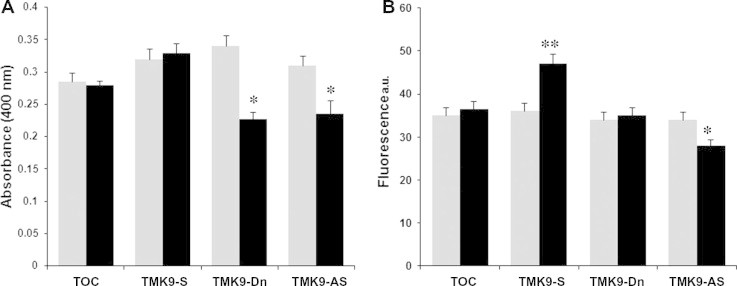
Role of EhTMKB1-9 in phagocytosis and pinocytosis. Expression of the transfectants was uninduced (grey bars) or induced (black bars) with 20 μg/ml tetracycline for 48 h. (A) Quantification of erythrophagocytosis in cells showing over-expression or suppression of EhTMKB1-9. Trophozoites were incubated with RBCs for 10 min at 37 °C followed by lysis of adherent RBCs with chilled water. The trophozoites with phagocytosed RBCs were then lysed using formic acid and amount of heme released was quantitated by measuring absorbance at 400 nm. The values are expressed as an average of three independent experiments ±SD. (B) Quantification of liquid phase pinocytosis. The different transfectants were incubated with 2 mg/ml RITC-dextran in PBS for 30 min and subjected to quantitative estimation by spectrofluorometer. The values are expressed as an average of three independent experiments ±SD. Abbreviations: TOC – tetracycline inducible vector control; TMK9 S – construct expressing full length EhTMKB1-9; TMK9 Dn – construct expressing kinase domain deletion mutant of EhTMKB1-9; TMK9 AS – construct expressing antisense RNA to N-terminal 1 kb region of EhTMKB1-9. p value <0.05; ∗∗p value <0.001.
Fig. 2
Fig. 2
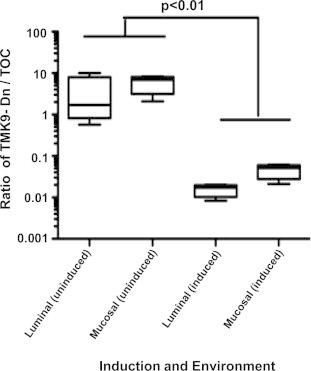
Competitive disadvantage of amebae expressing the dominant negative TMKB1-9 protein in the murine model of amebic colitis. Amebae were induced for 48 h with 20 μg/ml tetracycline where indicated. Mice carrying the susceptible Q223R Lepr allele were infected intracecally with induced TOC and TMK9-Dn amebae mixed in a 1:1 ratio. As a control, an equal number of mice were infected with the mixture of uninduced ameba. Induction was maintained by the addition of 0.2 mg/ml doxycycline and 5% sucrose in drinking water post-infectious challenge as appropriate. All mice were sacrificed 4 days after infection, and the ratios of the TMK9-Dn to the control TOC vector were determined by construct specific qPCR in amebae isolated from two different in vivo locations – the luminal gut (luminal) or the gut surface (mucosal). Values were corrected by the input data, and statistical significance was determined using t test. The difference in ratio was statistically significant in the luminal as well as mucosal samples (p < 0.01).
Fig. 3
Fig. 3
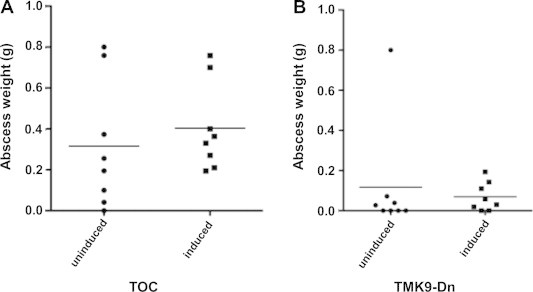
Induction of the EhTMKB1-9 dominant negative mutant did not affect liver abscess formation: Amebae transfected with the control vector or the plasmid expressing kinase domain deletion mutant of EhTMKB1-9 were grown in presence or absence of 20 μg/ml tetracycline for 48 h prior to infection. Amebae (106) were inoculated into different liver lobes of 50–60 day old Mongolian male gerbils. Induction was maintained where appropriate by adding 2 mg/ml doxycycline in the drinking water. Gerbils were sacrificed 7 days after infection, livers extracted and abscess weights measured. (A) Comparison between abscess weights formed by uninduced or induced vector transfectants (B) comparison between abscess weights formed by uninduced or induced EhTMKB9-Dn transfectants. The X-axis shows transfectant line and treatment whereas the Y-axis represents abscess weight.

References

    1. Asgharpour A., Gilchrist C., Baba D., Hamano S., Houpt E. Resistance to intestinal Entamoeba histolytica infection is conferred by innate immunity and Gr-1+ cells. Infect. Immun. 2005;73:4522–4529. - PMC - PubMed
    1. Beck D.L., Boettner D.R., Dragulev B., Ready K., Nozaki T., Petri W.A., Jr. Identification and gene expression analysis of a large family of transmembrane kinases related to the Gal/GalNAc lectin in Entamoeba histolytica. Eukaryotic Cell. 2005;4:722–732. - PMC - PubMed
    1. Boettner D.R., Huston C.D., Linford A.S., Buss S.N., Houpt E., Sherman N.E., Petri W.A., Jr. Entamoeba histolytica phagocytosis of human erythrocytes involves PATMK, a member of the transmembrane kinase family. PLoS Pathog. 2008;4:e8. - PMC - PubMed
    1. Buss S.N., Hamano S., Vidrich A., Evans C., Zhang Y., Crasta O.R., Sobral B.W., Gilchrist C.A., Petri W.A., Jr. Members of the Entamoeba histolytica transmembrane kinase family play non-redundant roles in growth and phagocytosis. Int. J. Parasitol. 2010;40:833–843. - PMC - PubMed
    1. Chadee K., Meerovitch E. Entamoeba histolytica: diffuse liver inflammation in gerbils (Meriones unguiculatus) with experimentally induced amebic liver abscess. J. Protozool. 1989;36:154–158. - PubMed

LinkOut - more resources