. 2013 Jan 23;135(3):1155-62.
doi: 10.1021/ja3119674. Epub 2013 Jan 11.

Biosynthetic multitasking facilitates thalassospiramide structural diversity in marine bacteria

Affiliations

Biosynthetic multitasking facilitates thalassospiramide structural diversity in marine bacteria

Avena C Ross et al. J Am Chem Soc. .

Abstract

Thalassospiramides A and B are immunosuppressant cyclic lipopeptides first reported from the marine α-proteobacterium Thalassospira sp. CNJ-328. We describe here the discovery and characterization of an extended family of 14 new analogues from four Tistrella and Thalassospira isolates. These potent calpain 1 protease inhibitors belong to six structure classes in which the length and composition of the acylpeptide side chain varies extensively. Genomic sequence analysis of the thalassospiramide-producing microbes revealed related, genus-specific biosynthetic loci encoding hybrid nonribosomal peptide synthetase/polyketide synthases consistent with thalassospiramide assembly. The bioinformatics analysis of the gene clusters suggests that structural diversity, which ranges from the 803.4 Da thalassospiramide C to the 1291.7 Da thalassospiramide F, results from a complex sequence of reactions involving amino acid substrate channeling and enzymatic multimodule skipping and iteration. Preliminary biochemical analysis of the N-terminal nonribosomal peptide synthetase module from the Thalassospira TtcA megasynthase supports a biosynthetic model in which in cis amino acid activation competes with in trans activation to increase the range of amino acid substrates incorporated at the N terminus.


Conflict of interest statement

The authors declare no competing financial interest.

Figures
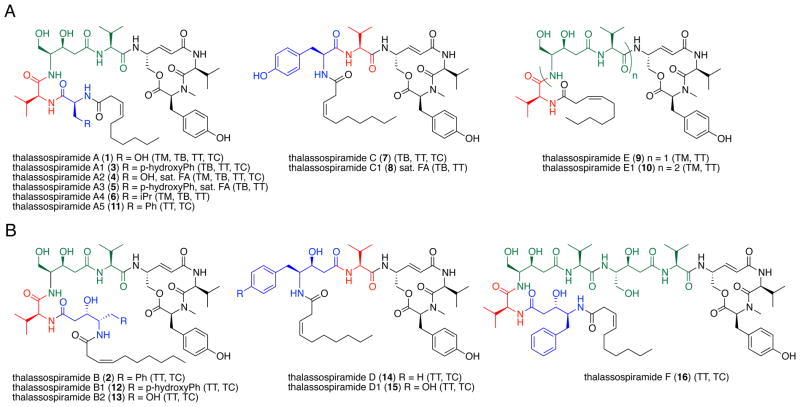
Figure 1
Figure 1
Structures of A) thalassospiramide A-like and B) thalassospiramide B-like natural products (blue portions indicate N-terminal amino acids used to distinguish the two groups, green portions highlight a repetitive amino acid motif, red portions indicate a common valine residue and black portions are conserved throughout the family). Producing organism(s) shown in brackets include Tistrella mobilis (TM), Tistrella bauzanensis (TB), Thalassospira sp. TrichSKD10 (TT), and Thalassospira sp. CNJ-328 (TC). Several compounds (4,5,8) have a saturated fatty acid at the N-terminus (sat. FA).
Figure 2
Figure 2
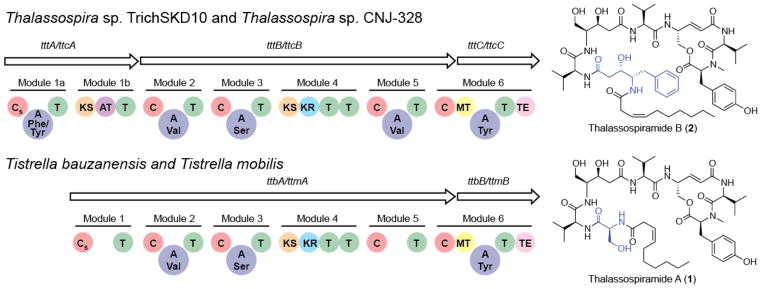
Homologous thalassospiramide gene clusters from Tistrella and Thalassospira. The T. mobilis KA081020-065 and T. bauzanensis TIO7329 thalassospiramide clusters ttm and ttb, respectively, encode the biosynthesis of thalassospiramide A-like molecules only, whereas the Thalassospira sp. CNJ-328 and Thalassospira sp. TrichSKD10 clusters ttc and ttt, respectively, encode the synthesis for both thalassospiramide A and B-like molecules. Domain abbreviations: Starter condensation (CS), condensation (C), adenylation (A), thiolation (T), ketosynthase (KS), acyltransferase (AT) ketoreductase (KR), methyltransferase (MT), thioesterase (TE).
Figure 3
Figure 3
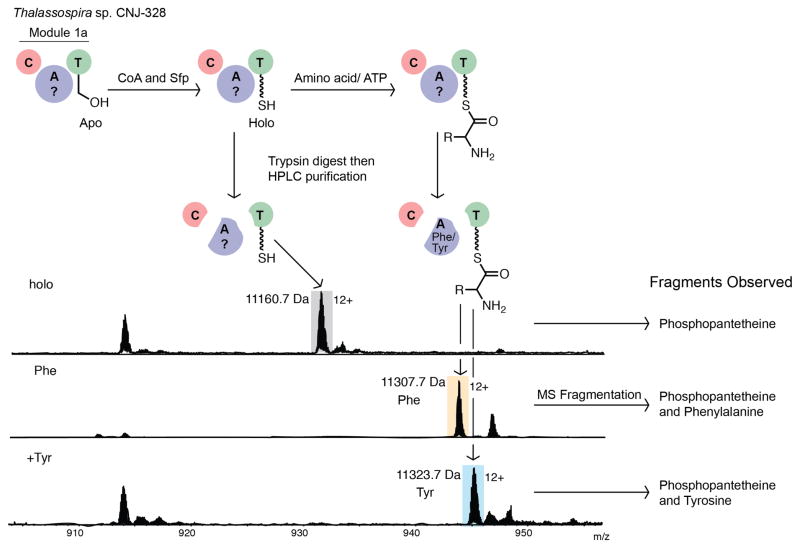
Determination of the amino acid selectivity of TtcA(CAT) via the phosphopantetheine ejection assay. Shown are the results for the holo enzyme without addition of amino acids and after treatment of the enzyme with L-phenylalanine or L-tyrosine. All other proteinogenic amino acids, including serine and valine, were not loaded as substrates (see Figures S1–S2).
Figure 4
Figure 4
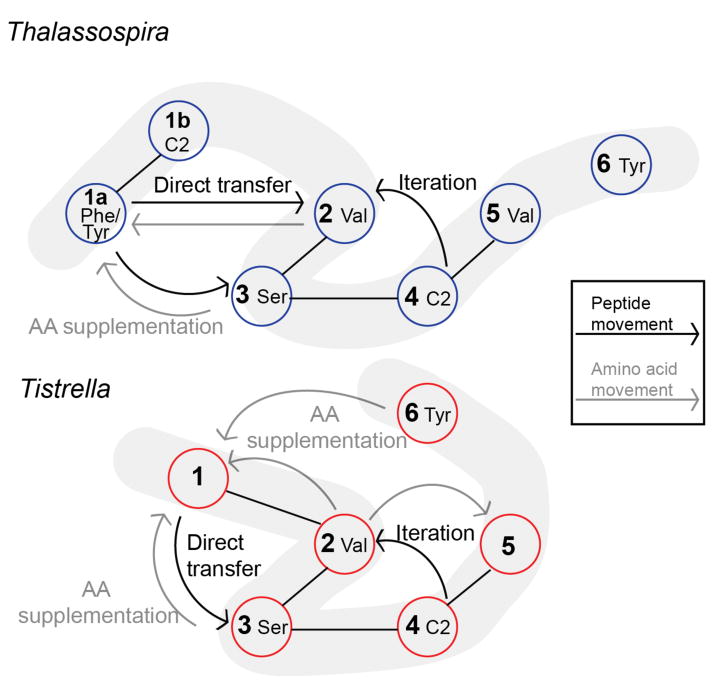
Representation of the proposed thalassospiramide biosynthetic pathways in Thalassospira and Tistrella. The pale grey ribbons represent the linear sequence of the gene products, black lines depict the modules located within the same protein, black arrows show the forward/backward movement of the growing peptide chain along the enzyme assembly line and grey arrows show the intermodular movement of amino acid substrates from supplementing A-domains to T-domains.

References

    1. Fischbach MA, Walsh CT. Chem Rev. 2006;106:3468. - PubMed
    1. Condurso HL, Bruner SD. Nat Prod Rep. 2012;29:1099. - PMC - PubMed
    1. Koglin A, Walsh CT. Nat Prod Rep. 2009;26:987. - PMC - PubMed
    1. Hur GH, Vickery CR, Burkart MD. Nat Prod Rep. 2012;29:1074. - PMC - PubMed
    1. Pieper R, Luo G, Cane DE, Khosla C. Nature. 1995;378:263. - PubMed

Publication types

MeSH terms