


The significance of the north water polynya to arctic top predators
- PMID: 23271401
- PMCID: PMC3698320
- DOI: 10.1007/s13280-012-0357-3
The significance of the north water polynya to arctic top predators
Abstract
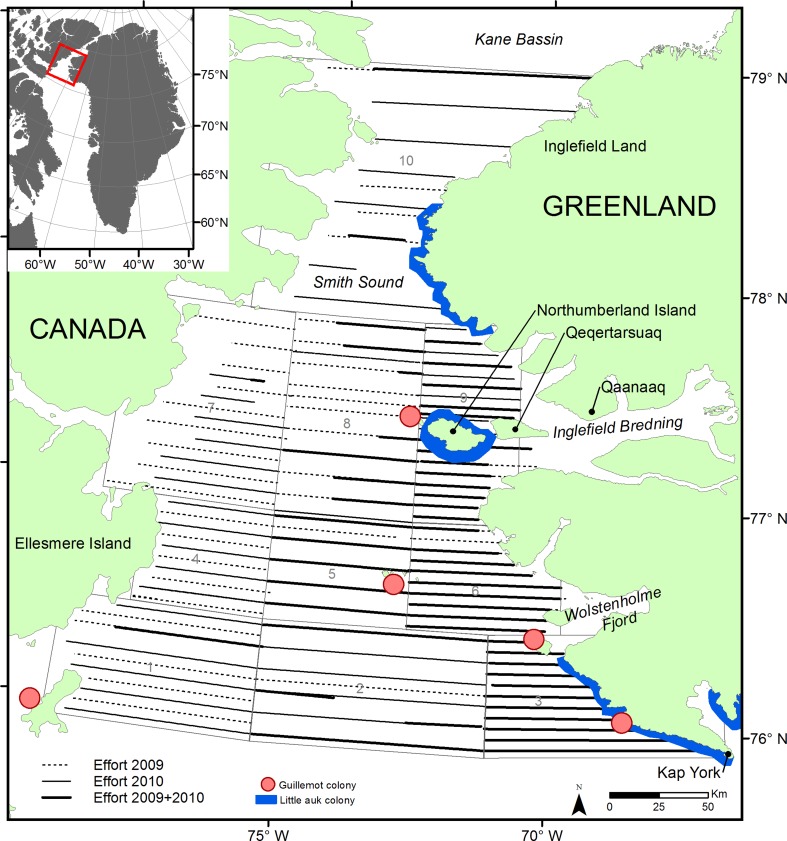
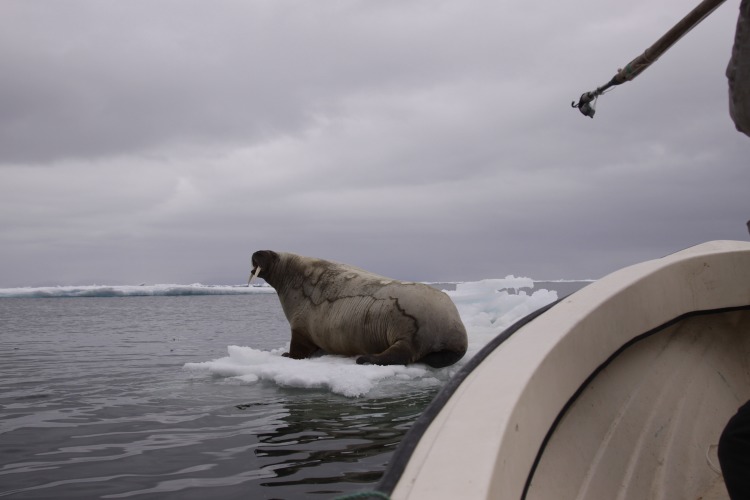
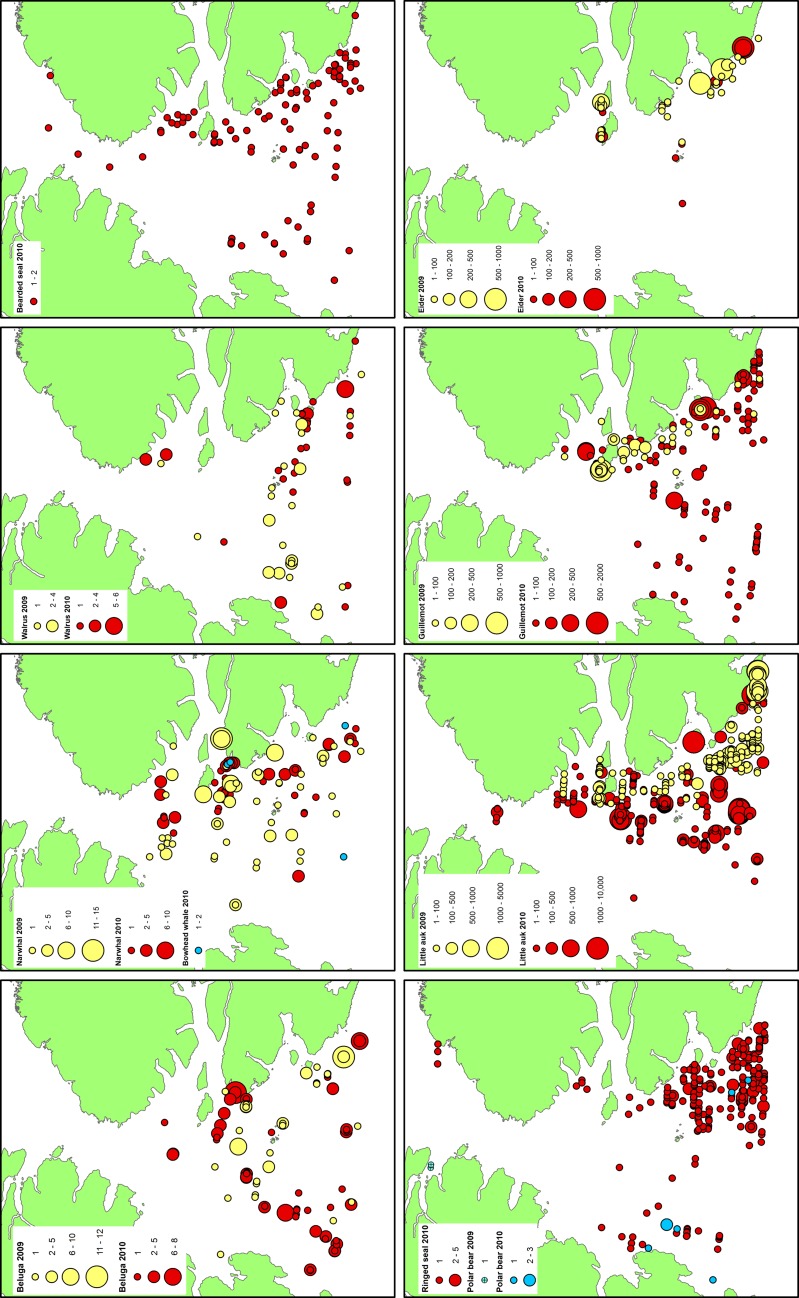
The North Water polynya (~76°N to 79°N and 70°W to 80°W) is known to be an important habitat for several species of marine mammals and sea birds. For millennia, it has provided the basis for subsistence hunting and human presence in the northernmost part of Baffin Bay. The abundance of air-breathing top predators also represents a potential source of nutrient cycling that maintains primary production. In this study, aerial surveys conducted in 2009 and 2010 were used for the first time to map the distribution and estimate the abundance of top predators during spring in the North Water. Belugas (Delphinapterus leucas) were not detected north of 77°20'N but were found along the coast of West Greenland and offshore in the middle of the North Water with an abundance estimated at 2245 (95 % CI 1811-2783). Narwhals (Monodon monoceros) were widely distributed on the eastern side of the North Water with an estimate of abundance of 7726 (3761-15 870). Walruses (Odobenus rosmarus) were found across the North Water over both shallow and deep (>500 m) water with an estimated abundance of 1499 (1077-2087). Bearded (Erignathus barbatus) and ringed seals (Phoca hispida) used the large floes of ice in the southeastern part of the North Water for hauling out. Most polar bears (Ursus maritimus) were detected in the southern part of the polynya. The abundances of bearded and ringed seals were 6016 (3322-10 893) and 9529 (5460-16 632), respectively, and that of polar bears was 60 (12-292). Three sea bird species were distributed along the Greenland coast (eiders, Somateria spp.), in leads and cracks close to the Greenland coast (little auks, Alle alle) or widely in open water (thick-billed guillemots, Uria lomvia).
Figures


References
-
- Barber DG, Hanesiak JM, Chan W, Piwowar J. Sea-ice and meteorological conditions in northern Baffin Bay and the North Water polynya between 1979 and 1996. Atmosphere-Ocean. 2001;39:343–359. doi: 10.1080/07055900.2001.9649685. - DOI
-
- Born, E.W. 1987. Aspects of present-day maritime subsistence hunting in the Thule Area, Northwest Greenland. In Between Greenland and America, eds. L. Hacquebord and R. Vaughan, 109–132. The Netherlands: Arctic Centre, University of Groningen.
-
- Born EW, Teilmann J, Riget F. Haul-out activity of ringed seals (Phoca hispida) determined from satellite telemetry. Marine Mammal Science. 2002;18:167–181. doi: 10.1111/j.1748-7692.2002.tb01026.x. - DOI
-
- Born EW, Teilmann J, Acquarone M, Riget F. Habitat use of ringed seals (Phoca hispida) in the North Water area (North Baffin Bay) Arctic. 2004;57:129–142.
Publication types
MeSH terms
LinkOut - more resources
Full Text Sources
Miscellaneous
