Obesity interacts with cerebral hypoperfusion to exacerbate cognitive impairment in older adults with heart failure
- PMID: 23272007
- PMCID: PMC3507266
- DOI: 10.1159/000343222
Obesity interacts with cerebral hypoperfusion to exacerbate cognitive impairment in older adults with heart failure
Abstract
Background: Cerebral hypoperfusion accompanies heart failure (HF) and is associated with reduced cognitive performance. Obesity is prevalent in persons with HF and is also a likely contributor to cognitive function, as it has been independently linked to cognitive impairment in healthy individuals. The current study examined the association between obesity and cognitive performance among older adults with HF and whether obesity interacts with cerebral hypoperfusion to exacerbate cognitive impairment.
Methods: Patients with HF (n = 99, 67.46 ± 11.36 years of age) completed neuropsychological testing and impedance cardiography. Cerebral blood flow velocity (CBF-V) measured by transcranial Doppler sonography quantified cerebral perfusion and body mass index (BMI) operationalized obesity.
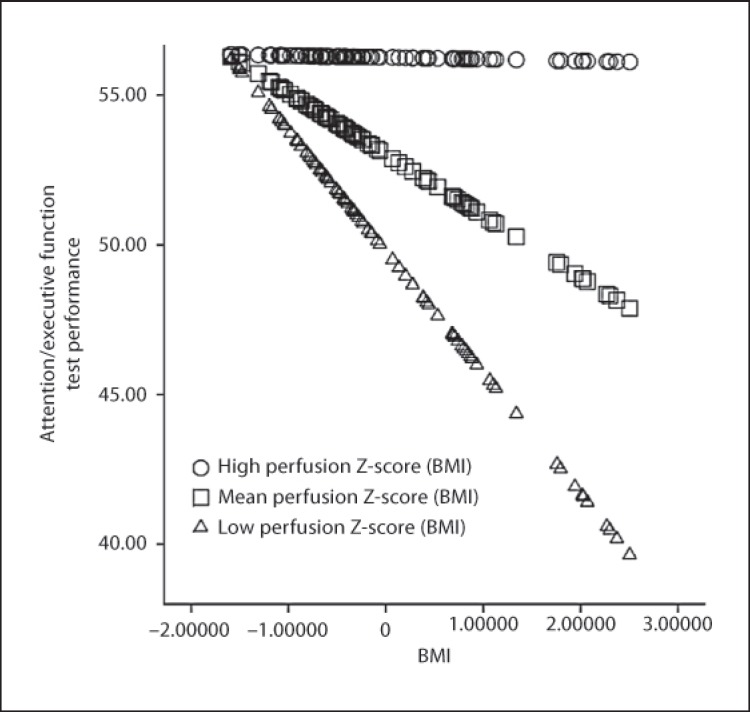
Results: A hierarchical regression analysis showed that lower CBF-V was associated with reduced performance on tests of attention/executive function and memory. Elevated BMI was independently associated with reduced attention/executive function and language test performance. Notably, a significant interaction between CBF-V and BMI indicated that a combination of hypoperfusion and high BMI has an especially adverse influence on attention/executive function in HF patients.
Conclusions: The current findings suggest that cerebral hypoperfusion and obesity interact to impair cognitive performance in persons with HF. These results may have important clinical implications, as HF patients who are at high risk for cerebral hypoperfusion may benefit from weight reduction.
Keywords: Body mass index; Cerebral perfusion; Cognitive function; Heart failure; Obesity.
Figures
References
-
- Roger VL, Go AS, Lloyd-Jones DM, Benjamin EJ, Berry JD, Borden WB, Bravata DM, Dai S, Ford ES, Fox CS, Fullerton HJ, Gillespie C, Hailpern SM, Heit JA, Howard VJ, Kissela BM, Kittner SJ, Lackland DT, Lichtman JH, Lisabeth LD, Makuc DM, Marcus GM, Marelli A, Matchar DB, Moy CS, Mozaffarian D, Mussolino ME, Nichol G, Paynter NP, Soliman EZ, Sorlie PD, Sotoodehnia N, Turan TN, Virani SS, Wong ND, Woo D, Turner MB, American Heart Association Statistics Committee and Stroke Statistics Subcommittee Heart disease and stroke statistics – 2012 update. Circulation. 2012;125:e2–e220. - PMC - PubMed
-
- Jencks SF, Williams MV, Coleman EA. Rehospitalization among patients in Medicare fee-for-service program. N Engl J Med. 2009;360:1418–1428. - PubMed
-
- Roger VL, Weston SA, Redfield MM, Hellermann-Homan JP, Killian J, Yawn BP, Jacobsen SJ. Trends in heart failure incidence and survival in a community-based population. JAMA. 2004;292:344–350. - PubMed
-
- Bennett SJ, Oldridge NB, Eckert G, Embree JL, Browning S, Hou N, Chui M, Deer M, Murray MD. Comparison of quality of life measures in heart failure. Nurs Res. 2003;52:207–216. - PubMed
Grants and funding
LinkOut - more resources
Full Text Sources
Research Materials
Miscellaneous