


The pattern of attrition from an antiretroviral treatment program in Nigeria
- PMID: 23272094
- PMCID: PMC3521762
- DOI: 10.1371/journal.pone.0051254
The pattern of attrition from an antiretroviral treatment program in Nigeria
Abstract
Objective: To evaluate the rate and factors associated with attrition of patients receiving ART in tertiary and secondary hospitals in Nigeria.
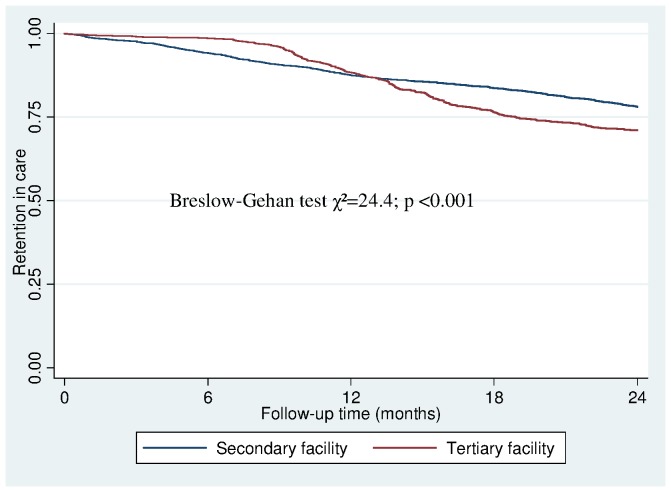
Methods and findings: We reviewed patient level data collected between 2007 and 2010 from 11 hospitals across Nigeria. Kaplan-Meier product-limit and Cox regression were used to determine probability of retention in care and risk factors for attrition respectively. Of 6,408 patients in the cohort, 3,839 (59.9%) were females, median age of study population was 33years (IQR: 27-40) and 4,415 (69%) were from secondary health facilities. The NRTI backbone was Stavudine (D4T) in 3708 (57.9%) and Zidovudine (ZDV) in 2613 (40.8%) of patients. Patients lost to follow up accounted for 62.7% of all attrition followed by treatment stops (25.3%) and deaths (12.0%). Attrition was 14.1 (N = 624) and 15.1% (N = 300) in secondary and tertiary hospitals respectively (p = 0.169) in the first 12 months on follow up. During the 13 to 24 months follow up period, attrition was 10.7% (N = 407) and 19.6% (N = 332) in secondary and tertiary facilities respectively (p<0.001). Median time to lost to follow up was 11.1 (IQR: 6.1 to 18.5) months in secondary compared with 13.6 (IQR: 9.9 to 17.0) months in tertiary sites (p = 0.002). At 24 months follow up, male gender [AHR 1.18, 95% CI: 1.01-1.37, P = 0.038]; WHO clinical stage III [AHR 1.30, 95%CI: 1.03-1.66, P = 0.03] and clinical stage IV [AHR 1.90, 95%CI: 1.20-3.02, p = 0.007] and care in a tertiary hospital [AHR 2.21, 95% CI: 1.83-2.67, p<0.001], were associated with attrition.
Conclusion: Attrition could potentially be reduced by decentralizing patients on ART after the first 12 months on therapy to lower level facilities, earlier initiation on treatment and strengthening adherence counseling amongst males.
Conflict of interest statement
Figures
References
-
- WHO, UNAIDS, UNICEF (2010) Towards universal access: scaling up priority HIV/AIDS interventions in the health sector. Treatment and care for people living with HIV. pp. 4.
-
- Tayler-Smith K, Zachariah R, Manzi M, Kizito W, Vandenbulcke A, et al. (2011) Antiretroviral treatment uptake and attrition among HIV-positive patients with tuberculosis in Kibera, Kenya. Tropical Medicine and International Health 16. - PubMed
Publication types
MeSH terms
Substances
Grants and funding
LinkOut - more resources
Full Text Sources
Medical
