


Percentiles of percentage body fat in german children and adolescents: an international comparison
- PMID: 23272283
- PMCID: PMC3530302
- DOI: 10.4103/2008-7802.104855
Percentiles of percentage body fat in german children and adolescents: an international comparison
Abstract
Background: Age- and gender-specific percentiles of body mass index in children and adolescents are a cornerstone categorizing overweight and obesity in youths worldwide. Since corresponding worldwide growth curves of percent body fat (% BF) are missing, the purpose was to contribute smoothed percentiles of percentage body fat from a large urban sample of German youths and to include them in actual national and international percentile curves.
Methods: We estimated % BF in 22 113 German youths aged 3 to 18 years participating in yearly cross-sectional surveys of the PEP Family Heart Study Nuremberg between 1993 and 2007. Percentage body fat was calculated from skinfold thickness using Slaughter equations. Ten smoothed percentile curves were constructed for % BF using the LMS method significant.
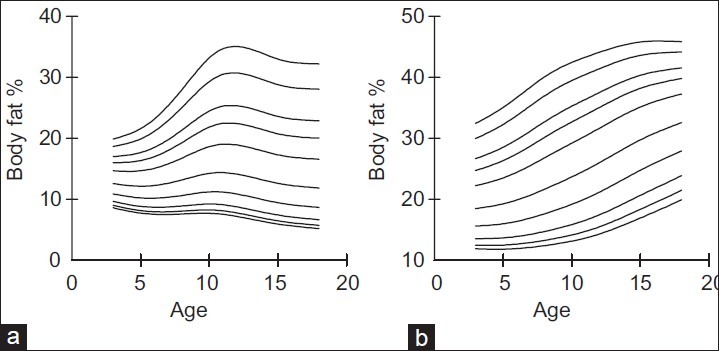
Results: The age- and gender-specific reference curves demonstrate a continuous age-dependent increase of percentage body fat from age 3 to 18 years in girls; whereas in boys, the percentile curves steeply increase from 5 to 11 years and thereafter slightly decrease. The shape of the percentile curves, the maxima among boys at puberty and the median % BF at age 18 years are consistent with most of the current growth curves. % BF in urban studies seems to be lower than in national surveys .
Conclusions: More than these nine studies should contribute to worldwide-standardized growth charts for % BF to better define overweight and obesity in youth.
Keywords: Germany; Youths; international comparison; percentage body fat; reference curves.
Conflict of interest statement
Figures
References
-
- National Center for Health Statistics. Pediatric Growth Charts. [Last cited in 2000]. Available from: www.cdc.gov/growthcharts .
-
- Prentice AM, Jebb SA. Beyond body mass index. ObesRev. 2001;2:141–7. - PubMed
-
- Garn SM, Leonard WR, Hawthorne VM. Three limitations of body mass index. Am J Clin Nutr. 1986;44:996–7. - PubMed
-
- Sarria A, Garcia Llop LA, Moreno LA, Fleta J, Morellón MP, Bueno M. Skin fold thickness measurements are better predictors of body fat percentage than body mass index in male Spanish children and adolescents. Eur J Clin Nutr. 1998;52:573–6. - PubMed
LinkOut - more resources
Full Text Sources
Miscellaneous