


Loneliness predicts pain, depression, and fatigue: understanding the role of immune dysregulation
- PMID: 23273678
- PMCID: PMC3633610
- DOI: 10.1016/j.psyneuen.2012.11.016
Loneliness predicts pain, depression, and fatigue: understanding the role of immune dysregulation
Abstract
Objective: The pain, depression, and fatigue symptom cluster is an important health concern. Loneliness is a common risk factor for these symptoms. Little is known about the physiological mechanisms linking loneliness to the symptom cluster; immune dysregulation is a promising candidate. Latent herpesvirus reactivation, which is reflected by elevated herpesvirus antibody titers, provides a window into immune dysregulation. Cytomegalovirus (CMV) and Epstein-Barr virus (EBV) are two common herpesviruses.
Methods: Participants were 200 breast cancer survivors who were 2 months to 3 years post-treatment at the time of the study. They completed questionnaires and provided a blood sample that was assayed for CMV and EBV antibody titers.
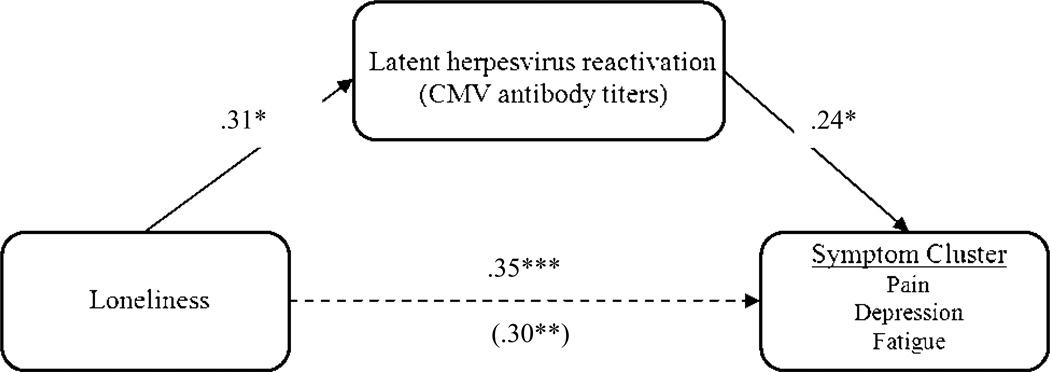
Results: Lonelier participants experienced more pain, depression, and fatigue than those who felt more socially connected. Lonelier participants also had higher CMV antibody titers which, in turn, were associated with higher levels of the pain, depression, and fatigue symptom cluster. Contrary to expectations, EBV antibody titers were not associated with either loneliness or the symptom cluster.
Conclusions: The pain, depression, and fatigue symptom cluster is a notable clinical problem, especially among cancer survivors. Accordingly, understanding the risk factors for these symptoms is important. The current study suggests that loneliness enhances risk for immune dysregulation and the pain, depression, and fatigue symptom cluster. The present data also provide a glimpse into the pathways through which loneliness may impact health.
Copyright © 2012 Elsevier Ltd. All rights reserved.
Conflict of interest statement
All authors declare that there are no financial conflicts of interest.
Figures
References
-
- Aggarwal BB, Shishodia S, Sandur SK, Pandey MK, Sethi G. Inflammation and cancer: How hot is the link? Biochem Pharmacol. 2006;72:1605–1621. - PubMed
-
- Bair MJ, Robinson RL, Katon W, Kroenke K. Depression and pain comorbidity: A literature review. Arch Intern Med. 2003;163:2433–2445. - PubMed
-
- Becker N, Bondegaard Thomsen A, Olsen AK, Sjøgren P, Bech P, Eriksen J. Pain epidemiology and health related quality of life in chronic non-malignant pain patients referred to a Danish multidisciplinary pain center. Pain. 1997;73:393–400. - PubMed
-
- Berlin AA, Kop WJ, Deuster PA. Depressive mood symptoms and fatigue after exercise withdrawal: The potential role of decreased fitness. Psychosom Med. 2006;68:224–230. - PubMed
-
- Bower JE, Ganz PA, Desmond KA, Rowland JH, Meyerowitz BE, Belin TR. Fatigue in breast cancer survivors: occurrence, correlates, and impact on quality of life. J Clin Oncol. 2000;18:743–753. - PubMed
Publication types
MeSH terms
Substances
Grants and funding
LinkOut - more resources
Full Text Sources
Other Literature Sources
Medical
