


Evidence of a causal relationship between adiponectin levels and insulin sensitivity: a Mendelian randomization study
- PMID: 23274890
- PMCID: PMC3609596
- DOI: 10.2337/db12-0935
Evidence of a causal relationship between adiponectin levels and insulin sensitivity: a Mendelian randomization study
Abstract
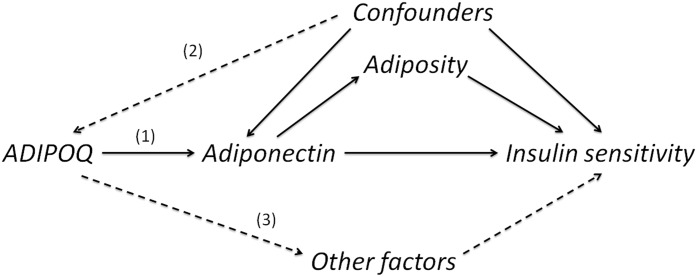
The adipocyte-secreted protein adiponectin is associated with insulin sensitivity in observational studies. We aimed to evaluate whether this relationship is causal using a Mendelian randomization approach. In a sample of Swedish men aged 71 years (n = 942) from the Uppsala Longitudinal Study of Adult Men (ULSAM), insulin sensitivity (M/I ratio) was measured by the euglycemic insulin clamp. We used three genetic variants in the ADIPOQ locus as instrumental variables (IVs) to estimate the potential causal effect of adiponectin on insulin sensitivity and compared these with results from conventional linear regression. The three ADIPOQ variants, rs17300539, rs3774261, and rs6444175, were strongly associated with serum adiponectin levels (all P ≤ 5.3 × 10(-9)) and were also significantly associated with M/I ratio in the expected direction (all P ≤ 0.022). IV analysis confirmed that genetically determined adiponectin increased insulin sensitivity (β = 0.47-0.81, all P ≤ 0.014) comparable with observational estimates (β = 0.50, all P(difference) ≥ 0.136). Adjustment for BMI and waist circumference partly explained the association of both genetically determined and observed adiponectin levels with insulin sensitivity. The observed association between higher adiponectin levels and increased insulin sensitivity is likely to represent a causal relationship partly mediated by reduced adiposity.
Figures
Comment in
-
A tangled threesome: adiponectin, insulin sensitivity, and adiposity: can Mendelian randomization sort out causality?Diabetes. 2013 Apr;62(4):1007-9. doi: 10.2337/db12-1673. Diabetes. 2013. PMID: 23520272 Free PMC article. No abstract available.
References
-
- Li S, Shin HJ, Ding EL, van Dam RM. Adiponectin levels and risk of type 2 diabetes: a systematic review and meta-analysis. JAMA 2009;302:179–188 - PubMed
-
- Hotta K, Funahashi T, Arita Y, et al. Plasma concentrations of a novel, adipose-specific protein, adiponectin, in type 2 diabetic patients. Arterioscler Thromb Vasc Biol 2000;20:1595–1599 - PubMed
-
- Weyer C, Funahashi T, Tanaka S, et al. Hypoadiponectinemia in obesity and type 2 diabetes: close association with insulin resistance and hyperinsulinemia. J Clin Endocrinol Metab 2001;86:1930–1935 - PubMed
-
- Berg AH, Combs TP, Du X, Brownlee M, Scherer PE. The adipocyte-secreted protein Acrp30 enhances hepatic insulin action. Nat Med 2001;7:947–953 - PubMed
-
- Yamauchi T, Kamon J, Waki H, et al. The fat-derived hormone adiponectin reverses insulin resistance associated with both lipoatrophy and obesity. Nat Med 2001;7:941–946 - PubMed
Publication types
MeSH terms
Substances
LinkOut - more resources
Full Text Sources
Miscellaneous
