


Personality factors in the Long Life Family Study
- PMID: 23275497
- PMCID: PMC3744045
- DOI: 10.1093/geronb/gbs117
Personality factors in the Long Life Family Study
Abstract
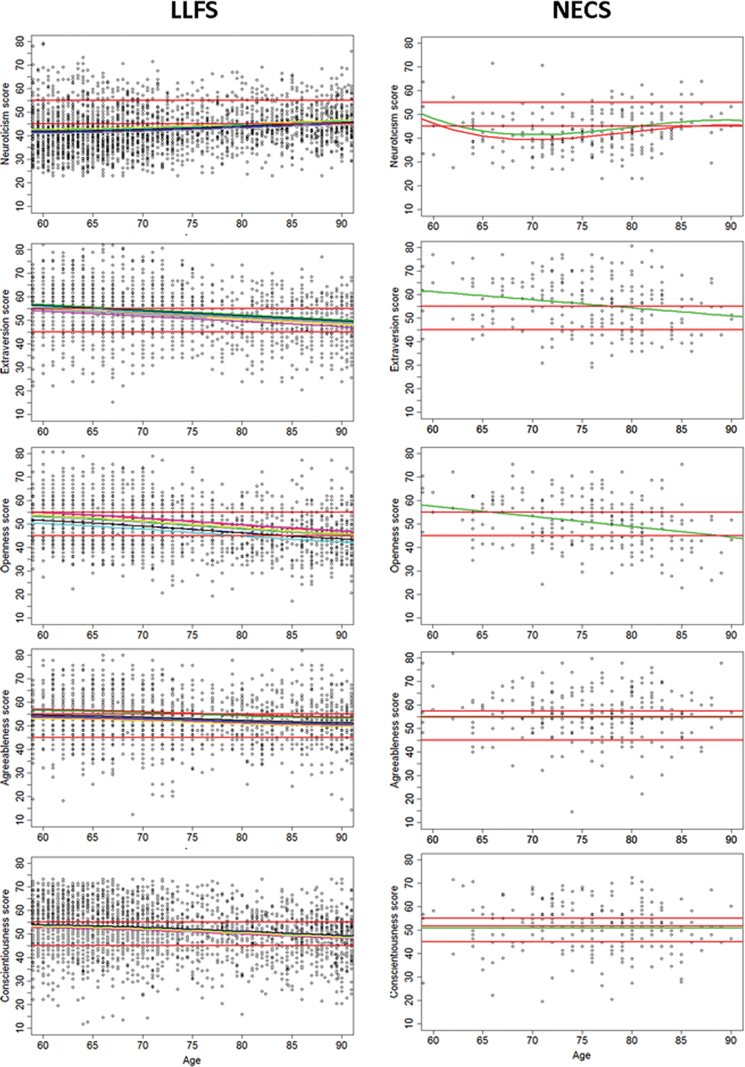
Objectives: To evaluate personality profiles of Long Life Family Study participants relative to population norms and offspring of centenarians from the New England Centenarian Study. METHOD Personality domains of agreeableness, conscientiousness, extraversion, neuroticism, and openness were assessed with the NEO Five-Factor Inventory in 4,937 participants from the Long Life Family Study (mean age 70 years). A linear mixed model of age and gender was implemented adjusting for other covariates.
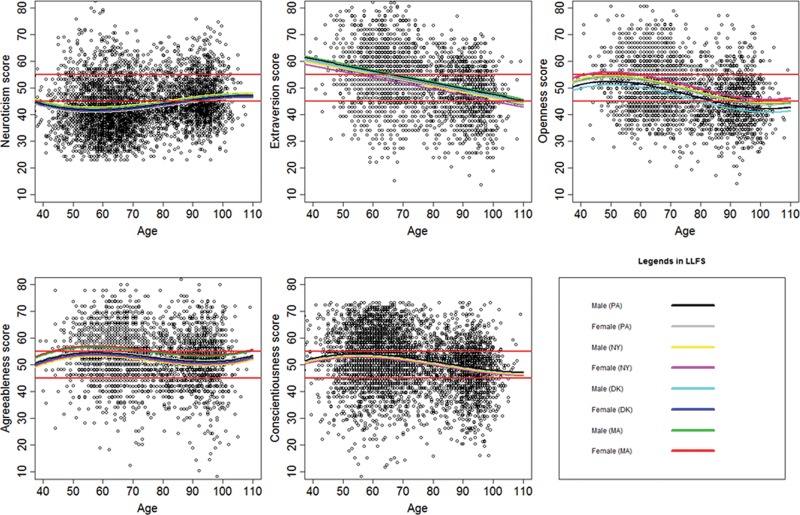
Results: A significant age trend was found in all five personality domains. On average, the offspring generation of long-lived families scored low in neuroticism, high in extraversion, and within average values for the other three domains. Older participants tended to score higher in neuroticism and lower in the other domains compared with younger participants, but the estimated scores generally remained within average population values. No significant differences were found between long-lived family members and their spouses.
Discussion: Personality factors and more specifically low neuroticism and high extraversion may be important for achieving extreme old age. In addition, personality scores of family members were not significantly different from those of their spouses, suggesting that environmental factors may play a significant role in addition to genetic factors.
Keywords: Centenarian; Longevity; NEO; Neuroticism; Personality..
Figures
References
-
- Bogg T., Roberts B. W. (2004). Conscientiousness and health-related behaviors: A meta-analysis of the leading behavioral contributors to mortality. Psychological Bulletin. 130, 887–919.10.1037/0033-2909.130.6.887 - PubMed
-
- Costa P. T., Jr., McCrae R. R. (1992). Revised NEO Personality Inventory (NEO PI-R) and NEO Five-Factor Inventory (NEO-FFI) professional manual. Lutz, FL: Psychological Asssessment Resources, Inc;
-
- Costa P. T., Jr., McCrae R. R. (2006). Age changes in personality and their origins: Comment on Roberts, Walton, and Viechtbauer (2006). Psychological Bulletin. 132, 26–28.10.1037/ 0033-2909.132.1.26 - PubMed
-
- Friedman H. S., Kern M. L., Reynolds C. A. (2010). Personality and health, subjective well-being, and longevity. Journal of Personality. 78, 179–216.10.1111/j.1467-6494.2009.00613.x - PubMed
Publication types
MeSH terms
Grants and funding
LinkOut - more resources
Full Text Sources
Medical
