


Weight-bearing versus nonweight-bearing exercise for persons with diabetes and peripheral neuropathy: a randomized controlled trial
- PMID: 23276801
- PMCID: PMC3637853
- DOI: 10.1016/j.apmr.2012.12.015
Weight-bearing versus nonweight-bearing exercise for persons with diabetes and peripheral neuropathy: a randomized controlled trial
Abstract
Objective: To determine the effects of weight-bearing (WB) versus nonweight-bearing (NWB) exercise for persons with diabetes mellitus (DM) and peripheral neuropathy (PN).
Design: Randomized controlled trial with evaluations at baseline and after intervention.
Setting: University-based physical therapy research clinic.
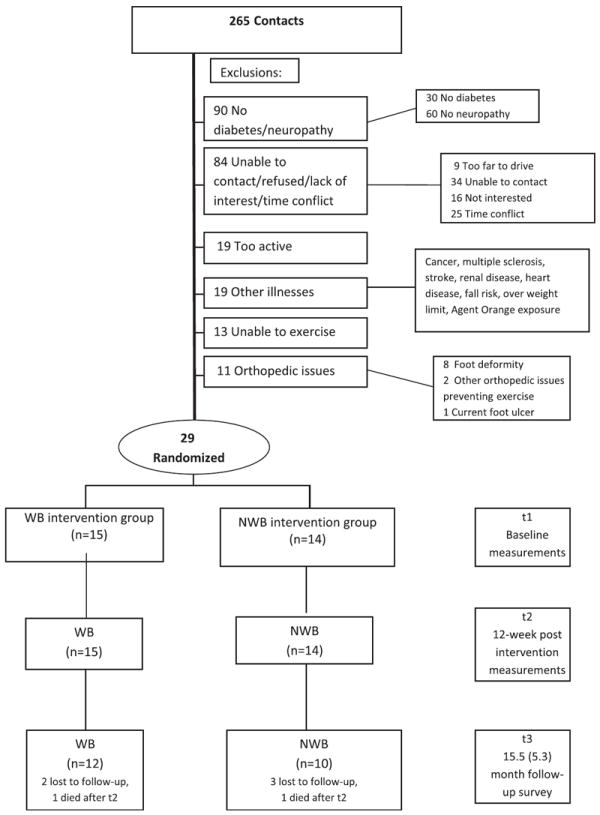
Participants: Participants with DM and PN (N=29) (mean age ± SD, 64.5±12.5y; mean body mass index [kg/m(2)] ± SD, 35.5±7.3) were randomly assigned to WB (n=15) and NWB (n=14) exercise groups. All participants (100%) completed the intervention and follow-up evaluations.
Interventions: Group-specific progressive balance, flexibility, strengthening, and aerobic exercise conducted sitting or lying (NWB) or standing and walking (WB) occurred 3 times a week for 12 weeks.
Main outcome measures: Measures included the 6-minute walk distance (6MWD) and daily step counts. Secondary outcome measures represented domains across the International Classification of Functioning, Disability and Health.
Results: The WB group showed greater gains than the NWB group over time on the 6MWD and average daily step count (P<.05). The mean and 95% confidence intervals (CIs) between-group difference over time was 29m (95% CI, 6-51) for the 6MWD and 1178 (95% CI, 150-2205) steps for the average daily step count. The NWB group showed greater improvements than the WB group over time in hemoglobin A1c values (P<.05).
Conclusions: The results of this study indicate the ability of this population with chronic disease to increase 6MWD and daily step count with a WB exercise program compared with an NWB exercise program.
Copyright © 2013 American Congress of Rehabilitation Medicine. Published by Elsevier Inc. All rights reserved.
Conflict of interest statement
No commercial party having a direct financial interest in the results of the research supporting this article has or will confer a benefit on the authors or on any organization with which the authors are associated.
References
-
- Centers for Disease Control and Prevention (CDC) Mobility limitation among persons aged > or =40 years with and without diagnosed diabetes and lower extremity disease–United States, 1999-2002. MMWR Morb Mortal Wkly Rep. 2005;54:1183–6. - PubMed
-
- Gregg EW, Mangione CM, Cauley JA, et al. Diabetes and incidence of functional disability in older women. Diabetes Care. 2002;25:61–7. - PubMed
-
- Volpato S, Blaum C, Resnick H, Ferrucci L, Fried LP, Guralnik JM. Comorbidities and impairments explaining the association between diabetes and lower extremity disability: The Women’s Health and Aging Study. Diabetes Care. 2002;25:678–83. - PubMed
-
- Gregg EW, Gerzoff RB, Caspersen CJ, Williamson DF, Narayan KM. Relationship of walking to mortality among US adults with diabetes. Arch Intern Med. 2003;163:1440–7. - PubMed
Publication types
MeSH terms
Grants and funding
LinkOut - more resources
Full Text Sources
Other Literature Sources
Medical
