Use of a urine anastrozole assay to determine treatment discontinuation among women with hormone-sensitive breast cancer: a pilot study
- PMID: 23277771
- PMCID: PMC3439234
- DOI: 10.1200/JOP.2011.000487
Use of a urine anastrozole assay to determine treatment discontinuation among women with hormone-sensitive breast cancer: a pilot study
Abstract
Purpose: Multiple studies have shown that adherence to adjuvant hormonal therapy in women with breast cancer is suboptimal. Measurements of compliance with self-report, pill counts, and/or pharmacy records are susceptible to bias. We assessed the feasibility of using a urine anastrozole assay as an objective biomarker of nonadherence to anastrozole treatment.
Patients and methods: We recruited consecutive postmenopausal women, age ≥ 18 years, with hormone-sensitive nonmetastatic breast cancer who were prescribed anastrozole at least 3 months before enrollment. Each completed a short survey to gather information on demographics, anastrozole compliance history, and self-reported medication history, tumor characteristics, and treatment received. A single, random 15-mL urine sample was collected and tested for the presence of anastrozole using a previously validated assay. Patients were told they were part of a study to determine if anastrozole could be detected in the urine.
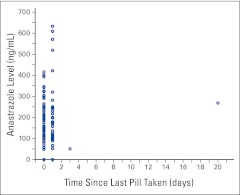
Results: Among 96 participants, mean age was 63.7 years (range, 51 to 70 years). The population was diverse, with 56.5% white, 57.6% US born, 59.8% unemployed, and 56.6% college educated. Prior treatment included chemotherapy (50%) and/or radiotherapy (58.7%). Mean duration of anastrozole treatment was 2.2 years (standard deviation, 1.6). Four participants reported nonadherence and declined to submit urine samples, and two had no detectable level of anastrozole (six of 96; 6.3%). Detectable levels among adherent women ranged from 49.3 to 632.8 ng/mL.
Conclusion: We demonstrated that collection of urine to measure anastrozole levels is feasible and reliable. Identifying biomarkers to measure adherence is critical for studies investigating interventions to improve hormonal therapy compliance.
Figures
References
-
- Howell A, Cuzick J, Baum M, et al. Results of the ATAC (Arimidex, Tamoxifen, Alone or in Combination) trial after completion of 5 years' adjuvant treatment for breast cancer. Lancet. 2005;365:60–62. - PubMed
-
- Early Breast Cancer Trialists' Collaborative Group (EBCTCG) Effects of chemotherapy and hormonal therapy for early breast cancer on recurrence and 15-year survival: An overview of the randomised trials. Lancet. 2005;365:1687–1717. - PubMed
-
- Bickell NA, LePar F, Wang JJ, et al. Lost opportunities: Physicians' reasons and disparities in breast cancer treatment. J Clin Oncol. 2007;25:2516–2521. - PubMed
-
- Bickell NA, Wang JJ, Oluwole S, et al. Missed opportunities: Racial disparities in adjuvant breast cancer treatment. J Clin Oncol. 2006;24:1357–1362. - PubMed
Publication types
MeSH terms
Substances
LinkOut - more resources
Full Text Sources
Medical