HIV acquisition among women from selected areas of the United States: a cohort study
- PMID: 23277896
- PMCID: PMC4033695
- DOI: 10.7326/0003-4819-158-1-201301010-00004
HIV acquisition among women from selected areas of the United States: a cohort study
Abstract
Background: Women account for 23% of newly diagnosed HIV infections in the United States, but there are few recent, well-characterized cohorts of U.S. women in whom behavior characteristics and HIV acquisition have been well-described.
Objective: To evaluate HIV incidence and describe behaviors among U.S. women residing in areas of high HIV prevalence.
Design: Multisite, longitudinal cohort of women who had HIV rapid testing and audio computer-assisted self-interviews at baseline and every 6 months for up to 12 months. (ClinicalTrials.gov: NCT00995176)
Setting: 10 urban and periurban communities with high HIV prevalence and poverty rates, located in the northeastern and southeastern United States.
Patients: Venue-based sampling was used to recruit women aged 18 to 44 years who recently had unprotected sex and had 1 or more additional personal or partner risk factors and no self-reported previous HIV diagnosis.
Measurements: HIV prevalence and incidence, frequency of HIV risk behaviors, and health status perceptions.
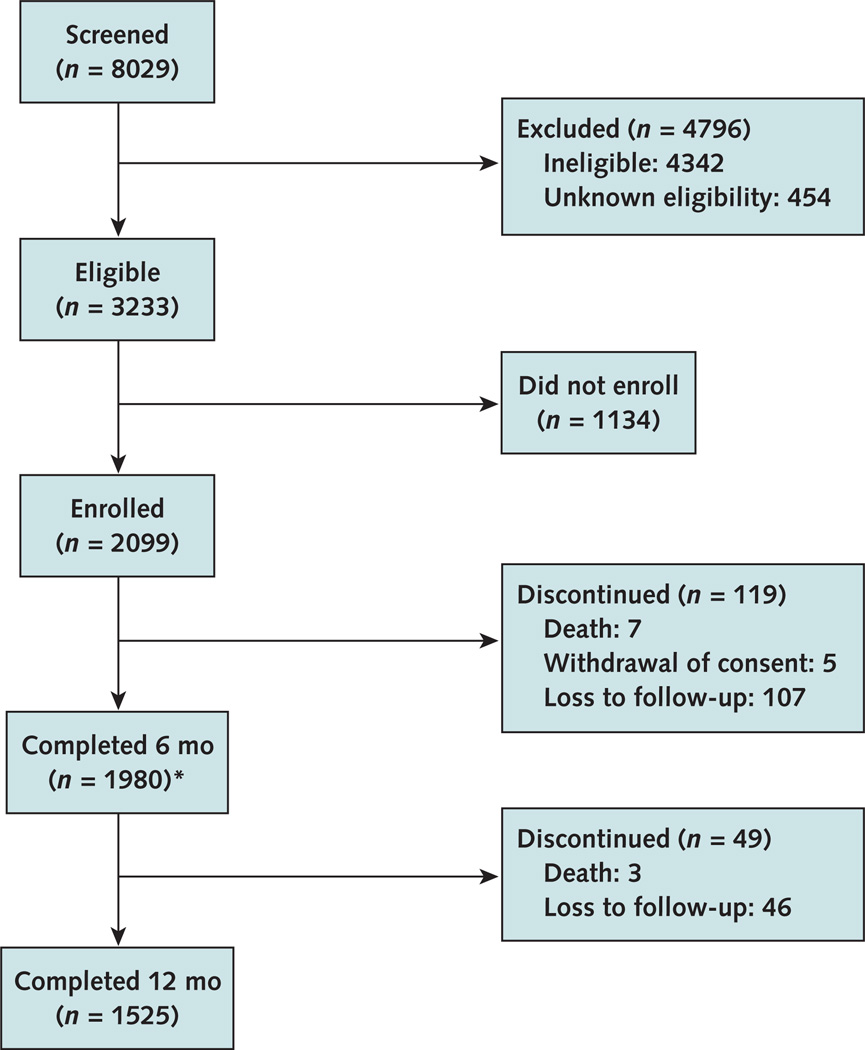
Results: Among 2099 high-risk women (85.9% black and 11.7% of Hispanic ethnicity), 32 (1.5%) were diagnosed with HIV infection at enrollment. Annual HIV incidence was 0.32% (95% CI, 0.14% to 0.74%). Older age, substance use, and knowing a partner had HIV were associated with HIV prevalence. Ten women died during the study (0.61% per year).
Limitations: Longitudinal assessment of risk behaviors was limited to a maximum of 12 months. There were few incident HIV infections, precluding identification of characteristics predictive of HIV acquisition.
Conclusion: This study enrolled a cohort of women with HIV incidence substantially higher than the Centers for Disease Control and Prevention national estimate in the general population of U.S. black women. Concerted efforts to improve preventive health care strategies for HIV and overall health status are needed for similar populations.
Primary funding source: National Institutes of Health.
Conflict of interest statement
Figures
References
-
- Centers for Disease Control and Prevention. HIV Among Women. 2011 Aug; Accessed at www.cdc.gov/hiv/topics/women/pdf/women.pdf on 6 September 2012.
-
- Centers for Disease Control and Prevention. HIV Surveillance in Women. [updated 6 April 2012]; Accessed at www.cdc.gov/hiv/topics/surveillance/resources/slides/women/index.htm on 6 September 2012.
-
- HIV Prevention Trials Network. Accessed at www.hptn.org/index.htm on 6 September 2012.
Publication types
MeSH terms
Supplementary concepts
Associated data
Grants and funding
- U01-AI068613/AI/NIAID NIH HHS/United States
- UL1 RR025005/RR/NCRR NIH HHS/United States
- U01 AI069465/AI/NIAID NIH HHS/United States
- U01 AI069484/AI/NIAID NIH HHS/United States
- U01 AI069418/AI/NIAID NIH HHS/United States
- AI069423/AI/NIAID NIH HHS/United States
- UL1 RR025008/RR/NCRR NIH HHS/United States
- P30 AI050410/AI/NIAID NIH HHS/United States
- UM1 AI069423/AI/NIAID NIH HHS/United States
- AI050410/AI/NIAID NIH HHS/United States
- P30 AI050409/AI/NIAID NIH HHS/United States
- U01 AI069423/AI/NIAID NIH HHS/United States
- AI069465/AI/NIAID NIH HHS/United States
- UL1 TR000454/TR/NCATS NIH HHS/United States
- RR 025747/RR/NCRR NIH HHS/United States
- U01 AI068613/AI/NIAID NIH HHS/United States
- UM1 AI068619/AI/NIAID NIH HHS/United States
- 5UM1AI069466/AI/NIAID NIH HHS/United States
- UL1 RR025747/RR/NCRR NIH HHS/United States
- UM1 AI069465/AI/NIAID NIH HHS/United States
- UM1 AI068613/AI/NIAID NIH HHS/United States
- 5U01AI069418/AI/NIAID NIH HHS/United States
- UM1-AI068613/AI/NIAID NIH HHS/United States
LinkOut - more resources
Full Text Sources
Other Literature Sources
Medical